

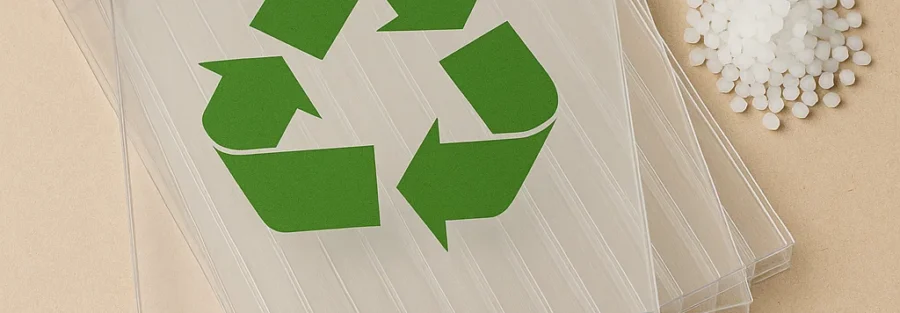
As global industries shift toward sustainable manufacturing, polycarbonate recycling has become a critical pillar in modern plastic production. Businesses today are not only looking for durability and performance but also environmentally responsible materials.
At G-Crystal Plastic Industries, we bridge the gap between sustainability and premium quality by offering advanced recycling solutions while maintaining 100% virgin-grade polycarbonate standards — delivering both performance and environmental value.
Is Polycarbonate Recyclable?
Yes — polycarbonate is fully recyclable, making it one of the most sustainable engineering thermoplastics used in construction and industrial applications. Through advanced polycarbonate recycling processes, post-industrial and post-consumer waste can be reprocessed into reusable raw material while retaining strong impact resistance, durability, and transparency.
However, at G-Crystal Plastic Industries, we manufacture our polycarbonate sheets using 100% virgin raw material, not recycled content. This ensures superior optical clarity, enhanced UV protection, and long-term performance — especially for demanding applications such as greenhouses, architectural glazing, and roofing systems.

What is Polycarbonate Recycling?
Polycarbonate recycling is the process of recovering polycarbonate waste — including both post-industrial scrap and post-consumer materials — and reprocessing it into reusable raw material for new production cycles.
The process involves collection, sorting, cleaning, shredding into flakes, then melting and re-extruding the material into pellets or finished sheets. Thanks to polycarbonate’s strong molecular structure and thermal stability, recycled polycarbonate can retain a considerable level of impact strength, durability, and light transmission.
Today, polycarbonate recycling plays a key role in sustainable manufacturing, with recycled material commonly used in industrial roofing, protective barriers, light diffusers, and various technical applications — helping reduce plastic waste and support circular economy goals.
Recycled vs. Virgin Polycarbonate
| Aspect | Recycled Polycarbonate | Virgin Polycarbonate |
|---|---|---|
| Raw Material Source | Reprocessed polycarbonate waste | 100% new virgin resin |
| Optical Clarity | Moderate clarity | Superior optical clarity |
| Impact Resistance | Good performance | Maximum impact strength |
| UV Protection | May require additives | Integrated UV protection |
| Service Life | good | Long-term durability |
| Cost Efficiency | More cost-effective | Higher material cost |
| Typical Uses | Industrial & secondary applications | Architectural & greenhouse applications |
How to Recycle Polycarbonate?
Polycarbonate can be recycled through specialized industrial recycling processes designed to preserve its mechanical and optical properties.
The recycling process typically includes the following steps:
- Collection: Polycarbonate waste is gathered from manufacturing scrap or post-consumer products such as roofing sheets, panels, and industrial components.
- Sorting: Materials are separated by polymer type and color to ensure consistent recycled output quality.
- Cleaning: Contaminants such as dust, coatings, and adhesives are removed to prevent material degradation.
- Shredding: The cleaned polycarbonate is ground into small flakes for easier processing.
- Melting & Re-Extrusion: Flakes are melted and re-extruded into pellets or new sheets for reuse in manufacturing.
- Quality Stabilization: Additives may be introduced to restore UV resistance, strength, or clarity depending on the final application.
Through these steps, polycarbonate recycling helps reduce plastic waste while enabling the material to be reused in various industrial and construction applications.
Role of Polycarbonate in Green Building
Polycarbonate sheets are widely used in green building and sustainable construction due to their high light transmission, thermal insulation, and long service life — helping reduce overall energy consumption in modern structures.
They support daylight optimization, lowering reliance on artificial lighting, while improving temperature control in polycarbonate roofing and façade systems.
Additionally, recyclable polycarbonate materials align with environmental material standards in eco-friendly developments.
However, at G-Crystal Plastic Industries, all sheets are manufactured using 100% virgin polycarbonate resin — ensuring superior clarity, maximum strength, and long-term UV protection for high-performance architectural and agricultural applications.
Polycarbonate Recycling in Green Building
Recyclable polycarbonate plays a growing role in green building and sustainable construction. Its ability to be reprocessed and reused helps reduce plastic waste, lower carbon emissions, and support circular economy practices in modern architectural projects.
In addition to its recyclability, polycarbonate sheets contribute to energy efficiency through high light transmission and thermal insulation — reducing reliance on artificial lighting and improving indoor climate control.
However, at G-Crystal Plastic Industries, all polycarbonate sheets are manufactured using 100% virgin raw material. This ensures superior optical clarity, maximum structural strength, and long-term UV protection — delivering high-performance solutions while still supporting sustainability through durability and extended product lifespan.
Designed for extreme climates, our exported materials include UV-resistant Polycarbonate sheets UAE, ensuring long-lasting protection for major construction and industrial projects.
Benefits of Polycarbonate Recycling
Polycarbonate recycling offers significant environmental and economic advantages, making it a key component in sustainable manufacturing and green construction practices.
- Environmental Benefits: Recycling polycarbonate helps reduce plastic waste in landfills and lowers carbon emissions associated with producing virgin resin. It also supports circular economy models by reusing high-performance engineering plastics instead of discarding them.
- Energy Efficiency: Producing recycled polycarbonate requires substantially less energy than manufacturing virgin material — helping industries reduce overall energy consumption and environmental impact.
- Resource Conservation: By reprocessing existing polycarbonate waste, manufacturers decrease reliance on fossil-fuel-based raw materials, preserving natural resources and stabilizing supply chains.
- Cost Optimization: Recycled polycarbonate can offer cost advantages in industrial and secondary applications, making it an economical solution for projects that do not require premium optical performance.
- Sustainable Construction Support: Recyclable polycarbonate materials contribute to green building initiatives through material sustainability credits and reduced lifecycle environmental impact.
At G-Crystal Plastic Industries, however, all polycarbonate sheets are manufactured using 100% virgin raw material — ensuring superior clarity, strength, and long-term performance for high-spec architectural and agricultural applications.
What Are the Applications of Recycled Polycarbonate?
Recycled polycarbonate is used across various industrial and construction applications, including:
- Industrial roofing systems
- Protective barriers and safety shields
- Light diffusers and lighting panels
- Machine guards and equipment covers
- Interior partitions and wall panels
- Agricultural structures and utility buildings
- Secondary construction components
These applications benefit from polycarbonate’s impact resistance and durability while supporting sustainability through material reuse.
Why Choose G-Crystal Plastic Industries
G-Crystal Plastic Industries manufactures polycarbonate sheets using 100% virgin raw material, ensuring superior optical clarity, high impact resistance, and long-term structural durability for architectural and agricultural applications.
Our products are certified according to international and European quality standards, including:
- CE Marking — European Construction & Safety Compliance
- ISO 9001 — Quality Management Systems
- ISO 14001 — Environmental Management
- ISO 45001 — Occupational Health & Safety
All sheets are protected with advanced UV co-extrusion technology and backed by a 10-year warranty, with an expected service life exceeding 15 years under normal outdoor conditions.
Contact Us
For project pricing, export inquiries, or technical support, connect with our team directly
Frequently Asked Questions
What thicknesses are available for polycarbonate sheets?
Polycarbonate sheets are available in multiple thickness options to suit roofing, skylights, façade systems, and greenhouse applications, depending on structural and insulation requirements.
Are G-Crystal polycarbonate sheets suitable for greenhouse applications?
Yes. G-Crystal sheets provide high light transmission, advanced UV protection, and long-term durability, making them ideal for agricultural and greenhouse structures.
Do your sheets include UV protection?
All G-Crystal polycarbonate sheets are manufactured with advanced UV co-extrusion technology to prevent yellowing and material degradation under prolonged sun exposure.
Can you supply export container quantities?
Yes. G-Crystal supports bulk orders and container-scale exports, serving distributors, contractors, and project developers across international markets.
Are custom sizes and colors available?
Custom dimensions and color options are available based on project specifications and minimum order quantities.
What is the warranty and lifespan of your polycarbonate sheets?
G-Crystal sheets are backed by a 10-year warranty and engineered for an expected service life exceeding 15 years under normal outdoor conditions.


