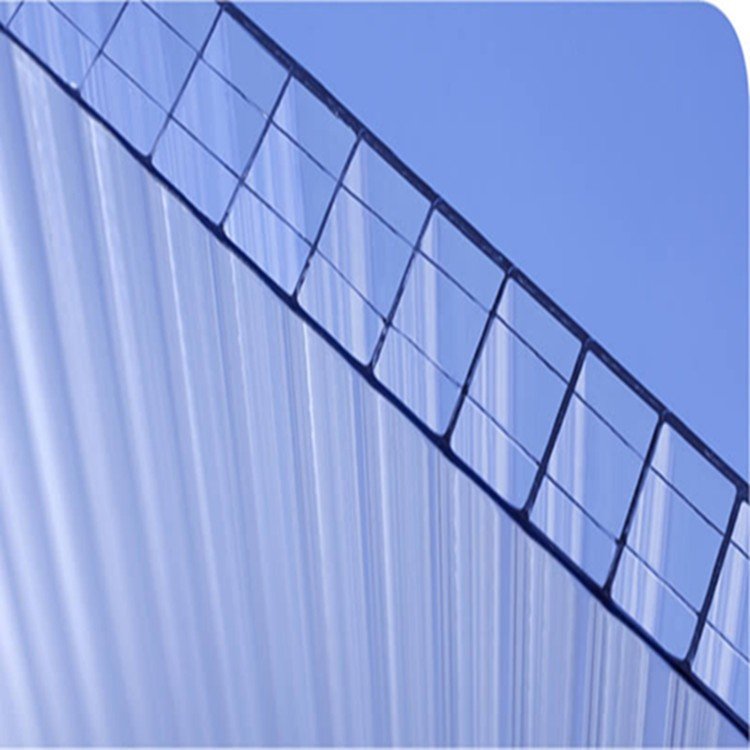
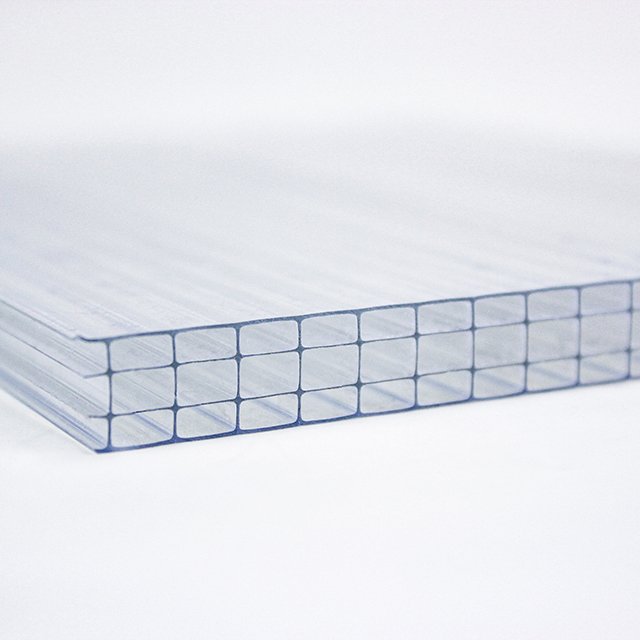
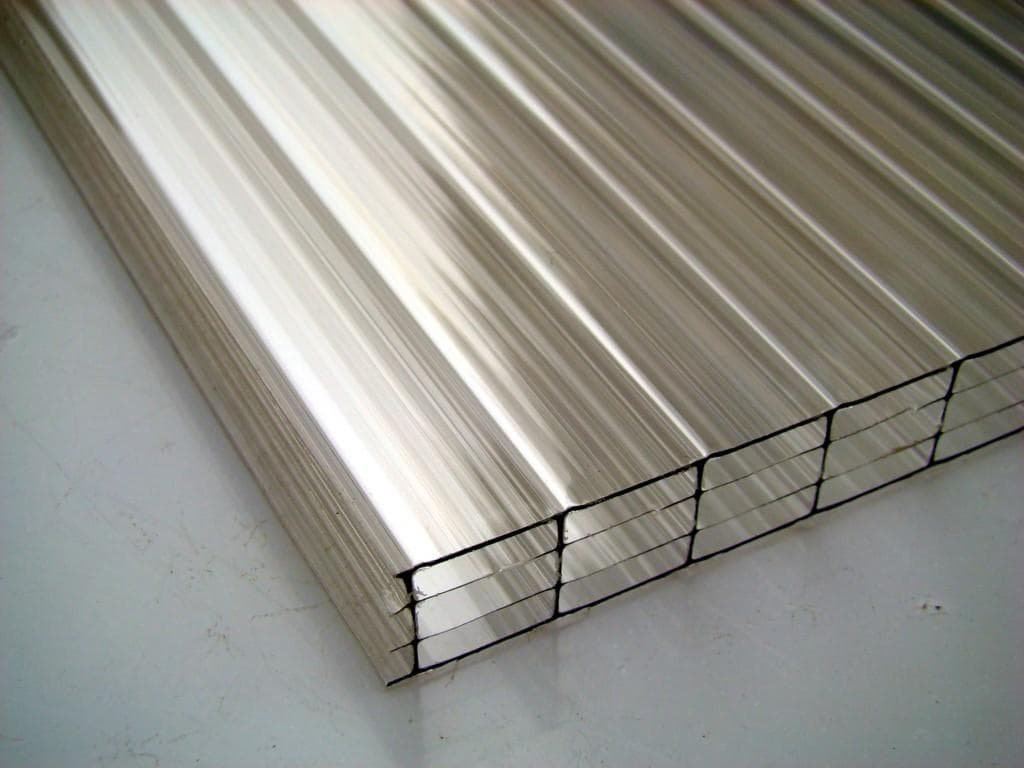
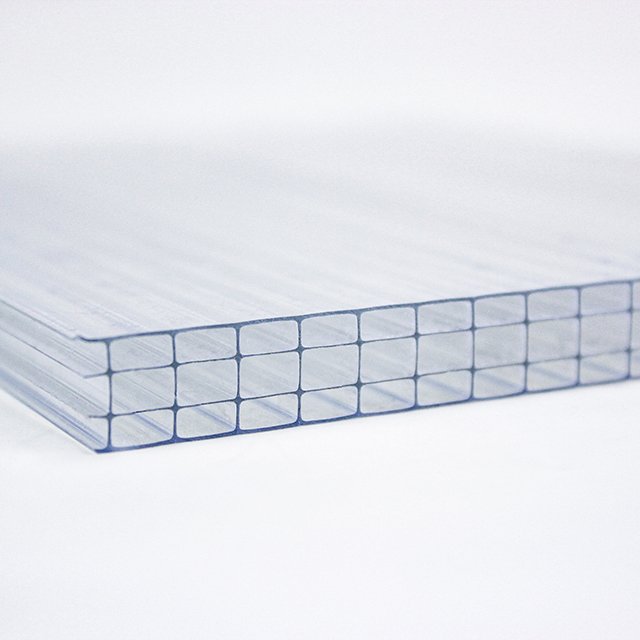
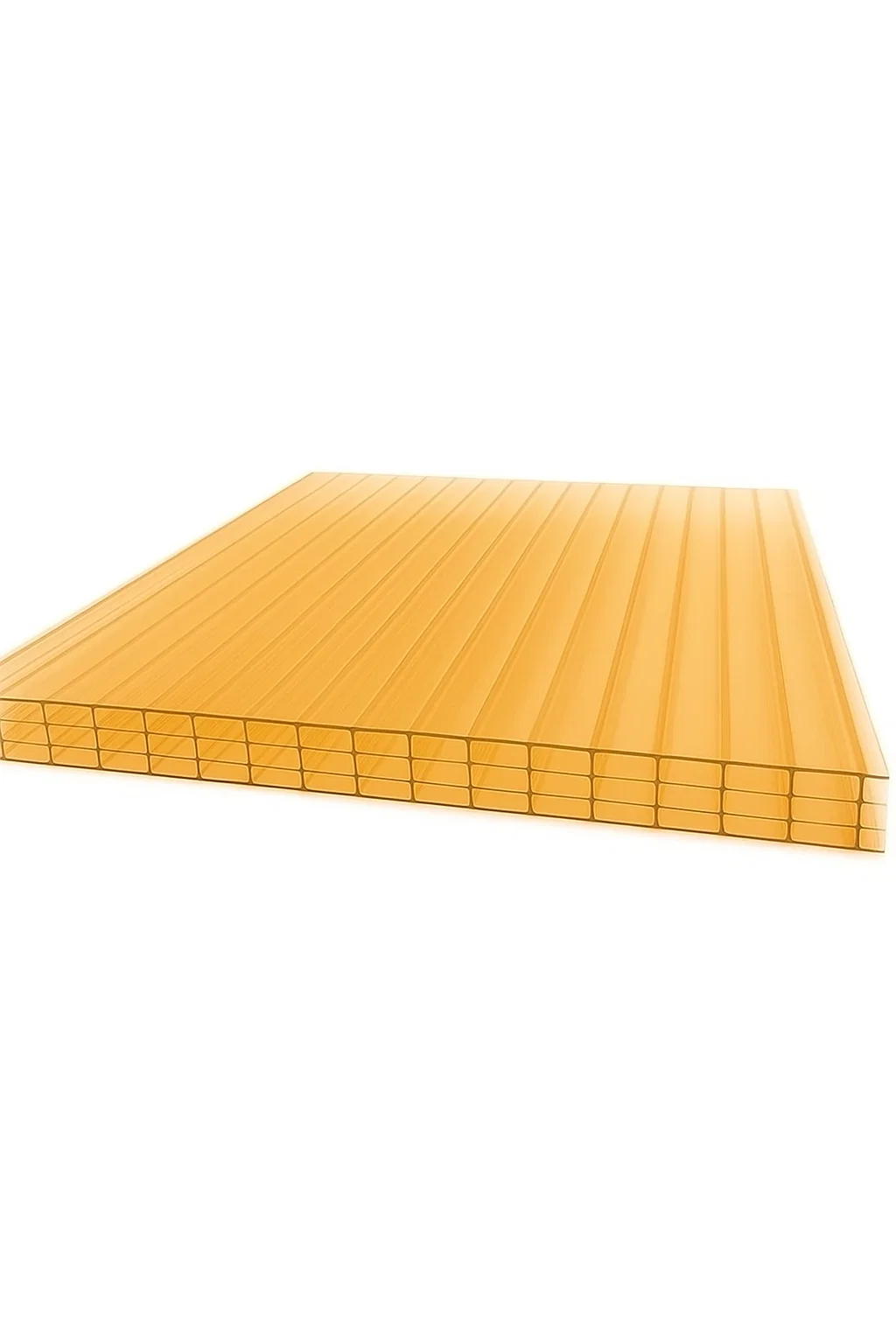
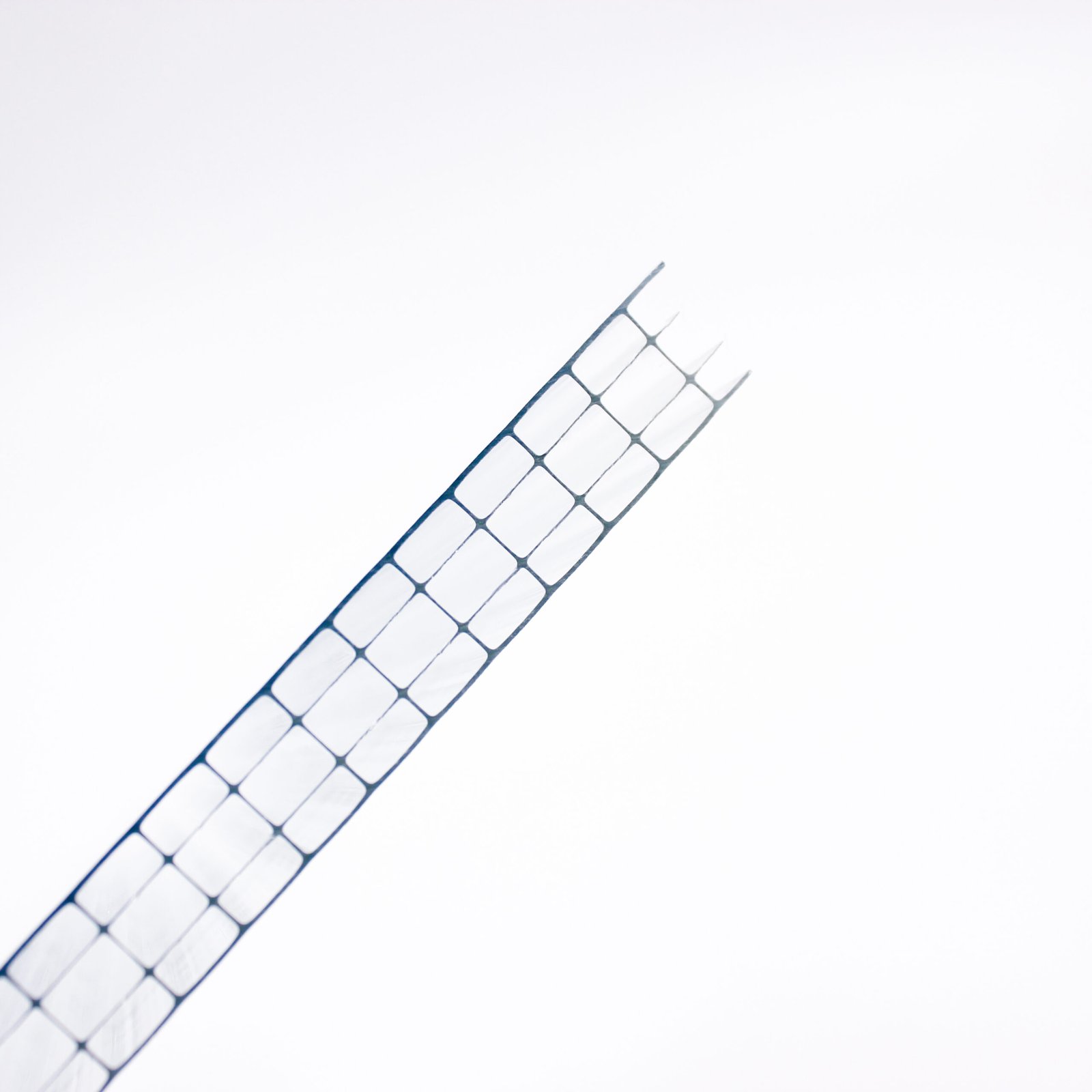
A multiwall polycarbonate sheet has four walls separated by internal ribs, forming three chambers of trapped air. That structure delivers U-values down to 1.7 W/m²K — more than three times better than single glazing — at a weight starting from 1.6 kg/m².
It is the panel specified when thermal performance decides the project: commercial greenhouses, industrial roofing, and any large span where heating or cooling cost matters over the building’s life.
📞 Request a factory quote — FOB $2.50–3.50/kg, MOQ 5 tonnes or one 20 ft container. +2 01095990442

What Is a Multiwall Polycarbonate Sheet?
A multiwall polycarbonate sheet is an extruded panel built from four parallel walls connected by vertical ribs. The three resulting air chambers are what make it perform: still air is a poor conductor of heat, so each additional chamber improves insulation without adding meaningful weight.
This distinguishes it from twin-wall, which has two walls and a single chamber. The extra structure gives multiwall better thermal values, greater rigidity and longer spans between supports — at a modest increase in weight and cost.
All our multiwall sheets are extruded from 100% virgin resin with a co-extruded UV layer, and carry a 10-year warranty against yellowing.
Technical Specifications
| Property | Value |
|---|---|
| Structure | 4 walls, 3 air chambers |
| Thickness range | 8 – 18 mm |
| Weight per m² | 1.6 – 2.9 kg |
| Light transmission | 83 – 91% (clear) |
| U-value | 1.7 – 2.5 W/m²K |
| Impact resistance | up to 250× glass |
| Service temperature | −40 °C to +120 °C |
| Thermal expansion | ≈ 3 mm per metre |
| Fire behaviour | Self-extinguishing, B1 by grade |
| UV protection | Co-extruded, blocks 99.9% (280–400 nm) |
| Standard sheet | 2,100 × 5,800 mm |
| Raw material | 100% virgin, no regrind |
| Warranty | 10 years against yellowing |
Thickness, Weight and Span
| Thickness | Weight/m² | Weight/sheet (2.1 × 5.8 m) | U-value | Span between supports |
|---|---|---|---|---|
| 8 mm | 1.60 kg | 18.3 – 20.7 kg | ≈ 2.5 W/m²K | 90 – 110 cm |
| 10 mm | 1.85 kg | 20.7 – 24.4 kg | ≈ 2.3 W/m²K | up to 120 cm |
| 12 mm | 2.15 kg | 24.4 – 28.0 kg | ≈ 2.1 W/m²K | up to 130 cm |
| 14 mm | 2.38 kg | 27.0 – 31.0 kg | ≈ 1.9 W/m²K | up to 140 cm |
| 16 mm | 2.63 kg | 30.0 – 34.0 kg | ≈ 1.8 W/m²K | up to 150 cm |
| 18 mm | 2.88 kg | 33.0 – 37.0 kg | ≈ 1.7 W/m²K | up to 160 cm |
Sheet area: 12.18 m². Spans are indicative — reduce by 20% in snow-load or high-wind regions and confirm against local code.
The commercial logic: moving from 8 mm to 16 mm raises the sheet cost by roughly 60%, but extends the span from 110 cm to 150 cm. On a large roof, that means around a third fewer purlins. Above a certain area, the structural saving exceeds the material premium.
Multiwall vs Twin-Wall vs Solid
| Criterion | Multiwall (4-wall) | Twin-wall (2-wall) | Solid |
|---|---|---|---|
| Walls | 4 | 2 | 1 (full thickness) |
| Thickness | 8 – 18 mm | 4 – 10 mm | 1 – 12 mm |
| Weight/m² | 1.6 – 2.9 kg | 0.8 – 1.7 kg | 1.2 – 14.4 kg |
| U-value | 1.7 – 2.5 W/m²K | 2.9 – 3.5 | ≈ 5.0 |
| Clarity | 83–91%, diffused | 80–88%, translucent | up to 90%, sharp |
| Max span | up to 160 cm | 60 – 90 cm | 60 – 80 cm |
| Cost per m² | Low | Lowest | Highest |
| Best for | Greenhouses, industrial roofs, cold climates | Carports, pergolas, small covers | Glazing, security, façades |
How to choose: multiwall when insulation or span decides the specification. Twin-wall when the cover is small and budget leads. Solid when optical clarity is non-negotiable.
Why U-Value Matters
U-value measures heat transfer through the panel: the lower the number, the less energy escapes.
| Solution | U-value |
|---|---|
| Single glazing | ≈ 5.8 W/m²K |
| Solid polycarbonate 6 mm | ≈ 5.0 |
| Twin-wall 10 mm | ≈ 2.9 |
| Multiwall 10 mm | ≈ 2.3 |
| Multiwall 18 mm | ≈ 1.7 |
In a heated greenhouse, this figure is not academic. The difference between 2.9 and 1.7 W/m²K across a few thousand square metres shows up on every heating bill for the life of the structure — which is why commercial growers specify multiwall even where twin-wall would carry the load.
The same logic applies in reverse in hot climates: a lower U-value reduces the cooling load under a roof.
Colours and Light Transmission
| Colour | Transmission | Effect |
|---|---|---|
| Clear | 83 – 91% | Maximum daylight — the greenhouse standard |
| Opal | 25 – 45% | Even diffusion, no glare or hot spots |
| Bronze | 35 – 50% | Solar control, warm tone |
| Smoke grey | 35 – 50% | Neutral shading |
| Blue / green | varies | Architectural, pool covers |
| Heat-reflective | 15 – 30% | High-irradiance regions |
Standard colours carry no price premium. Custom RAL adds approximately 5%.
For greenhouses, clear is specified almost universally: crops need the light, and the air chambers handle the insulation. For roofing over occupied space, opal or bronze prevents overheating.
Applications
Commercial greenhouses — the largest application. Clear 10 mm or 16 mm combines the light plants need with insulation that cuts heating cost. See greenhouse panels and replacement panels.
Industrial roofing — translucent strips replacing metal sheeting, cutting daytime lighting cost. Long spans reduce the steel frame required.
Skylights and atria — where the span exceeds what twin-wall can carry.
Covered walkways and station canopies — public infrastructure where impact resistance and span both matter.
Sports halls and pool enclosures — the low U-value limits condensation and heat loss.
Façade cladding — translucent walls in architectural projects.
Sound barriers — motorway screening where mass and rigidity are needed.
Sector pages: agriculture · construction · industrial
Price
Polycarbonate is priced by the kilogram — and multiwall is where that method shows its advantage.
| Thickness | Weight/m² | Cost per m² (FOB) |
|---|---|---|
| 8 mm | 1.60 kg | $4.00 – 5.60 |
| 10 mm | 1.85 kg | $4.63 – 6.48 |
| 12 mm | 2.15 kg | $5.38 – 7.53 |
| 16 mm | 2.63 kg | $6.58 – 9.21 |
| 18 mm | 2.88 kg | $7.20 – 10.08 |
Factory price: $2.50–3.50 USD/kg FOB. One sheet covers 12.18 m².
Compare with solid: a 10 mm solid sheet weighs 12.0 kg/m² and costs around $36/m² at the same price per kilo — more than seven times the multiwall of identical thickness, with worse insulation.
Minimum order: 5 tonnes or one 20 ft container. Volume discounts apply by tonnage.
🧮 Price your order with our polycarbonate price & container calculator — weight, cost per m², cost per sheet and container fill.
Full pricing guide: polycarbonate sheet price · bulk orders
Container loading
Multiwall fills a container by volume long before payload. One tonne of 16 mm multiwall occupies roughly twice the space of one tonne of thin solid sheet, because the panel is mostly air held within a thick profile.
A container loaded only with thick multiwall reaches its space limit well below the weight limit, raising the freight cost per square metre. Adding solid sheet to the same load uses the remaining payload without extra freight — a point worth raising with any customer ordering multiwall alone.
Installation
- Flutes vertical, running with the slope — always. Laid across, they trap condensation and the panel goes permanently opaque.
- UV face toward the sun — marked on the protective film. Reversed, the sheet yellows within months.
- Respect the span for the thickness specified.
- Oversize the holes — 3 to 5 mm clearance per side. The material expands about 3 mm per metre.
- Screws with EPDM sealing washers, tightened to contact without crushing.
- Seal the flutes — solid aluminium tape at the top, vented anti-dust tape at the bottom. Never the reverse.
- Minimum pitch 5%, 10–15% recommended for self-cleaning.
- Neutral silicone only — acidic silicone attacks polycarbonate.
- Profiles matched to thickness — U-channel for edges, H-channel for joints, HCP-channel for reinforced assemblies. Profiles sized for 8 mm do not fit 16 mm.
Cutting: fine-tooth circular saw, 60 teeth minimum. Blow compressed air through the channels afterwards to clear swarf, then seal the edges. Full guide: how to cut polycarbonate sheets.
Common Mistakes
- Flutes laid horizontally — trapped water, permanently opaque panel
- UV layer facing inward — yellowing within one season
- Profiles sized for another thickness — poor seal, water ingress
- Solid tape at the bottom — condensation cannot drain
- Span beyond the rating — deflection, then failure under snow
- Screws torqued fully — cracks around holes by the first summer
- Acidic silicone — progressive attack on the material
- Walking on the panel — always use load-spreading boards
Specification and Ordering
| Term | Detail |
|---|---|
| Thickness | 8, 10, 12, 14, 16, 18 mm |
| Standard sheet | 2,100 × 5,800 mm |
| Custom length | up to 11,800 mm, cut to order |
| Colours | Clear, opal, bronze, smoke, blue, green, custom RAL |
| UV protection | Single or double sided |
| Coatings | Anti-drip for greenhouses, anti-fog |
| MOQ | 5 tonnes or one 20 ft container |
| Lead time | 14 days from order confirmation |
| Incoterms | FOB, CIF, CFR, EXW |
| Ports | Alexandria, Damietta |
Anti-drip treatment deserves a note for greenhouse projects: condensation on the underside of a panel forms droplets that fall on crops and reduce light transmission. The treatment makes water spread into a film that runs to the edge instead.
Buying Direct from the Manufacturer
We extrude multiwall sheets in our own facility — 1,000 tonnes per month from 4,700 m² in Egypt, exporting to more than 60 countries.
- Factory pricing, no reseller margin
- Custom dimensions — length to your project, no paid-for offcuts
- 100% virgin resin, co-extruded UV protection
- 10-year warranty against yellowing
- CE certified (1871-CPR-RtF-846), ISO 9001, 14001 and 45001
- Private label available for distributor programmes
More on our capability: polycarbonate sheet manufacturers · full sheet range
Related products: solid sheets · twin-wall · embossed · UV-resistant · accessories · hollow sheet types
📞 Send your specification — quote within 24 hours.
WhatsApp: +2 01095990442 | ✉️ info@gcrystal-pc.com
Frequently Asked Questions
What is a multiwall polycarbonate sheet?
An extruded panel with four walls separated by internal ribs, forming three air chambers. The structure delivers U-values from 1.7 W/m²K with a weight starting at 1.6 kg/m², making it the standard for greenhouses and industrial roofing.
What is the difference between multiwall and twin-wall?
Multiwall has four walls and three air chambers; twin-wall has two walls and one. Multiwall insulates better, spans further and comes in thicker gauges from 8 to 18 mm, while twin-wall is lighter and cheaper per m² at 4 to 10 mm.
How much does multiwall polycarbonate weigh?
From 1.6 kg/m² in 8 mm to 2.9 kg/m² in 18 mm. A standard 2,100 × 5,800 mm sheet weighs between 18 and 37 kg depending on thickness.
What U-value does multiwall polycarbonate achieve?
From approximately 2.5 W/m²K in 8 mm down to 1.7 W/m²K in 18 mm — more than three times better than single glazing at 5.8 W/m²K.
What span can multiwall polycarbonate cover?
Roughly 90 to 110 cm in 8 mm, up to 120 cm in 10 mm and up to 160 cm in 18 mm. Reduce by 20% in snow-load or high-wind regions and confirm against local code.
How much does multiwall polycarbonate cost?
Factory pricing is $2.50 to 3.50 USD per kilogram FOB. In 10 mm at 1.85 kg/m², that works out to roughly $4.63 to $6.48 per m².
Is multiwall polycarbonate suitable for greenhouses?
It is the standard choice for commercial growing. Clear 10 mm or 16 mm gives 83 to 91% light transmission with insulation that cuts heating cost, and anti-drip treatment prevents condensation falling on crops.
Does multiwall polycarbonate yellow?
Not with a co-extruded UV layer, which blocks 99.9% of ultraviolet radiation. Our sheets carry a 10-year warranty against yellowing. Untreated polycarbonate does yellow.
Which way do the flutes run?
Vertically, following the slope, without exception. Laid horizontally, the channels trap condensation and dust, and the panel becomes permanently opaque.
Can multiwall polycarbonate be cold-bent?
Yes, with a minimum radius of 175 times the thickness — no heating required. Bending must follow the direction of the flutes.
What is the minimum order quantity?
5 tonnes or one 20 ft container. Samples are available for technical qualification before ordering.
Do you produce custom thicknesses and lengths?
Length is cut to order up to 11,800 mm. Non-standard thicknesses are produced to order for volume programmes — send your specification for confirmation.