

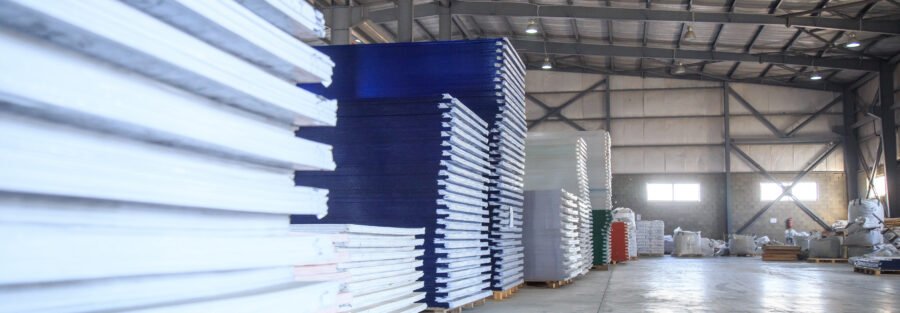
Polycarbonate sheet manufacturers operate their own extrusion lines and produce sheets from raw resin. Traders buy finished sheets and resell them. The difference decides your price, your thickness options, and whether anyone can answer a technical question about what you are buying.
This guide covers how to evaluate polycarbonate sheet manufacturers, what to verify before ordering, and the specifications that separate a producing factory from a reseller with a warehouse.
📞 Request a factory quote — FOB $2.50–3.50/kg, MOQ 5 tonnes or one 20 ft container. +2 01095990442
What Is a Polycarbonate Sheet Manufacturer?
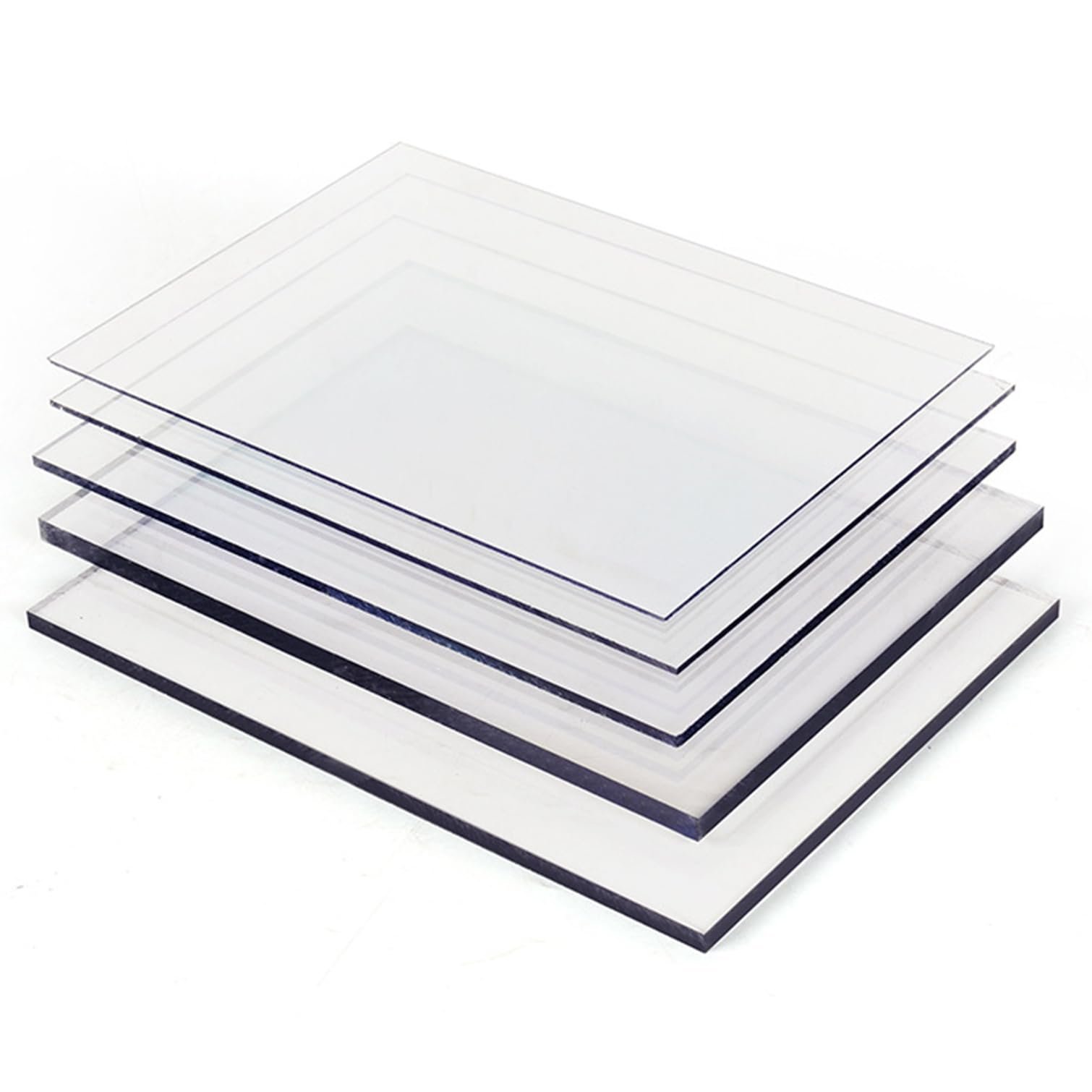
A polycarbonate sheet manufacturer is a producer that owns extrusion equipment and converts polycarbonate resin into finished sheets. Production involves drying the resin, melting and forcing it through a flat die, co-extruding the UV-protective layer in the same pass, calibrating thickness through cooled rollers, then cutting, filming and packing.
Because the manufacturer controls every stage, it can vary thickness, colour, width, length and surface treatment to order. That flexibility is the practical marker of a factory.
Polycarbonate sheet suppliers and distributors serve a different function: they hold stock, break bulk and deliver locally. Both roles are legitimate and both are necessary in the supply chain — but they are not interchangeable. A buyer who needs 4.3 mm in a custom RAL is dealing with a manufacturer or accepting a compromise.
Manufacturer vs. Trader: What Is the Difference?
Many suppliers describe themselves as manufacturers. These questions help clarify which you are dealing with:
| Question | A producing factory typically answers | A reseller often deflects |
|---|---|---|
| What is your monthly capacity? | A specific tonnage | “We can supply any quantity” |
| Who supplies your resin? | Named suppliers | “High-quality raw material” |
| Can you produce 2.2 mm? | Yes, with lead time | “We only stock standard sizes” |
| What is your CE certificate number? | A number you can verify | “We are CE certified” |
| Can I visit or audit the factory? | Yes, or shares audit reports | Avoids the question |
| What is your factory address? | Plot number and industrial zone | An office address |
The most revealing request: ask for a non-standard thickness. A manufacturer quotes it with a lead time. A stockist explains it is unavailable, because it is not in their inventory.
None of this means a trader is a poor supplier. For small quantities, fast local delivery and mixed orders, a distributor is often the better choice. The distinction matters when you need custom specifications, volume pricing or direct technical support.
How to Choose the Right Polycarbonate Sheet Manufacturers
- Production capacity. A factory should be able to state monthly tonnage. If your programme needs 40 tonnes a quarter, a producer running several hundred tonnes a month can absorb it comfortably; a smaller line may need to displace other orders to fit you in.
- Resin sourcing. Ask who supplies the raw material. Named suppliers indicate virgin resin and traceability. Vague answers may mean regrind, mixed sourcing, or simply that the seller does not know — which is itself informative.
- Certification with numbers. “CE certified” is a claim; a certificate number is verifiable. The same applies to ISO — ask which body issued it and when it was last audited.
- Customisation range. Can they produce your thickness, your dimensions, your colour? Manufacturers quote non-standard specifications with a lead time; stockists are limited to their range.
- MOQ and commercial terms. Minimum order quantity, Incoterms, lead time and payment terms should be stated clearly before you invest time in negotiation.
- Export capability. Complete documentation — commercial invoice, packing list, bill of lading, certificate of origin, test reports — is routine for an established exporter and often improvised by a newcomer to export markets.
- Technical support. A manufacturer’s team can advise on thickness for a given span, installation sequence and container loading. A reseller may forward the question to their own supplier, which adds days to every technical exchange.
What to Check Before Choosing a Polycarbonate Sheet Manufacturers
Ask for these eight items before committing to a first order:
- Factory address with plot number and industrial zone — not only a commercial office
- Monthly production capacity in tonnes
- Resin supplier names and evidence of virgin material
- CE certificate number and the issuing body for each ISO standard
- Third-party audit reports, where available
- Technical data sheets for the exact grade you are buying
- Samples for physical qualification before the first container
- A quotation for a non-standard thickness — often the most revealing request
A supplier who can provide clear evidence for all eight points is more likely to be a genuine manufacturer. Repeatedly avoiding these questions is a strong reason to investigate further before placing a first order.
Types of Polycarbonate Sheets Manufacturers Produce
Solid Polycarbonate Sheets
Full-thickness panels, 1 to 12 mm, with light transmission up to 90% and impact resistance up to 250 times that of glass. Used in glazing, skylights, machine guards and security applications. A solid polycarbonate sheet manufacturer should offer clear, frosted, diffuser and anti-scratch finishes.
Finishes: clear · frosted · light diffuser · anti-scratch
→ Solid polycarbonate sheets
Twin-Wall Polycarbonate Sheets
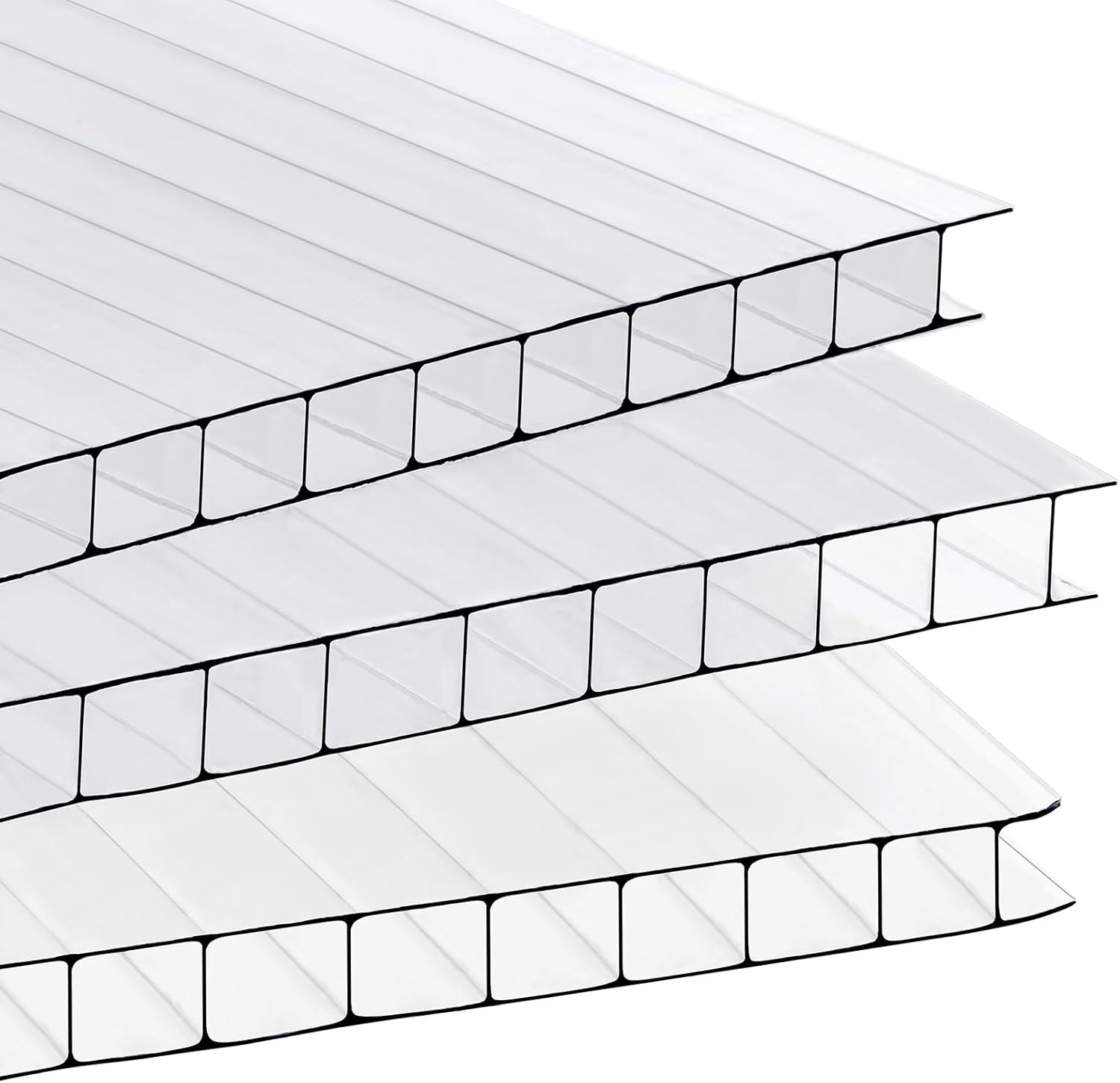
Two walls with air chambers, 4 to 10 mm, from 0.80 kg/m². The standard for greenhouses, carports and pergolas. A twin-wall polycarbonate manufacturer produces these on dedicated dies — hollow profiles cannot be made on solid-sheet equipment.
→ Twin-wall sheets
Multiwall Polycarbonate Sheets
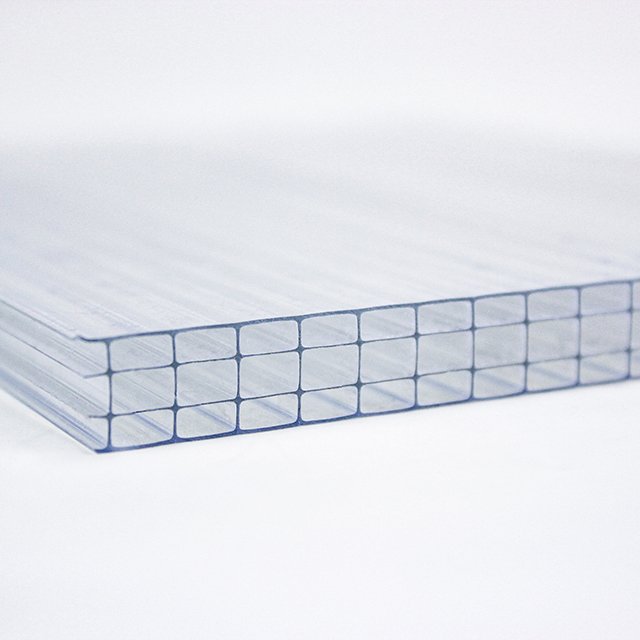
Four walls, 8 to 18 mm, with U-values reaching 1.7 W/m²K — more than three times better than single glazing. A multiwall polycarbonate manufacturer serves commercial greenhouses and industrial roofing, where thermal performance affects operating cost.
→ Multiwall sheets
Embossed Polycarbonate Sheets
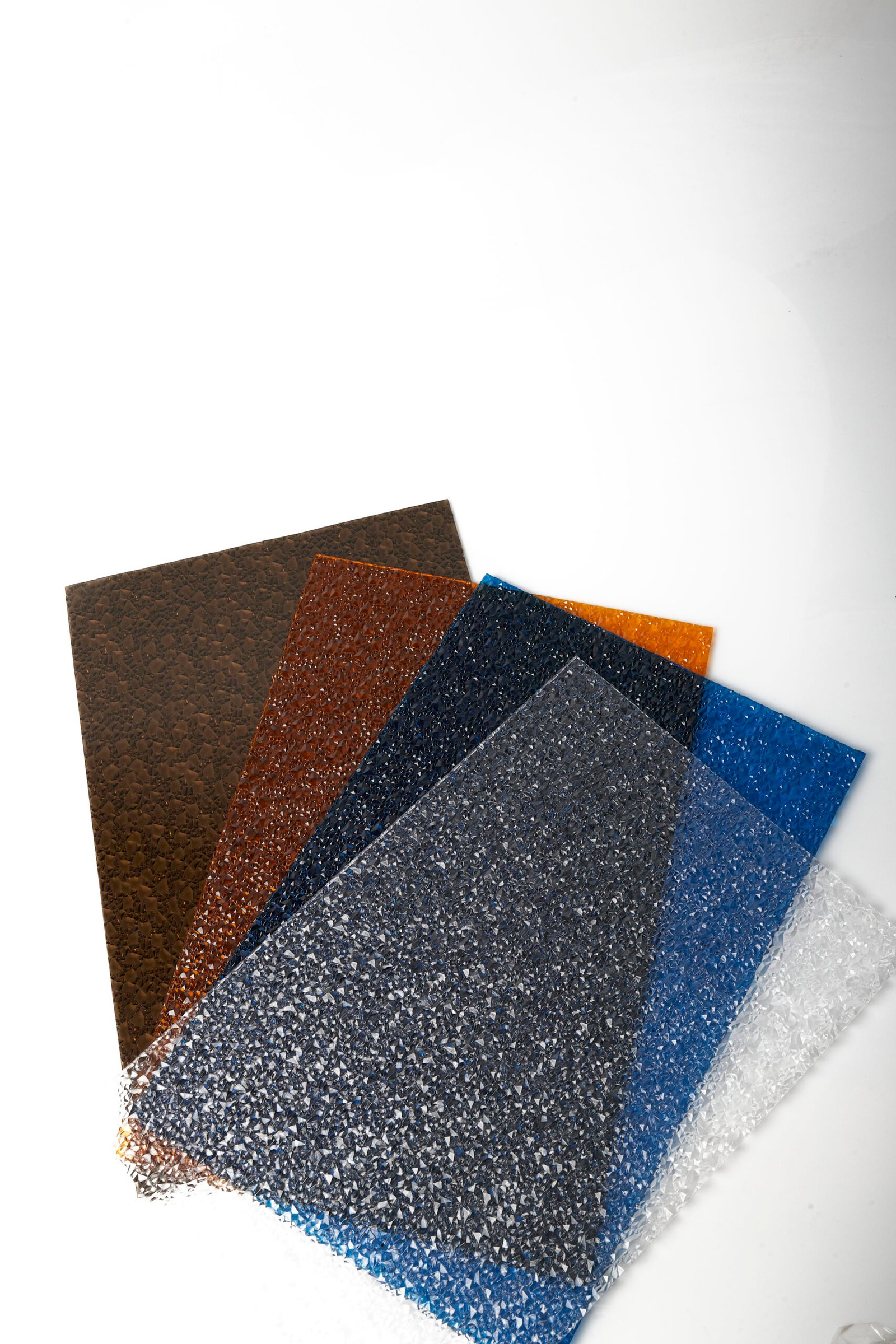
Textured surface that diffuses light and hides scratches. Patterns: Crystal, Prismatic, Diva. Common in partitions, signage and lighting covers.
→ Embossed sheets
Specialist Grades and Accessories
Beyond the four core structures, established polycarbonate manufacturers produce specialist grades: UV-resistant for high-exposure regions, fire-rated for regulated buildings, bullet-resistant for security glazing and hurricane-rated for storm zones.
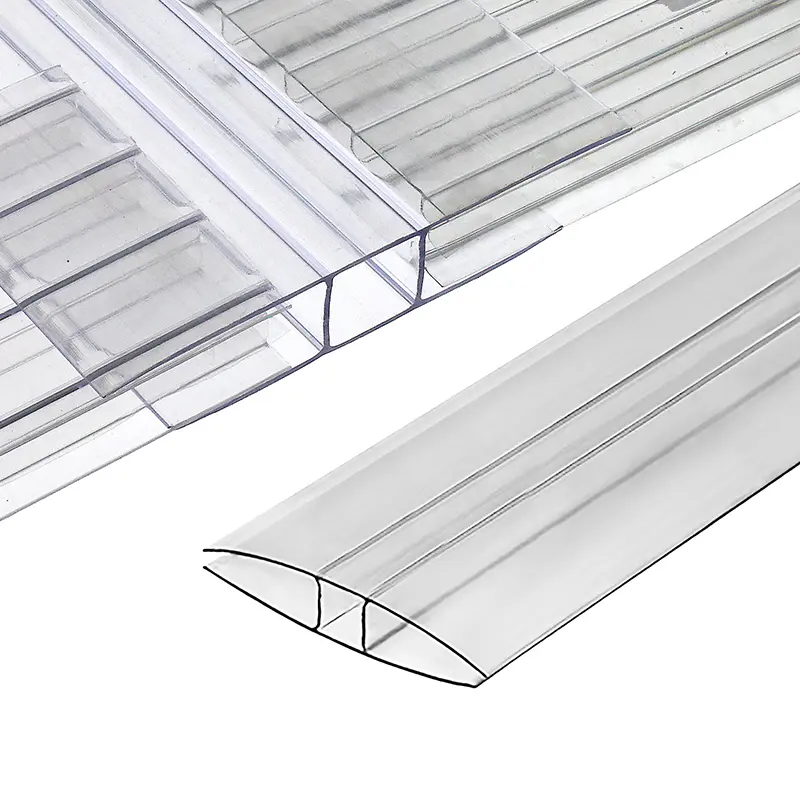
Accessories matter too: U, H and HCP profiles must match sheet thickness exactly, and a manufacturer producing both ensures compatibility. We also supply nylon cable ties for installation.
Full range: polycarbonate sheets guide

G-Crystal Polycarbonate Sheet Manufacturing
G-Crystal has manufactured polycarbonate sheets in Egypt since 2006, exporting to more than 60 countries as a polycarbonate sheet exporter serving distributors, contractors and importers.
| Specification | Detail |
|---|---|
| Established | 2006 |
| Location | Plot T11-C, Northern Expansions, 6th of October City, Giza, Egypt |
| Facility size | 4,700 m² |
| Production capacity | 1,000 tonnes per month |
| Export markets | 60+ countries |
| Raw material | 100% virgin resin, no regrind |
| Third-party audit | Pro QC International, ref. GEMS00160161SV3 (Nov 2025) |
| Lead time | 14 days from order confirmation |
| MOQ | 5 tonnes or one 20 ft container |
Raw material sourcing
We produce exclusively from virgin resin supplied by Covestro (Germany), Sabic (Saudi Arabia), LG and Samsung (South Korea), and Mitsubishi (Japan). Every batch is traceable from resin lot to finished sheet.
Why this matters commercially: recycled polycarbonate costs less and looks acceptable on delivery. It carries a faint yellow haze from the outset, loses impact strength faster, and yellows visibly within a few years outdoors. A distributor who sells it once tends to spend the following years handling complaints.
Ask any supplier to name their resin source — the answer tells you a great deal about what you are buying. See our virgin material commitment.
Inside the Polycarbonate Sheet Manufacturer
The video below follows a sheet through our line: resin drying, co-extrusion of the UV layer, thickness calibration, quality control and export packing.
Co-extrusion is the step that matters most. The UV-protective layer is fused into the sheet during extrusion, not sprayed on afterwards. A sprayed coating degrades within a few years; a co-extruded layer cannot peel, wash off or wear away — which is why we warranty against yellowing for 10 years.
Production Capacity, Specifications and Customization
| Capability | Range |
|---|---|
| Thickness | 1–12 mm solid · 4–10 mm twin-wall · 8–18 mm multiwall |
| Width | up to 2,100 mm |
| Length | up to 11,800 mm, cut to order |
| Standard sheet | 2,100 × 5,800 mm |
| Colours | Clear, opal, bronze, smoke grey, blue, green + custom RAL |
| UV protection | Co-extruded, single or double sided |
| Coatings | Anti-scratch, anti-drip, anti-fog |
| Custom production | Any dimension within the width limit |
| Private label | Available for distributor programmes |
Non-standard thickness is routine here. A 2.2 mm embossed or a 4.3 mm solid is produced to order — the capability that separates a manufacturer from a stockist, and the reason project buyers with awkward structural spans often end up dealing directly with factories.
Custom production for projects
Producing to the exact dimension a project requires removes offcuts. Since polycarbonate is sold by weight, waste is paid for whether it is installed or discarded. On a project where the structural grid does not match the standard 2,100 mm width, custom production can change the material budget noticeably — and reduce installation time, since fewer cuts and joints are needed on site.
Certifications and Factory Verification
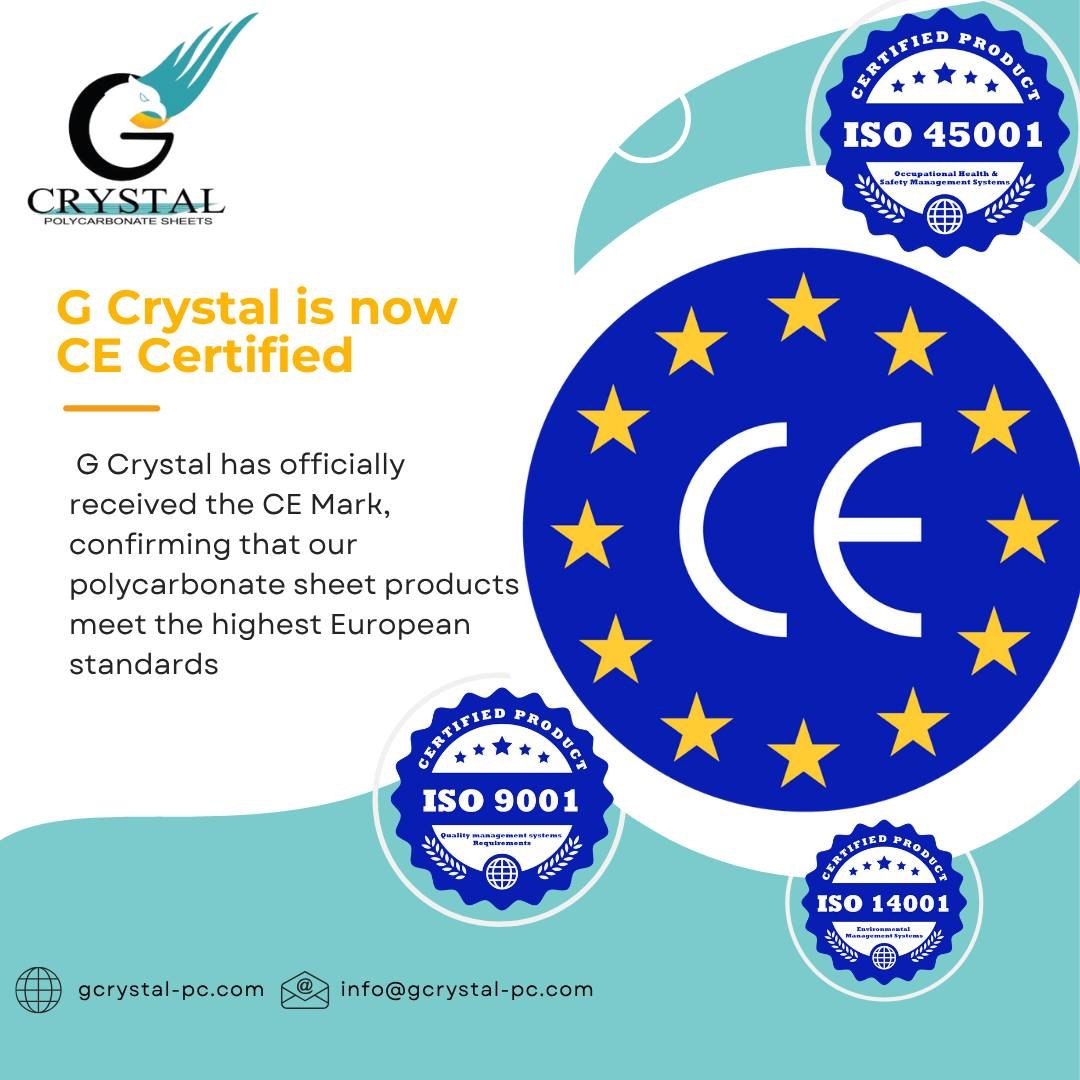
| Certification | Scope | Verification |
|---|---|---|
| CE Marking | European market conformity | Certificate 1871-CPR-RtF-846 |
| ISO 9001 | Quality management | Issued by SGS |
| ISO 14001 | Environmental management | Audited annually |
| ISO 45001 | Occupational health & safety | Audited annually |
| Factory audit | Production capability | Pro QC International, Nov 2025 |
Certificate numbers are given so they can be checked. A supplier stating “CE certified” without a number is asking you to take their word for it — reasonable in an established relationship, less so for a first container.
Full documentation — technical data sheets, certificates and test reports — accompanies every shipment. See our CE-certified sheets for the European market.
What quality control covers
On every production run, thickness is verified against specification, light transmission is measured, and the UV layer is checked for uniform coverage. Batch records tie each pallet back to its resin lot, which matters if a technical question arises months after delivery.
Polycarbonate Sheet Pricing and MOQ
Polycarbonate is priced by the kilogram — the method that reflects material actually supplied, regardless of format.
| Term | Detail |
|---|---|
| Factory price (FOB) | $2.50 – 3.50 USD/kg |
| MOQ | 5 tonnes or one 20 ft container |
| Volume discounts | By tonnage and repeat orders |
| Incoterms | FOB, CIF, CFR, EXW |
| Ports of loading | Alexandria, Damietta |
| Lead time | 14 days from order confirmation |
| Samples | Available for technical qualification |
Price per m² = thickness (mm) × density × price/kg
A 4 mm solid sheet weighs 4.8 kg/m². At $3.00/kg → $14.40/m².
A 10 mm multiwall weighs about 1.85 kg/m² → $5.55/m² — the reason hollow sheets dominate large roofing projects.
🧮 Price your order with our polycarbonate price & container calculator — weight, cost per m², cost per sheet and container fill.
Detailed breakdown: polycarbonate sheet price guide · bulk orders
Container loading affects landed cost
A container has two limits — payload in kilograms and usable volume in cubic metres — and with polycarbonate the volume often runs out first. One tonne of thin solid sheet occupies roughly 0.83 m³; one tonne of thick multiwall occupies about twice that, because hollow sheets are mostly air held within a thick profile.
The practical consequence: a container loaded only with thick hollow sheet reaches its space limit well below the weight limit, and the freight cost per square metre rises accordingly. Combining solid and hollow sheets in the same load uses the remaining payload without additional freight.
Why Egyptian manufacturing competes
- Freight advantage to three continents. Egypt sits at the Suez Canal. Shipping to Europe, the Middle East and East Africa is shorter than from Asia — often meaningfully cheaper on the same tonnage.
- European compliance without European cost base. CE marking allows direct entry to the EU market from a manufacturing base with lower input costs than Western European producers.
- Free trade agreements with the EU, COMESA, the Arab League and Turkey. Depending on destination, preferential tariffs may apply — worth confirming with your customs broker before budgeting.
- Faster transit than Asia — around two weeks to Northern Europe against four to six from China on comparable routes.
How to Order from a Polycarbonate Sheet Manufacturer
- Send your specification — sheet type, thickness, dimensions, colour, treatments, quantity, destination port and preferred Incoterm.
- Receive a quotation within 24 hours — price per kg, total weight, sheet count and container loading estimate.
- Request samples if technical qualification is needed before committing.
- Confirm the order — production is scheduled on confirmation.
- Production: 14 days with quality control on thickness, light transmission and UV layer.
- Export packing — double-sided protective film, export-standard pallets, marking to your references.
- Shipment with full documentation: commercial invoice, packing list, bill of lading, certificate of origin, ISO and CE certificates.
What to include for an accurate quote: sheet type, thickness in mm (or the span between supports if you want it specified), dimensions, colour, treatments, quantity in m² or tonnes, destination port, Incoterm, and any private-label requirement. The more complete the specification, the firmer the quotation.
Who We Supply
- Distributors and wholesalers — repeat-volume programmes with private label options, where consistent specification across shipments matters more than any single order.
- Importers — full container loads with complete export documentation.
- Contractors and construction firms — project quantities produced to specification, including non-standard dimensions.
- Greenhouse builders — twin-wall and multiwall in project dimensions, with anti-drip treatment where condensation control is needed.
- Signage manufacturers — embossed and diffuser grades for illuminated displays.
Regional pages: UAE · Kenya · global supply
📞 Send your specification — quotation within 24 hours.
WhatsApp: +2 01095990442 | ✉️ info@gcrystal-pc.com
Frequently Asked Questions
What is a polycarbonate sheet manufacturer?
A company that operates extrusion lines and produces sheets from raw polycarbonate resin, rather than buying finished sheets to resell. A manufacturer controls thickness, colour, dimensions and the UV layer; a trader is limited to what they stock.
Who are the leading polycarbonate sheet manufacturers?
The global market includes large petrochemical-backed producers in Europe and Asia — Covestro, Sabic and Palram among the best known — alongside regional manufacturers serving specific markets. Rather than ranking by size, evaluate any manufacturer on production capacity, resin sourcing, verifiable certifications, customisation range and export documentation. G-Crystal produces 1,000 tonnes per month from Egypt, exporting to over 60 countries under CE and ISO certification.
How do I verify a supplier is a real manufacturer?
Ask for monthly production capacity, the name of their resin supplier, the CE certificate number and the factory address with plot number. Then request a non-standard thickness — a manufacturer quotes it with a lead time, while a stockist explains it is unavailable.
What should I check before choosing a polycarbonate sheet manufacturer?
Factory address, monthly capacity, resin supplier names, CE certificate number, ISO issuing bodies, third-party audit reports, technical data sheets, and samples for physical qualification.
What is your production capacity?
1,000 tonnes per month from a 4,700 m² facility in 6th of October City, Egypt.
What resin do you use?
Virgin resin from Covestro (Germany), Sabic (Saudi Arabia), LG and Samsung (South Korea) and Mitsubishi (Japan). No recycled content, with batch traceability from resin lot to finished sheet.
What certifications do polycarbonate sheet manufacturers need?
CE marking is required for the European market. ISO 9001 covers quality management, ISO 14001 environmental management and ISO 45001 occupational safety. Our CE certificate is 1871-CPR-RtF-846, and the factory was audited by Pro QC International in November 2025.
What is the minimum order quantity?
5 tonnes or one 20 ft container. Samples are available for technical qualification before ordering.
What is your lead time?
14 days from order confirmation to ready-for-shipment, plus sea transit to your destination port.
Can manufacturers produce custom thicknesses and dimensions?
A producing factory can. Our overall range covers 1–18 mm depending on the sheet structure: 1–12 mm solid, 4–10 mm twin-wall and 8–18 mm multiwall. Width goes up to 2,100 mm and length up to 11,800 mm, with non-standard thicknesses such as 2.2 mm or 4.3 mm produced to order.
Do you offer private label?
Yes, for distributor programmes — custom packaging, labelling and branding on bulk orders.
What are polycarbonate sheet prices from a Polycarbonate Sheet Manufacturer?
Factory pricing is $2.50 to 3.50 USD per kilogram FOB, with volume discounts by tonnage. A 4 mm solid sheet at 4.8 kg/m² works out at about $14.40/m² at $3.00/kg. Buying directly from a manufacturer can reduce intermediary costs and may offer more competitive pricing for volume orders.
How long do polycarbonate sheets last?
More than 15 years outdoors with a co-extruded UV layer and correct installation. Our sheets carry a 10-year warranty against yellowing.
Which countries do you export to?
More than 60 across the Middle East, Europe, Africa, Asia, the United States and Latin America, under FOB, CIF, CFR or EXW.


