

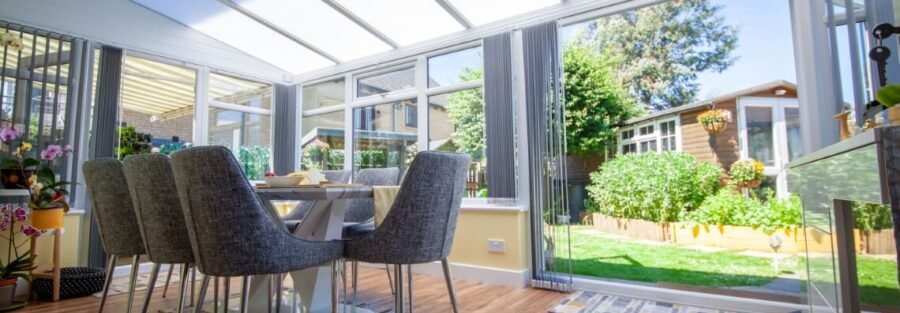
The global polycarbonate market was valued at USD 16.76 billion in 2024 and is projected to reach USD 32.40 billion by 2033 — and roofing is one of its fastest-growing applications. As builders move away from glass and metal, polycarbonate roofing sheets have become the material of choice for durable, light-transmitting, weather-resistant roofs.
What are polycarbonate roofing sheets? Polycarbonate roofing sheets are lightweight, high-impact thermoplastic panels used to cover roofs, canopies, skylights, and greenhouses. They transmit up to 90% natural light like glass, resist impact up to 200 times more than glass, withstand temperatures up to 120°C, and include built-in UV protection — making them ideal for both residential and industrial roofing.
Traditional roofing materials each have a weakness: glass shatters and is heavy, metal rusts and offers no light, and clear PVC yellows and cracks within a few years. Polycarbonate roof panels solve all three:
- Impact resistance up to 200× greater than glass — safe against hail, storms, and debris
- Lightweight — roughly half the weight of glass, cutting structural and installation costs
- Natural light — up to 90% light transmission, reducing daytime lighting costs
- Thermal insulation — multiwall types lower cooling loads significantly
- UV protection — a built-in UV-resistant coating prevents yellowing for 10–15+ years
- Weatherproof — resists rain, humidity, and extreme heat without corroding

Types of Polycarbonate Roofing Sheets
There are three main types, each suited to different roofing needs:
1. Solid Polycarbonate Roofing Sheets
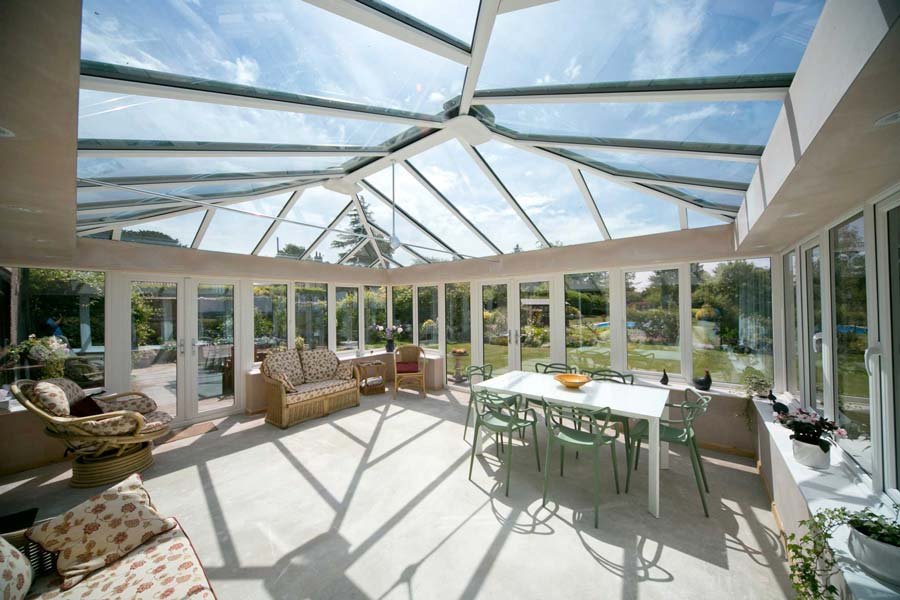
Single-layer, glass-clear panels with the highest impact resistance. Best for facades, skylights, walkways, and roofs where maximum clarity and strength matter. Also available as clear solid sheets for glass-like transparency.
2. Multiwall (Twin-Wall / Multi-Layer) Roofing Sheets
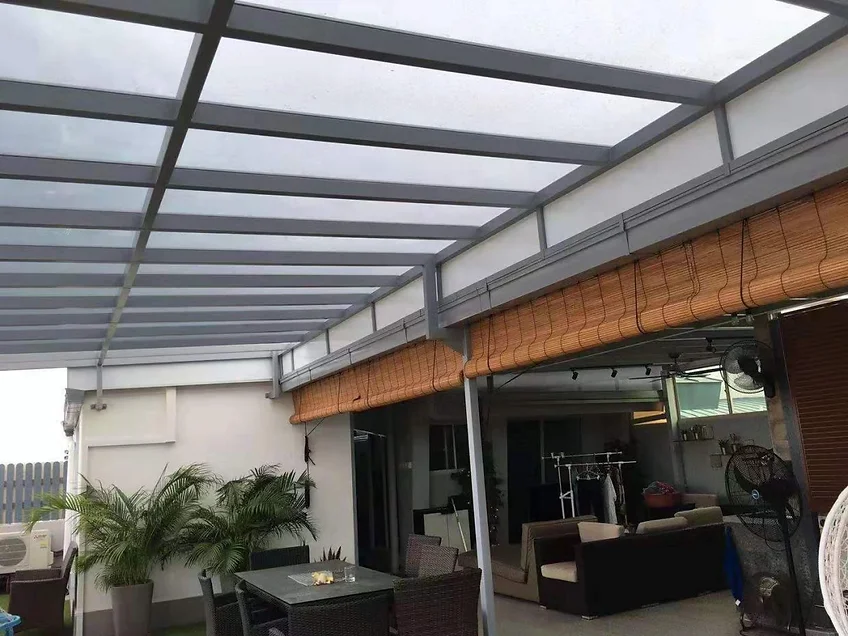
Hollow, multi-layer structure with air gaps for superior thermal and sound insulation. Lightweight and energy-efficient — the top choice for large roofs, greenhouses, and warehouses.
3. Corrugated Polycarbonate Roofing Sheets
Wavy profile matching standard metal roofing sheets, easy to install over existing structures. Ideal for verandas, car parks, agricultural roofing, and industrial sheds.
You can also explore decorative embossed sheets for roofs that combine daylighting with privacy and style.
Which Polycarbonate Roofing Sheet Is Best for Your Climate?
Choosing the right type depends heavily on your local weather:
| Climate | Recommended Type | Why |
|---|---|---|
| Hot & sunny (Gulf, Africa) | Solid or multiwall with tinted/UV | Reflects heat, blocks UV, resists 120°C |
| Tropical & rainy (Kenya, SE Asia) | Corrugated or multiwall | Sheds rain, rust-free, strong drainage |
| Cold & snowy (Europe) | Multiwall (10–16mm) | Thermal insulation, load-bearing strength |
| Temperate (mixed) | Multiwall 6–8mm | Balanced insulation and light |
| Greenhouses (any) | Twin-wall / multiwall | Diffused light + heat retention |
Which Sheet for Which Use?
- Home roofing & patios → corrugated or solid (4–6mm)
- Commercial & mall roofs → multiwall (10–16mm)
- Greenhouses & agriculture → twin-wall / multiwall (6–10mm)
- Skylights & facades → solid clear (4–8mm)
- Car parks & walkways → corrugated or solid (4–6mm)
- Industrial sheds → corrugated (2–2.4mm) or multiwall
Polycarbonate Roofing Sheets vs Other Roofing Materials
One of the most common questions contractors ask is how polycarbonate roofing sheets compare to traditional materials. Here’s a detailed breakdown:
| Feature | Polycarbonate | Glass | Metal / Iron | Clear PVC | FRP / Fiberglass |
|---|---|---|---|---|---|
| Impact resistance | Up to 200× glass | Shatters easily | High (dents) | Low, cracks | Moderate |
| Weight | Very light (½ glass) | Heavy | Medium | Light | Light |
| Light transmission | Up to 90% | Up to 90% | 0% | 80% (yellows) | 60–70% |
| UV resistance | Built-in coating | Good | N/A | Poor | Fades |
| Lifespan | 10–15+ years | Variable | Rusts over time | 2–5 years | 5–10 years |
| Thermal insulation | Excellent (multiwall) | Poor | Poor | Poor | Moderate |
| Rust / corrosion | None | None | Rusts | None | None |
| Installation | Easy, DIY-friendly | Difficult, risky | Medium | Easy | Medium |
| Cost | Mid-range, high value | High | Low upfront | Low | Mid |
The verdict: Metal is cheapest but rusts and blocks all light. Glass is clear but heavy and dangerous. PVC is cheap but yellows and cracks within a few years. Polycarbonate roofing sheets deliver the best overall balance — glass-like light, unmatched impact strength, no rust, and a 10–15 year lifespan — making them the smartest long-term investment.
Polycarbonate Roofing Sheets vs Metal Roofing
While metal (iron/aluminum) roofing is cheaper upfront, it blocks all natural light, rusts in humid or coastal climates, and offers poor insulation — raising lighting and cooling bills. Polycarbonate roofing sheets transmit up to 90% light, never rust, and insulate better, paying back the difference over their lifespan. This is why contractors in humid markets like Kenya increasingly replace iron sheets with polycarbonate.
Polycarbonate Roofing Sheets vs PVC Roofing
Clear PVC is the closest low-cost alternative, but it yellows, becomes brittle, and cracks within 2–5 years under UV exposure. UV-protected polycarbonate roofing sheets stay clear and flexible for 10–15+ years — a far better value for any permanent roof.
Types of Roofs That Need Polycarbonate Roofing Sheets
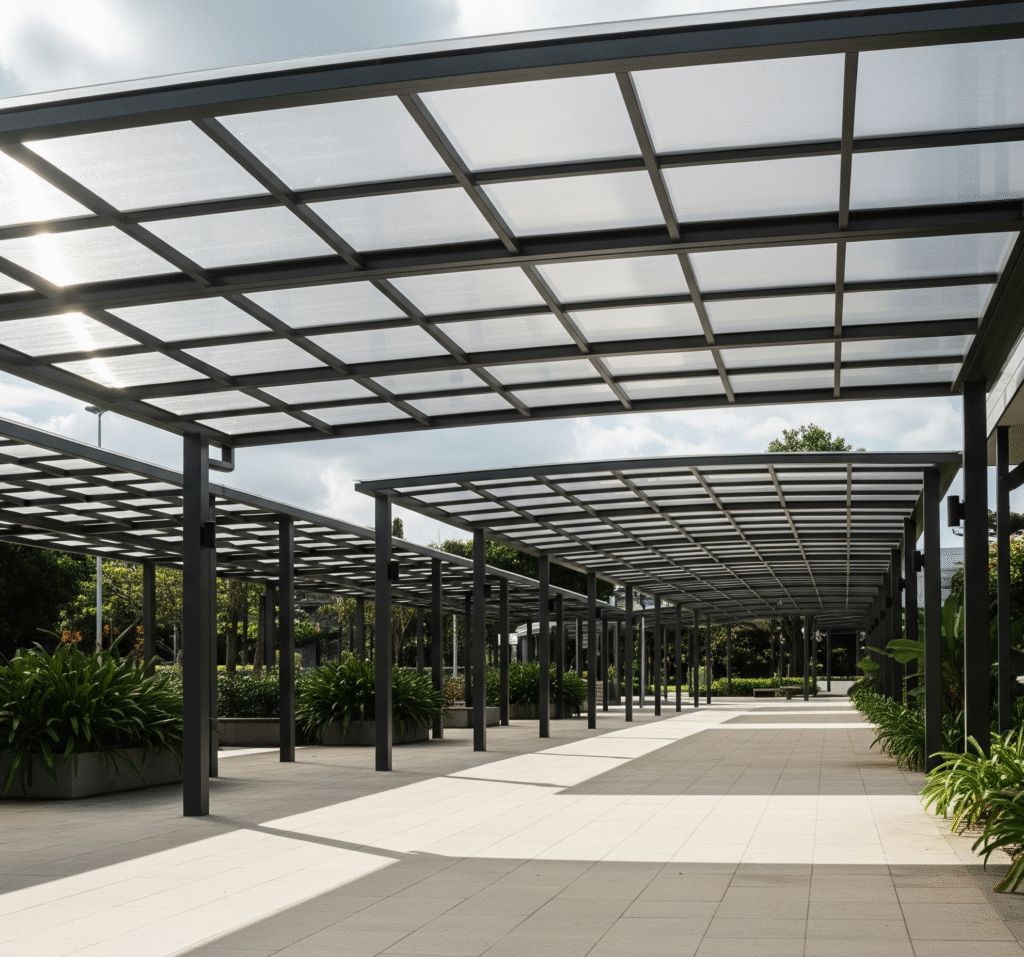
Certain roofing applications are almost always better served by polycarbonate roofing sheets than by any other material:
1. Skylight & Daylighting Roofs
Roofs designed to bring in natural light — offices, malls, atriums — need the clarity of polycarbonate with the safety of an unbreakable panel.
2. Greenhouse & Agricultural Roofs
Twin-wall and multiwall polycarbonate roofing sheets diffuse light evenly and retain heat, boosting crop yields while resisting hail and storms.
3. Curved & Arched Roofs
Polycarbonate is cold-bendable, making it ideal for barrel-vault roofs, domes, walkways, and tunnel canopies where rigid materials fail.
4. Patio, Pergola & Veranda Roofs
Lightweight roofing that shades outdoor living areas while blocking UV and letting soft light through — a top residential use.
5. Carport & Parking Roofs
Impact-resistant panels that withstand hail and sun, protecting vehicles without the weight or rust of metal.
6. Industrial & Warehouse Roofs
Large-span roofs needing insulation and daylighting use multiwall polycarbonate to cut both lighting and cooling costs.
7. Swimming Pool & Sports Facility Roofs
Corrosion-resistant panels that handle humidity and chlorine while allowing natural light — ideal for indoor pools and stadiums.
8. Walkway & Corridor Covers
Covered walkways between buildings use polycarbonate roofing for weather protection with full daylight.
How to Install Polycarbonate Roofing Sheets (Step by Step)
- Measure and plan — calculate roof area and add ~10% for overlaps and cuts.
- Choose the frame spacing — thicker sheets span wider supports; follow the span table for your thickness.
- Position the UV side up — the coated side must face the sun (marked on the film).
- Fix with the right profiles — use H-profiles to join sheets and U-profiles to seal edges.
- Drill oversized holes — slightly larger than screws to allow thermal expansion.
- Use proper screws and washers — with rubber washers to prevent leaks; don’t overtighten.
- Leave an expansion gap — polycarbonate expands in heat; leave room at edges.
- Seal and finish — apply breathable tape on open flutes (multiwall) to keep out dust and moisture.
How to Cut Polycarbonate Roofing Sheets
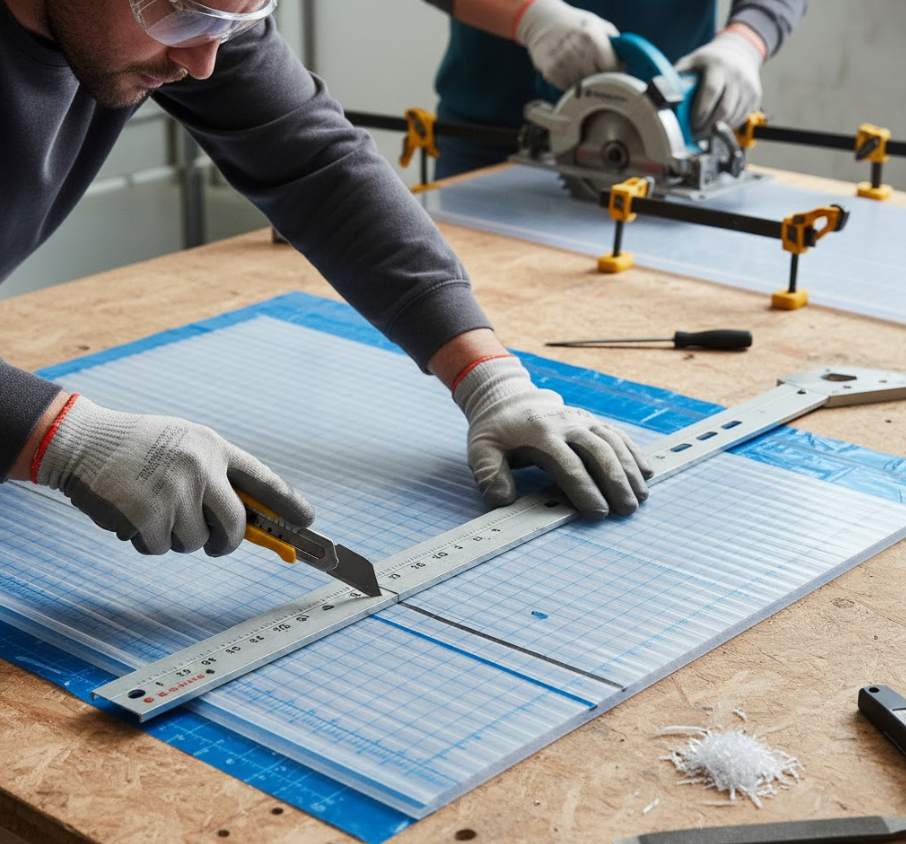
- Thin sheets (up to 3mm): a sharp utility knife scored several times, then snapped.
- Thicker or multiwall sheets: a fine-tooth circular saw or jigsaw at medium speed.
- Keep the protective film on while cutting to avoid scratches.
- Support the sheet fully to prevent cracking, and clear flutes of dust after cutting.
How to Calculate How Many Polycarbonate Roofing Sheets You Need
- Measure your roof area (length × width) in square meters.
- Divide by the coverage area of one sheet (standard sheet = 2.10m × 5.80m ≈ 12.18 m²).
- Add 10–15% for overlaps, cuts, and waste.
- Round up to the nearest whole sheet.
Example: a 100 m² roof ÷ 12.18 m² ≈ 8.2 sheets → +15% ≈ 10 sheets. For an exact quote and optimized cutting plan, contact our technical team.
How to Order from G-Crystal (Step by Step)
- Send your requirements — type, thickness, color, and quantity.
- Receive a quote — a detailed FOB offer within a short time.
- Confirm specs and Incoterms — FOB, CIF, CFR, or EXW.
- Production & packing — within days, in protective export packaging.
- Shipping & documents — direct to your port with full export paperwork.
- Delivery & support — fast customs clearance and technical assistance.
Maintenance & Care Tips
Polycarbonate roofing sheets need very little upkeep to last their full lifespan:
- Clean with lukewarm water, mild soap, and a soft cloth — never abrasive cleaners or solvents.
- Rinse thoroughly to avoid residue that can dull the surface.
- Inspect seals and profiles annually, especially after storms.
- Avoid walking directly on sheets; use support boards during installation or cleaning.
- Keep flutes clear (multiwall) with breathable tape to prevent dust and algae buildup.
Polycarbonate Roofing Sheets by Region
Climate shapes the ideal roofing choice, and we supply polycarbonate roofing sheets tailored to each market’s conditions:
- Polycarbonate Sheet Suppliers in Kenya & East Africa — rust-free, rain-resistant roofing that outperforms iron sheets across Nairobi, Mombasa, and beyond.
- Polycarbonate Sheets in the UAE & Gulf — heat and sandstorm-resistant sheets for Dubai, Abu Dhabi, and the wider Gulf, engineered for temperatures up to 50°C.
Wherever your project is, we ship factory-direct with FOB, CIF, CFR, and EXW options to over 60 countries.
Why Choose Polycarbonate Roofing Sheets from G-Crystal?
As a direct manufacturer — not a trader — G-Crystal delivers value that resellers can’t:
- Factory-direct FOB pricing ($2–3/kg) with no middleman margins
- 20+ years of manufacturing experience, exporting to 60+ countries
- Certified quality — CE Mark + ISO 9001, 14001, and 45001
- 100% virgin raw material for maximum strength and clarity
- Full range — solid, multiwall, and corrugated in all thicknesses and colors
- 10-year warranty against yellowing and weather damage
- B2B support — bulk supply for distributors and contractors
Summary
Polycarbonate roofing sheets combine the light of glass with strength far beyond it — lightweight, UV-protected, and weatherproof for 10–15+ years. Choose solid for clarity and strength, multiwall for insulation on large roofs, and corrugated for easy, economical roofing. For the best value, buy factory-direct from a certified manufacturer like G-Crystal.
📞 Request a quote: +2 01095990442 | ✉️ info@gcrystal-pc.com
Frequently Asked Questions
What are polycarbonate roofing sheets used for?
They’re used for roofs, canopies, skylights, greenhouses, car parks, and industrial sheds — anywhere you need a lightweight, impact-resistant roof that transmits natural light.
How long do polycarbonate roofing sheets last?
With built-in UV protection, quality polycarbonate roofing sheets last 10 to 15 years or more, even under strong sun and heavy rain.
Which is better: solid or multiwall polycarbonate roofing?
Solid offers maximum clarity and impact strength; multiwall offers better thermal insulation and is lighter. Choose solid for facades and skylights, multiwall for large or insulated roofs.
Are polycarbonate roofing sheets better than metal or PVC?
Yes — unlike metal they transmit light and don’t rust, and unlike PVC they resist yellowing and cracking, lasting far longer.
What thickness of polycarbonate roofing sheet do I need?
For homes and patios, 4–6mm; for large or insulated roofs, 10–16mm multiwall; for corrugated industrial roofing, 2–2.4mm. Thicker sheets span wider supports.
Can I buy polycarbonate roofing sheets directly from the factory?
Yes. G-Crystal supplies factory-direct at FOB pricing with bulk discounts, exporting to over 60 countries with full export documentation.


