

Nigeria is one of Africa’s fastest-growing markets for polycarbonate sheets, driven by a construction sector worth over $35 billion and an agricultural export push backed by federal budget allocation. Yet most Nigerian importers still navigate this market with incomplete information — unclear SONCAP requirements, wide and unexplained price swings between suppliers, and no reliable way to verify resin quality before a container lands at Apapa. This guide closes those gaps: real specifications for all four polycarbonate sheet structures, verified market data, transparent factory pricing, and the practical steps to import polycarbonate sheets for Nigeria with confidence — whether you’re placing your first order or scaling an existing supply chain.
📞 Request your factory quote for Nigeria — FOB $2.50–3.50/kg, SONCAP documentation included, samples available. +2 01095990442 | ✉️ info@gcrystal-pc.com
Table of Contents
ToggleThe Business Case: Why Now Is the Right Time to Import
Nigeria’s construction market was valued at $35.02 billion in 2025 and is projected to reach $50.28 billion by 2034, a 4.10% CAGR. GlobalData forecasts 4.1% real growth for 2026 alone, and Nigeria’s National Bureau of Statistics recorded 6.4% year-on-year growth in construction value-add in Q1 2026. Lagos State drives over 32% of national construction activity, with the state government targeting roughly 14,000 completed housing units by the end of 2026 against a national housing deficit of 14.9 million units. Every one of those units, plus the malls, warehouses and institutional buildings rising alongside them, represents a roofing and glazing decision — and polycarbonate is displacing corrugated iron and glass at an accelerating rate because it is lighter, more insulating, and doesn’t shatter.
Agriculture tells the same story from a different angle. Nigeria’s 2026 federal budget allocated ₦262 billion (~$170 million USD) to agricultural capital expenditure, explicitly targeting export-oriented food production. Greenhouse farming is expanding across Lagos, Ogun, Abuja, Plateau and Kano states as growers move to controlled-environment cultivation to meet international export standards and cut post-harvest losses currently running at 40–50%. Multiwall polycarbonate is the standard covering material for this shift — and demand for it is rising in direct proportion to Nigeria’s horticultural export ambitions.
For a distributor or contractor evaluating whether to import polycarbonate sheets for Nigeria in volume, these aren’t abstract statistics — they’re the demand curve you’d be selling into.

Understanding Polycarbonate: Why It’s Replacing Glass and Iron in Nigeria
Polycarbonate is an engineering thermoplastic, not a commodity plastic — the same material family used in bulletproof glazing and aircraft canopies, extruded into flat construction panels. Three properties explain why it’s winning share from traditional materials in Nigeria specifically:
- Impact resistance up to 250 times that of glass. In a market where hailstorms, and in some regions, security concerns are real considerations, a material that flexes rather than shatters under impact has an obvious advantage over glass.
- Roughly half the weight of glass at equal thickness. Lighter roofing means lighter supporting structure — a real cost saving on structural steel for large-span warehouse and mall roofing, which is exactly where much of Nigeria’s current commercial construction activity is concentrated.
- UV-stabilized transparency that doesn’t require constant replacement. Corrugated iron rusts and radiates heat; unprotected clear plastics yellow and become brittle under Nigeria’s intense equatorial sun. Genuine co-extruded UV protection is the difference between a 10-year roof and one that needs replacing within two seasons — a distinction most buyers in this market don’t yet know to ask about.
The Four Types of Polycarbonate Sheets: Full Technical Specifications
Every project has a different priority — clarity, insulation, weight, or budget — and the four structural types of polycarbonate sheet each optimize for a different one. Understanding the difference is the single most important factor in sourcing the right polycarbonate sheets for Nigeria project, because ordering the wrong structure wastes money in one direction or under-delivers performance in the other.
Solid Polycarbonate
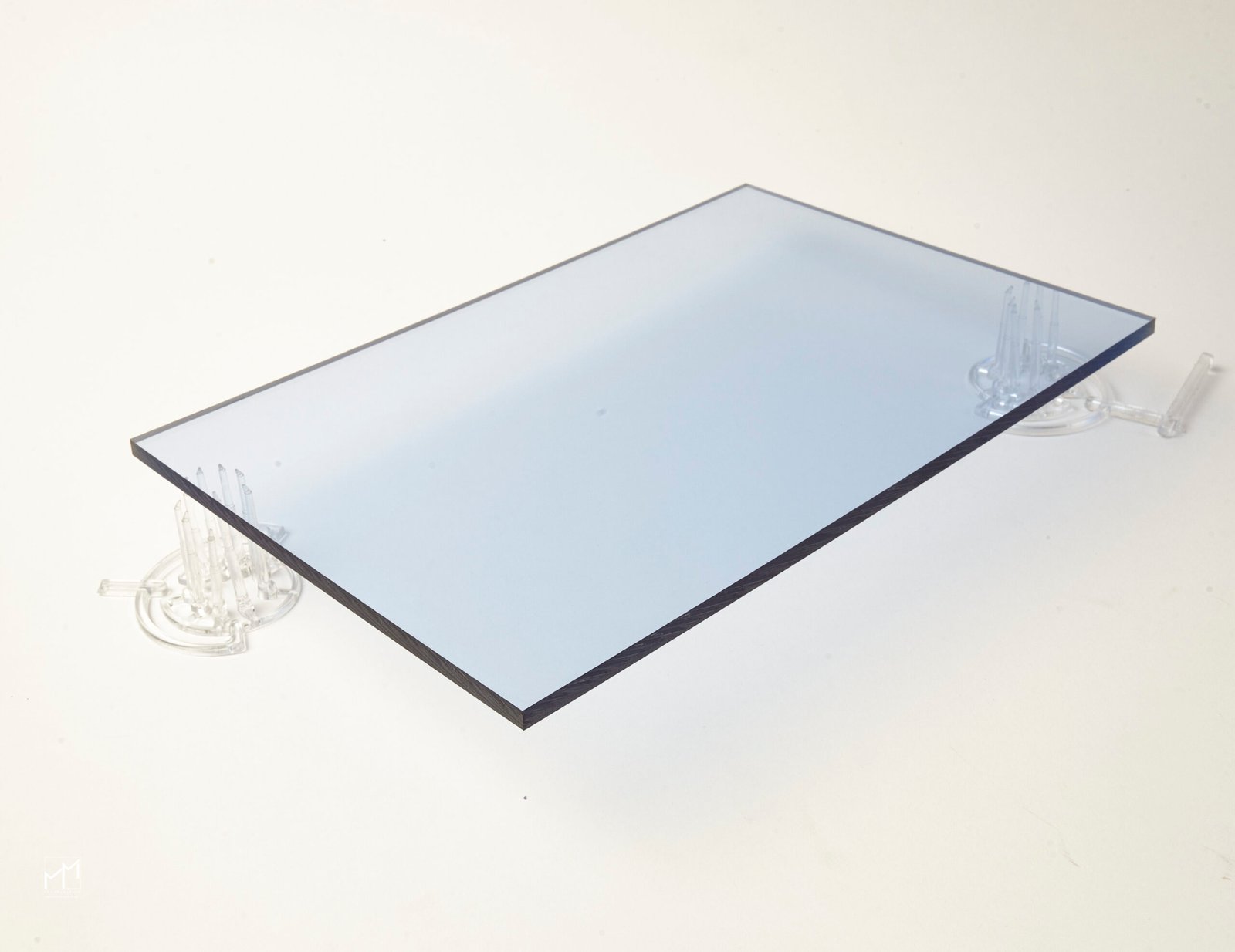
Full-thickness panels with no internal air chambers — the highest optical clarity and impact resistance in the entire polycarbonate range.
| Specification | Detail |
|---|---|
| Thickness range | 1–12 mm |
| Weight at 6mm | ~7.2 kg/m² |
| Light transmission | Up to 90% (clear grade) |
| Impact resistance | Up to 250× glass |
| Standard sheet size | 2.10 × 5.80 m |
| Factory price (6mm) | ~$18.00–25.20/m² |
Nigeria applications: bank teller windows and counters, government building security glazing, ATM enclosures, high-visibility retail display fronts, machine guarding in manufacturing facilities. Solid is specified when the priority is either maximum see-through clarity or maximum resistance to forced impact — not thermal performance.
Twin-Wall Polycarbonate
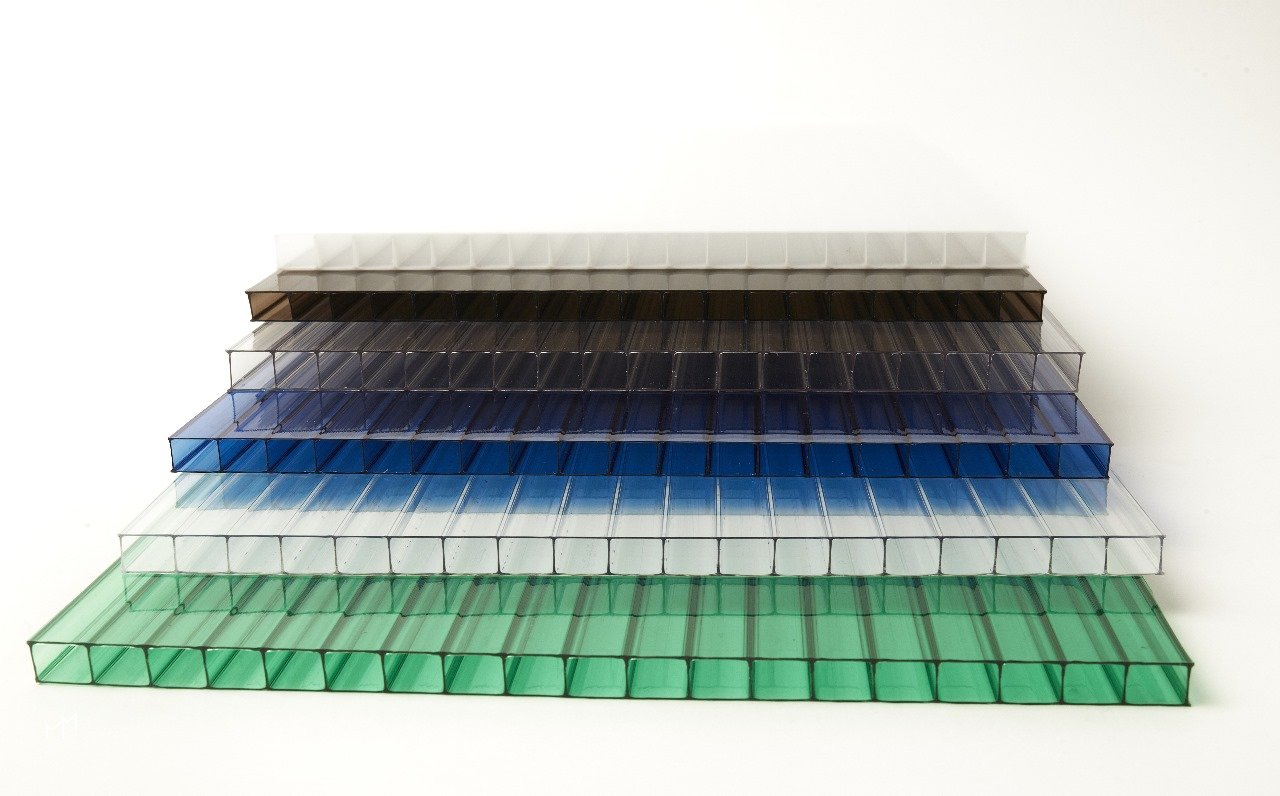
Two parallel walls connected by internal ribs, forming a single air chamber — the lightest and most economical structured polycarbonate.
| Specification | Detail |
|---|---|
| Thickness range | 4–10 mm |
| Weight at 6mm | ~1.10 kg/m² |
| Light transmission | 75–82% depending on thickness |
| Standard sheet size | 2.10 × 5.80 m |
| Factory price (6mm) | ~$2.75–3.85/m² |
Nigeria applications: residential carport and pergola roofing, small commercial canopy structures, covered walkways for schools and religious institutions. This is the natural entry-level replacement for corrugated iron sheeting on smaller structures — comparable cost, dramatically better light transmission and weight.
Multiwall (Celular) Polycarbonate
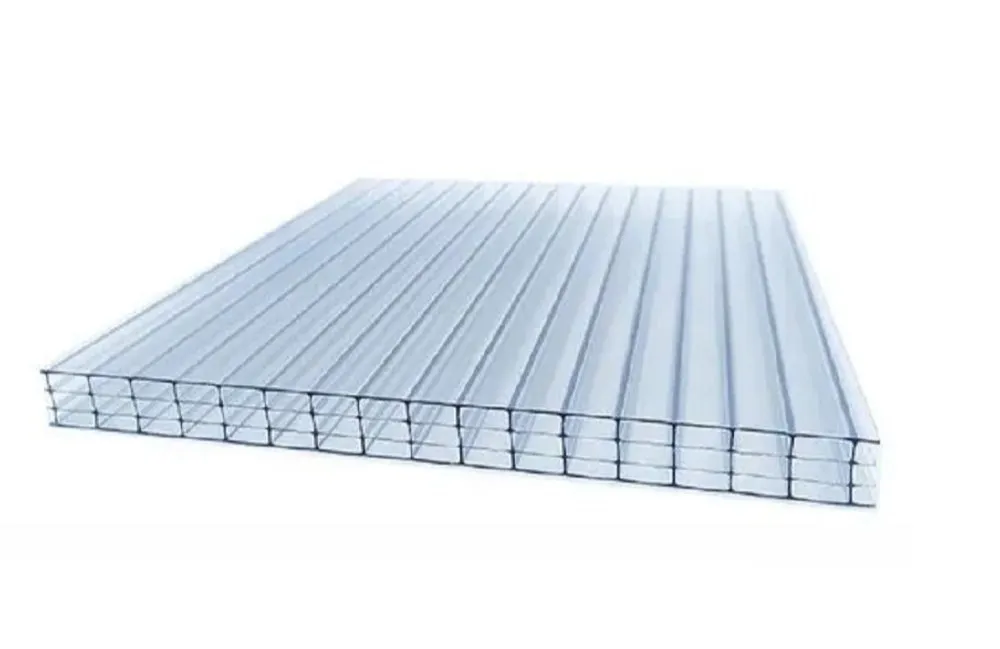
Three or more internal walls and air chambers — the best thermal insulation of any polycarbonate structure, and the standard specification for greenhouses worldwide.
| Specification | Detail |
|---|---|
| Thickness range | 8–18 mm |
| Weight at 10mm | ~1.85 kg/m² |
| Thermal transmittance (U-value) | From ~1.7 W/m²K |
| Light transmission | 65–80% (diffused) |
| Standard sheet size | 2.10 × 5.80 m |
| Factory price (10mm) | ~$4.63–6.48/m² |
Nigeria applications: commercial and export-oriented greenhouses in Ogun, Plateau and Kano; large-span warehouse and industrial roofing where reducing internal heat gain lowers ventilation and cooling costs; multi-storey atrium and skylight glazing. For any grower serious about protected cultivation and export compliance, multiwall is the material specification international buyers already expect to see.
Embossed (Textured) Polycarbonate
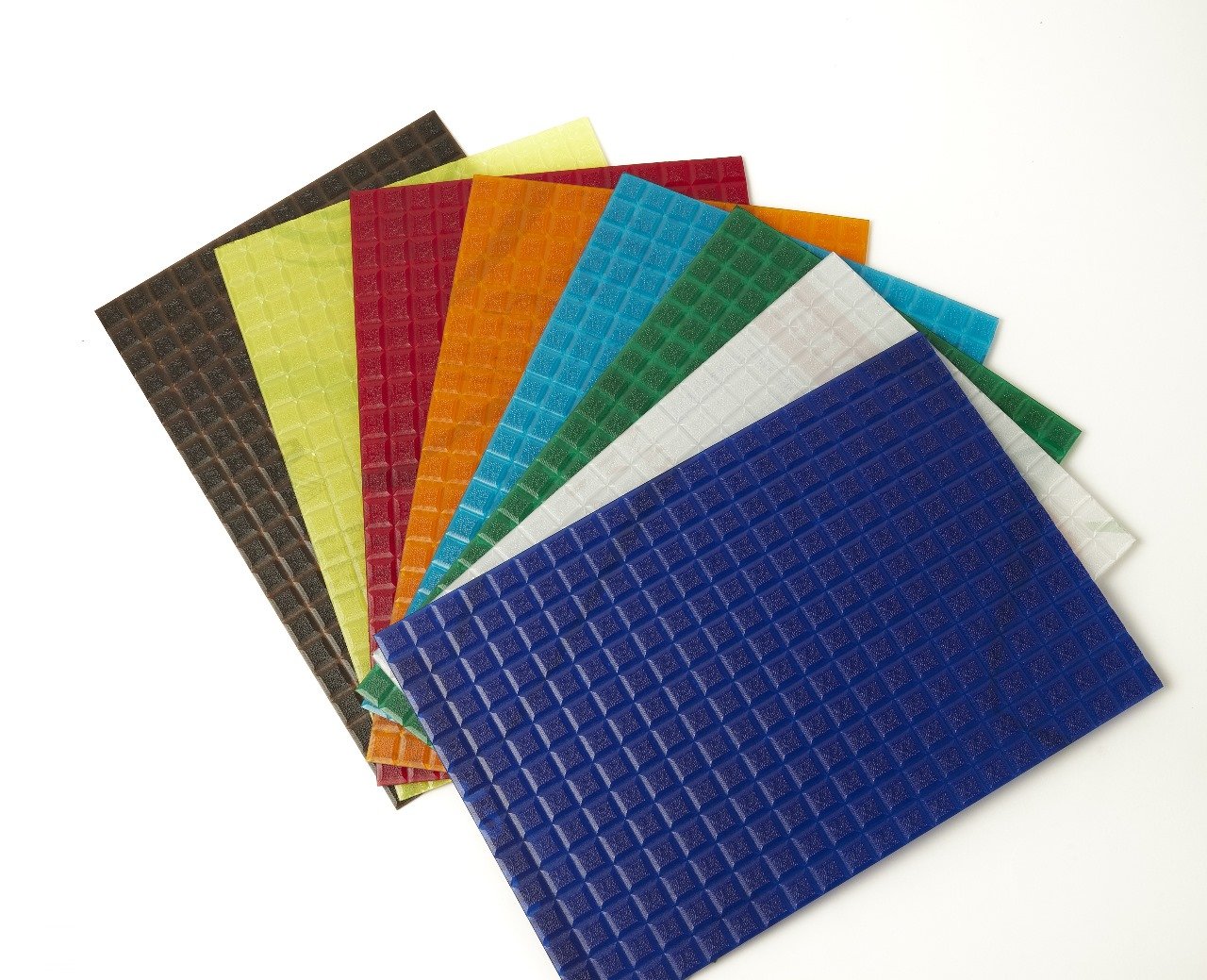
A surface pattern — Crystal, Prismatic, Diva or Diamond finish — pressed into the sheet during extrusion, diffusing light evenly while masking scratches, dust and fingerprints.
| Specification | Detail |
|---|---|
| Thickness range | 1.5–6 mm |
| Weight at 2mm | ~1.56 kg/m² |
| Light diffusion | High, glare-reduced |
| Standard sheet size | 2.10 × 5.80 m |
| Factory price (2mm) | ~$3.90–5.46/m² |
Nigeria applications: retail and hospitality interior partitions, office privacy screens, decorative facade cladding for the commercial developments concentrated in Lagos and Abuja. As Nigeria’s retail and hospitality construction pipeline expands, embossed finishes are increasingly specified where appearance matters as much as function.
Which Type for Your Project
| Application | Recommended type | Reasoning |
|---|---|---|
| Warehouse / commercial roofing | Multiwall 8–10mm | Best thermal performance, reduces cooling load |
| Export greenhouse (Ogun, Plateau, Kano) | Multiwall 6–10mm | Insulation and light diffusion drive consistent yield |
| Bank / security glazing | Solid 6–10mm | Maximum impact resistance |
| Residential carport / pergola | Twin-wall 6mm | Lowest cost, lightest weight |
| Retail partition / signage | Embossed or Solid | Privacy and finish, or clarity |
| Mall / atrium skylight | Solid or Multiwall | Clarity or diffused insulation |
Real Factory Pricing — No Guesswork
Polycarbonate is priced by weight, not area — the fabricator’s real cost is resin consumed, and a thicker or denser panel simply carries more material, regardless of nominal “per sheet” pricing some resellers quote to obscure the comparison.
| Type | Typical thickness | Weight/m² | Price per m² (FOB) |
|---|---|---|---|
| Twin-wall | 6 mm | 1.10 kg | $2.75 – 3.85 |
| Embossed | 2.0 mm | 1.56 kg | $3.90 – 5.46 |
| Multiwall | 10 mm | 1.85 kg | $4.63 – 6.48 |
| Solid | 6 mm | 7.20 kg | $18.00 – 25.20 |
Factory base price: $2.50–3.50 USD/kg FOB Alexandria/Damietta. Use our container calculator to price your exact order →
The quality red flag Nigerian buyers should know: a significant share of low-priced polycarbonate circulating in the Nigerian market is manufactured from regrind (recycled) resin rather than virgin material. It looks identical on delivery and often performs adequately for the first several months — then yellows, becomes brittle, and can crack within 12–18 months, well short of the 10-year performance genuine virgin-resin sheet delivers. Before signing any purchase order, ask your supplier directly: is this virgin or reclaimed resin, and will you put the UV warranty in writing? A supplier who hesitates on either question is telling you something.
G-Crystal vs. Sourcing From China
Most Nigerian buyers currently default to Chinese suppliers by habit rather than evaluation. On the factors that actually affect landed cost and project risk, the comparison looks different:
| Factor | G-Crystal (Egypt) | Typical China Supplier |
|---|---|---|
| Shipping time to Lagos | 12–18 days | 30–45 days |
| Minimum order | 5 tonnes | Often 10+ tonnes |
| Resin quality | 100% virgin, verified | Frequently regrind, undisclosed |
| SONCAP documentation | Prepared per shipment as standard | Often left to the importer |
| Sales communication | Direct, English-speaking | Frequently via third-party trading company |
| UV warranty | 10 years, written | Rarely offered in writing |
Shipping time alone is a working-capital advantage: a container that clears in under three weeks instead of six frees up cash for the next order cycle — a meaningful edge for any distributor managing tight margins against Naira volatility.
Try Before You Commit: De-Risking Your First Order
We understand the hesitation of wiring payment to an overseas supplier you haven’t worked with before — it’s the single biggest barrier to first-time B2B importers in Nigeria, and a rational one. Before committing to full container volumes:
- Request physical samples shipped by courier, so you can verify resin clarity, UV coating and surface finish with your own hands before placing a bulk order
- Verify our facility directly — a factory video walkthrough is available on request, alongside our ISO 9001, ISO 14001, ISO 45001 and CE certificates for independent verification
- Start smaller where feasible — a trial order lets you test quality, communication and delivery reliability before scaling to your full projected volume
This is standard practice for serious B2B trade, not an inconvenience — and any supplier unwilling to accommodate it is signaling something about what they’d rather you not verify.
SONCAP: The Compliance Step That Determines Whether Your Shipment Clears
Direct answer: polycarbonate sheets are SONCAP-regulated products. Every shipment requires a Product Certificate (PC) confirming the product meets Nigerian Industrial Standards, and a Shipment Certificate (SC) issued per consignment — without which Nigerian Customs will reject the shipment at the port. Once rejected, goods sit in bonded storage accruing demurrage fees until documentation is resolved or the shipment is re-exported.
This is not a minor administrative step. It is the difference between your container clearing Apapa or Port Harcourt on schedule, and it sitting for weeks while fees accumulate. At G-Crystal, SONCAP documentation — testing, Product Certificate, and Shipment Certificate — is prepared as a standard part of every Nigeria-bound order, not an optional add-on requested after the fact. Buyers who discover this gap with a supplier usually discover it at the worst possible moment: when their container is already at the port.
Shipping and Logistics
- Lagos — Apapa Port and Tin Can Island Port, the primary entry points for containerized cargo into Nigeria
- Lekki Deep Sea Port, the newer deep-water facility increasingly used for larger vessel calls
- Port Harcourt, serving the eastern region and industrial demand adjacent to the oil and gas sector
Incoterms offered: FOB, CIF and CFR from Alexandria or Damietta, Egypt. Sea transit to Lagos typically runs 12–18 days, versus 30–45 days from most Chinese ports — a difference that compounds across every reorder cycle.
Payment Terms Built for Nigerian Buyers
All pricing is quoted in USD, FOB — protecting your order’s real value from Naira exchange-rate volatility, a critical consideration in the current macroeconomic environment.
- T/T (Telegraphic Transfer) — the standard method for both repeat and first-time buyers, typically structured as 30% deposit / 70% balance before shipment
- L/C (Letter of Credit) — available for larger orders, adding a bank-verified layer of security on both sides of the transaction
- Complete export documentation — commercial invoice, packing list, certificate of origin, and SONCAP certification — provided to support smooth Customs clearance and CBN compliance on your end
Why B2B Buyers Choose G-Crystal for Nigeria
- Factory-direct pricing — no import-then-resell markup layered onto your cost
- 100% virgin resin on every order, eliminating the regrind quality risk common in the lower end of this market
- SONCAP documentation prepared per shipment, avoiding the port delays that catch unprepared importers
- 10-year written warranty against yellowing, backed by genuine co-extruded UV protection
- ISO 9001, ISO 14001, ISO 45001 and CE certification — independently verifiable, not just claimed
- Geographic proximity — significantly shorter shipping lanes to Lagos than sourcing from East Asia
📞 Ready to move forward? Request a sample kit, factory verification video, and your factory quote in one message. Response within 24 hours.
+2 01095990442 | ✉️ info@gcrystal-pc.com
Frequently Asked Questions
Do polycarbonate sheets require SONCAP certification to import into Nigeria?
Yes. Polycarbonate sheets are SONCAP-regulated, requiring both a Product Certificate and a Shipment Certificate before Nigerian Customs will release the shipment.
What is the actual price of polycarbonate sheets for Nigeria in 2026?
Factory-direct pricing runs $2.50 to $3.50 USD per kilogram FOB, with the final price per square metre depending on sheet type and thickness — not a flat rate, since polycarbonate is priced by material weight.
Which ports handle polycarbonate imports into Nigeria?
Apapa Port and Tin Can Island Port in Lagos are the primary entry points, alongside the newer Lekki Deep Sea Port and Port Harcourt for the eastern region.
How long does shipping take from Egypt to Nigeria?
Typically 12–18 days by sea to Lagos — roughly half the transit time of most Chinese suppliers.
What’s the minimum order quantity?
5 tonnes, or one 20 ft container, with a 14-day lead time from order confirmation.
Why do some polycarbonate sheets sold in Nigeria yellow within a year?
This is almost always a sign of regrind (recycled) resin without genuine co-extruded UV protection. Authentic virgin resin with proper UV coextrusion carries a 10-year warranty against yellowing.
Which polycarbonate type is best for Nigerian greenhouses?
Multiwall (celular) at 6–10mm thickness — its thermal insulation and diffused light directly support consistent crop yield, and it’s the standard specification for export-oriented horticulture in Ogun, Plateau and Kano states.
Is Nigeria’s construction market large enough to justify bulk importing?
Yes. The market was valued at $35.02 billion in 2025, is forecast to grow at a 4.10% CAGR through 2034, and Lagos State alone accounts for over 32% of national construction activity.
Can I get samples before committing to a full container order?
Yes. We ship physical samples by courier so Nigerian buyers can independently verify resin quality, clarity and UV coating before placing a container-sized order.
Is G-Crystal actually faster than sourcing from China?
Significantly — 12 to 18 days transit to Lagos, compared to 30 to 45 days from most Chinese ports, meaning less working capital tied up in transit and faster restocking cycles.
What payment methods do you accept from Nigerian buyers?
T/T and L/C, both quoted in USD FOB to protect your order value against Naira fluctuation, with complete export documentation provided for Customs clearance.
Do you offer OEM branding or private label for distributors?
This is available on request for qualifying order volumes — contact our sales team to discuss your requirements.
What certifications does G-Crystal hold?
ISO 9001, ISO 14001, ISO 45001, and CE marking (1871-CPR-RtF-846) — all independently verifiable on request.


