

How long does polycarbonate last? A polycarbonate sheet with a co-extruded UV layer lasts 10 years and more outdoors, and can reach 20 years with the right protection, correct installation and simple maintenance. Without UV protection, the same sheet can start to yellow and turn brittle within a few years. This guide explains what decides the lifespan, how heat, cold, humidity and sand affect it, and how polycarbonate compares with glass, acrylic, fiberglass, clear PVC and greenhouse film in the same conditions.
Updated October 2026 · Reviewed by the technical team at G-Crystal Plastic Industries, polycarbonate sheet manufacturer.
In short:
- UV-protected sheet: 10 years and more; up to 20 years with enhanced protection and correct installation.
- G-Crystal backs its sheets with a real, written 10-year limited warranty against defects in material and workmanship.
- Extra UV protection on the sun-facing side slows yellowing to a minimum; it does not make any plastic immune to the sun.
- Polycarbonate stays tough from −40 °C to +120 °C, which is why it outlasts acrylic and clear PVC in hail, cold and heat.

How long does polycarbonate last? The answer by sheet type
The honest answer to how long does polycarbonate last is “it depends on the protection”. The resin itself is tough; what ages it is ultraviolet light. The table summarises what you can expect outdoors.
| Sheet | Typical outdoor life | What happens with time |
|---|---|---|
| Polycarbonate without UV protection | A few years before visible yellowing | Surface yellows, turns hazy, loses impact strength |
| UV-protected polycarbonate, co-extruded layer on one face | 10 years and more | Slow, gradual change in colour and light transmission |
| Enhanced protection: UV on both faces or a stronger UV package | Up to about 20 years | Yellowing kept to a minimum; properties retained longer |
The same logic applies to solid sheet and twin-wall sheet: the protection layer, not the format, sets the clock.
Does polycarbonate turn yellow, and why?
Yes, every polycarbonate changes with time in the sun; the question is how fast. Ultraviolet light breaks chemical bonds at the surface, a process called photo-oxidation. The broken bonds form groups that absorb blue light, so the sheet looks yellow. Heat and humidity speed the process up.
Research confirms both points. In an eight-year outdoor exposure study, high-molecular-weight polycarbonate kept its properties better than medium-molecular-weight grades, which is one reason resin quality matters. A study on temperature and moisture found that humidity accelerates degradation, yet even after severe ageing the loss of transparency was only about 10%.
How long does polycarbonate last with extra UV protection?
This is where manufacturers differ. A co-extruded UV layer is fused into the surface during production, so it cannot peel off like a coating. Adding more protection on the sun-facing side, or protecting both faces, slows yellowing further and keeps the sheet tough for longer.
A 21-month greenhouse study published in 2025 measured the difference: sheets with an extra protective package (UV plus infrared additives) yellowed less and lost about 6% of their impact resistance, against 20.3% for sheets with standard UV additives. Additive suppliers such as BASF make the same point: the UV package is chosen according to the application, the climate and the warranty required.
So how long does polycarbonate last with enhanced protection? Longer, and with less yellowing, but not forever. Any supplier promising that a sheet “never yellows” is overselling.
When you need UV on both faces:
- Vertical glazing and façades where both faces see sun or reflected light
- Open canopies and carports where the underside catches reflected sunlight
- Large projects where a sheet installed upside down by mistake would fail early
How long does polycarbonate last in heat?
G-Crystal’s technical data sheet rates polycarbonate for continuous service from −40 °C to +120 °C, with a softening point of 150 °C. No roof in the Gulf or the Sahel comes close to those temperatures, so heat does not soften the sheet.
Heat matters in two other ways. First, chemical ageing runs faster when the sheet is hotter, so the same sheet ages faster in Riyadh than in a mild climate. Second, polycarbonate expands about 6.8 × 10⁻⁵ per °C, so a sheet fixed without clearance will buckle and crack around the screws long before the material itself wears out. Our guide on how to install polycarbonate roofing sheets covers the clearances.
To help sheets last in hot climates: choose protection on both faces where possible, use tinted bronze or opal sheet to cut heat build-up under roofs, and ventilate the space under large canopies.
How long does polycarbonate last in cold and hail?
Cold is where polycarbonate pulls ahead of other plastics. It stays tough down to −40 °C, so hail and frozen impacts that crack acrylic or clear PVC leave it intact. In cold regions the main risks are snow load and contraction: use the right thickness and purlin spacing, and leave expansion clearance, because the sheet shrinks in winter as much as it grows in summer.
How long does polycarbonate last in humidity, sand and coastal air?
Humidity and coastal air. Moisture speeds up chemical ageing, as the research above shows. On coastal sites, seal the ends of multiwall sheet properly so water does not sit inside the flutes, and choose stainless or coated fixings.
Sand and dust. Wind-blown sand in the Gulf, the Sahara and during the West African harmattan scratches smooth surfaces. Scratches do not shorten the structural life, but they reduce clarity. Embossed textures hide fine scratches, and rinsing with plenty of water before wiping prevents most of the damage.
Chemicals. Aromatic hydrocarbons, ketones, esters, chlorinated solvents and ammonia-based cleaners attack polycarbonate (G-Crystal TDS). Many early failures come from the wrong sealant or cleaner, not from the sun.
How long does polycarbonate last compared with other materials?
Every transparent material ages differently. The table compares typical market values for each material in the conditions that matter most in Africa and the Gulf.
| Condition | Polycarbonate (UV-protected) | Glass | Acrylic (PMMA) | Fiberglass (GRP) sheet | Clear PVC sheet | Greenhouse PE film |
|---|---|---|---|---|---|---|
| Strong sun / UV | Slow yellowing with UV layer | Unaffected | Very UV-stable, stays clear | Yellows; surface erodes and fibres show | Yellows and turns brittle | Breaks down in a few seasons |
| Heat | Service up to +120 °C | Excellent | Softens at lower temperatures (about 80 °C in service) | Good | Softens at around 60–70 °C | Sags and stretches |
| Cold | Tough to −40 °C | Unaffected, but brittle | Becomes more brittle | Good | Becomes brittle below freezing | Stiffens |
| Hail and impact | About 250× glass, 30× acrylic (TDS) | Breaks | Cracks | Can crack or dent | Cracks, especially when cold | Tears |
| Sand abrasion | Scratches without hard-coat | Very resistant | Scratches, less than PC | Surface wears | Scratches | Abrades |
| Typical outdoor life | 10–20 years | Decades, if not broken | 10 years and more | About 10–20 years | Shorter than PC | About 1–4 years |
The conclusion is practical. Glass lasts longest if nothing breaks it, and acrylic stays clearest, but polycarbonate is the material that survives heat, cold and impact together. For a deeper look at the two closest alternatives, see plexiglass vs polycarbonate and polycarbonate as a glass alternative. For farms that replace film every few seasons, see polycarbonate greenhouse panels.
Signs that a polycarbonate sheet is ageing
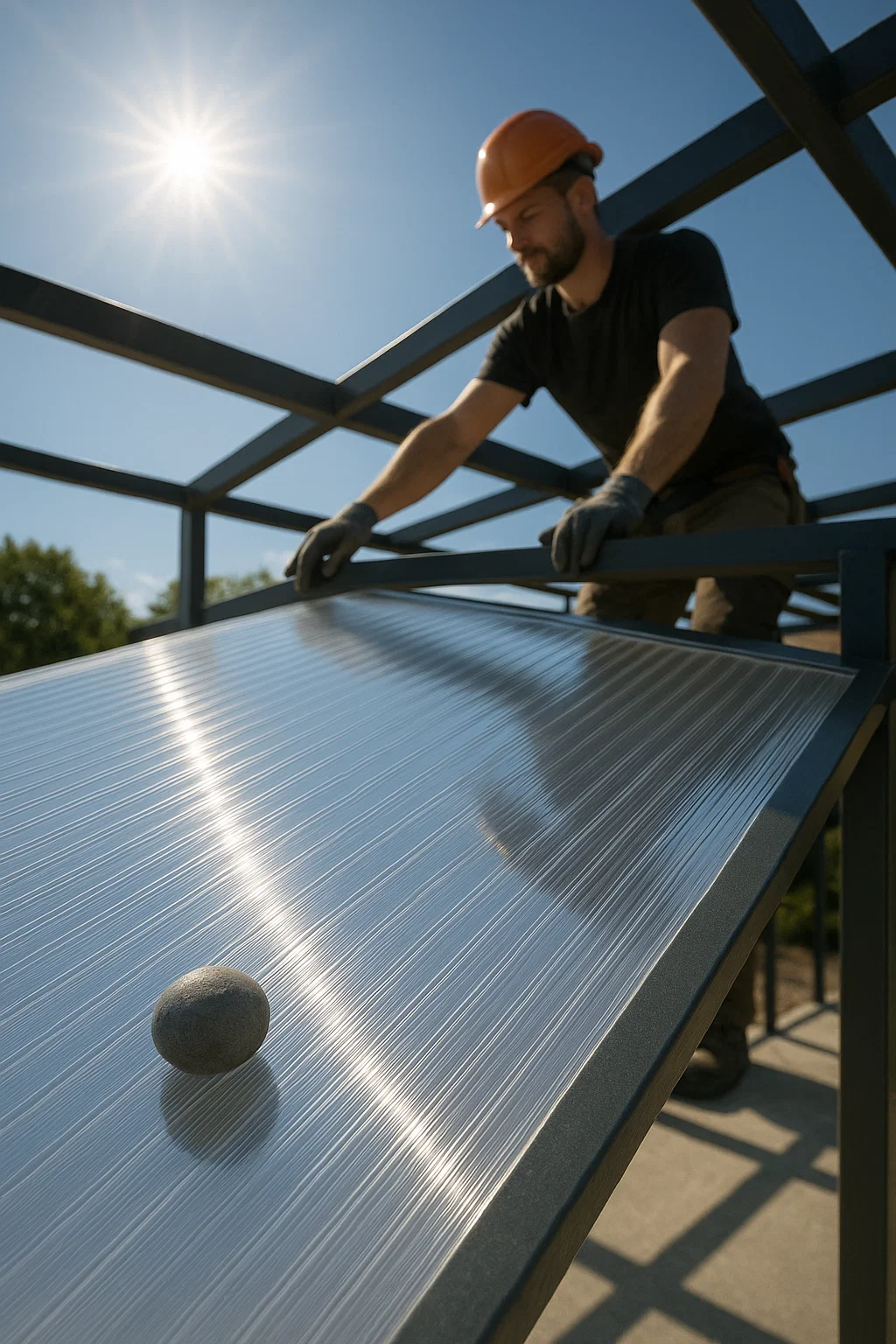
- Yellow tint that shows clearly against a white background
- Haze and loss of light under the roof
- Fine surface cracks (crazing), often around screws
- The sheet feels brittle and cracks instead of flexing
- Leaks around fixings, usually from wrong installation rather than age
How to make polycarbonate last longer
When customers ask how long does polycarbonate last in their project, the answer depends as much on the job site as on the factory. These steps add years:
- Install the marked UV face towards the sun; specify UV on both faces where both see sun
- Leave expansion clearance and use oversized holes
- Seal multiwall ends with aluminium and vented tape plus U profiles
- Use only neutral silicone and EPDM gaskets; no PVC gaskets or solvents
- Clean with mild soap and plenty of water, never dry-wipe sand
- Inspect fixings, tapes and gaskets once a year
- Choose the right thickness for the span, as explained in our guide to polycarbonate sheet sizes
The G-Crystal 10-year warranty: what it covers
G-Crystal gives a real, written 10-year limited warranty on its solid, twin-wall and embossed polycarbonate sheets, covering defects in material and workmanship under normal use. Ask for it in writing with every order, read what it covers, and keep the installation records: a warranty is only as useful as the paperwork behind it.
A warranty of 10 years and a service life that can reach 20 years are not a contradiction. The warranty is what the manufacturer guarantees in writing; the service life is what a well-protected, well-installed sheet typically achieves.
From the factory
G-Crystal produces polycarbonate sheet with a co-extruded UV layer on one or both faces, rated from −40 °C to +120 °C and fire-rated B1 (DIN 4102) and UL 94 V-2. Solid sheet runs from 1 to 10 mm, twin-wall from 4 to 12 mm and multiwall from 8 to 18 mm. What we see from the plant floor is consistent: when customers ask how long does polycarbonate last, the sheets that fail early almost always failed because of installation, cleaning chemicals or the wrong side facing the sun.
FAQ: how long does polycarbonate last?
How long does polycarbonate last outdoors? With a co-extruded UV layer, 10 years and more; with enhanced protection and correct installation, up to about 20 years.
Does polycarbonate turn yellow? All polycarbonate changes slowly in the sun. With UV protection the change is slow and minor; without it, yellowing can show within a few years.
Does extra UV protection stop yellowing completely? No. It slows yellowing to a minimum and extends the life of the sheet, but no plastic is immune to sunlight.
What temperature can polycarbonate withstand? G-Crystal sheets are rated for continuous service from −40 °C to +120 °C.
How long does polycarbonate last compared with acrylic? Acrylic stays clearer for longer but cracks under impact and in cold. Polycarbonate lasts longer where hail, impact or temperature swings are part of the job.
What does the G-Crystal warranty cover? A 10-year limited warranty against defects in material and workmanship under normal use, given in writing.
Can a yellowed polycarbonate sheet be restored? Polishing can improve the surface slightly, but a sheet that has yellowed through has reached the end of its useful life and should be replaced.
G-Crystal: long-life polycarbonate from the factory
G-Crystal Plastic Industries manufactures UV-protected solid, twin-wall, multiwall and embossed polycarbonate sheets in Egypt and exports to more than 60 countries.
- UV protection on one or both faces, chosen for your climate
- Written 10-year limited warranty
- Technical data sheet with every quote
- FOB or CIF pricing to Lagos, Mombasa, Jebel Ali or your port
Contact the factory: WhatsApp +20 109 599 0442 · info@gcrystal-pc.com
Sources
- G-Crystal technical data sheets (TDS): solid, hollow and embossed polycarbonate sheets, 2024 edition
- Radulović, “Investigation of natural weathering of medium and high molecular weight polycarbonate”, Scientific Technical Review, 2023
- Ascione et al., “Effect of environmental conditions on the durability of polycarbonate”, Journal of Applied Biomaterials & Functional Materials, 2019
- Korkmaz and Tezcan, polycarbonate greenhouse covering ageing study, Infrared Physics and Technology, 2025
- BASF, Tinuvin case study on UV stabilisation of polycarbonate building sheets
- Values for glass, acrylic, fiberglass, clear PVC and greenhouse film: typical market ranges


