Updated October 2026 · Reviewed by the technical team at G-Crystal Plastic Industries, polycarbonate sheet manufacturer.
In short:
- Twin-wall 6–10 mm for patios, carports and most roofs; multiwall 10–18 mm for insulated roofs; solid 3–6 mm for clarity and impact.
- Minimum slope 5°, flutes running down the slope, UV-protected face towards the sun.
- Bronze and opal sheets cut glare and heat under the roof; clear lets in the most light.
- Factory price: USD 2.50–3.50 per kg FOB, so twin-wall 6 mm runs about USD 2.50–4.55 per m².


Types of polycarbonate roofing sheets
Three families of polycarbonate roofing sheets cover almost every roof:
| Type | Thickness | Weight per m² | Light | Insulation | Best for |
|---|---|---|---|---|---|
| Twin-wall | 4–12 mm | 0.7–2.0 kg | High | Good | Patios, carports, walkways, greenhouses |
| Multiwall | 8–18 mm | 1.5–3.0 kg | Medium | High | Large roofs, warehouses, pools, air-conditioned spaces |
| Solid | 3–6 mm on roofs | 3.6–7.2 kg | Glass-like | Low | Skylights, canopies over entrances, hail and impact zones |
Embossed sheet (crystal, prismatic, Diva) is a solid sheet with a textured surface. On roofs it diffuses light and hides dust and fine scratches.
Which thickness for which span?
The thickness of polycarbonate roofing sheets goes hand in hand with the distance between purlins. Thinner sheet needs closer supports. These are typical market values for twin-wall sheet under moderate wind load:
| Twin-wall thickness | Typical purlin spacing | Typical use |
|---|---|---|
| 4 mm | 500–600 mm | Small canopies, garden structures |
| 6 mm | 600–750 mm | Patios, carports, walkways |
| 8 mm | 750–900 mm | Larger patios, commercial canopies |
| 10 mm | 900–1,050 mm | Industrial roofs, exposed sites |
Multiwall of 12–18 mm spans further and insulates better. On coastal sites, in hail zones or where snow builds up, reduce the spacing or go up a thickness. The full method is in our guide on how to install polycarbonate roofing sheets.
Colours: light, glare and heat
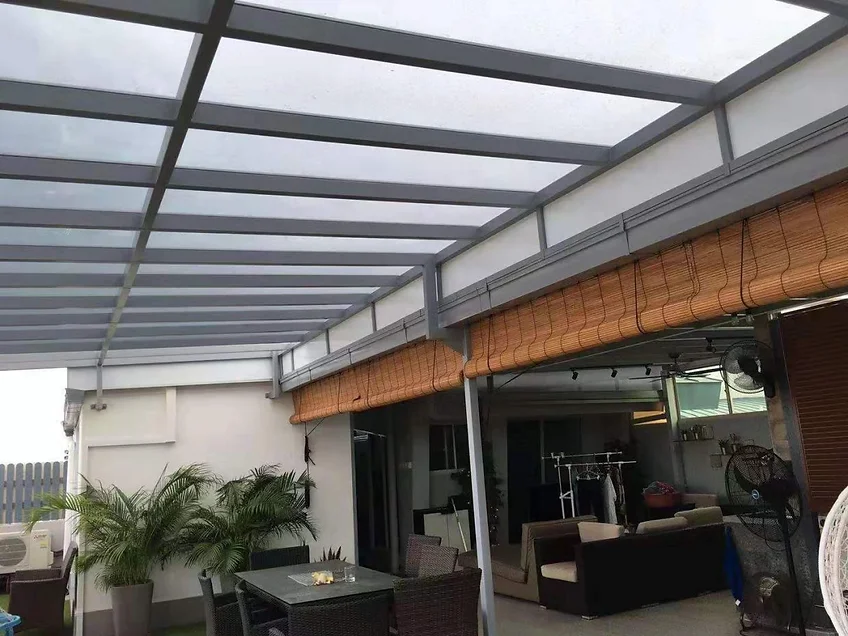
Colour changes how a polycarbonate roof feels underneath:
- Clear: the most daylight (82–88% for clear hollow sheet, G-Crystal TDS). Best for greenhouses and skylights; can feel hot under strong sun.
- Opal (white): soft, even light without direct sun; a common choice for offices, pools and warehouses.
- Bronze and grey: cut glare and heat; the usual choice for patios and carports in hot climates.
- Blue, green and other colours: for design and branding. See all options in tinted polycarbonate sheet.
Where polycarbonate roofing sheets are used
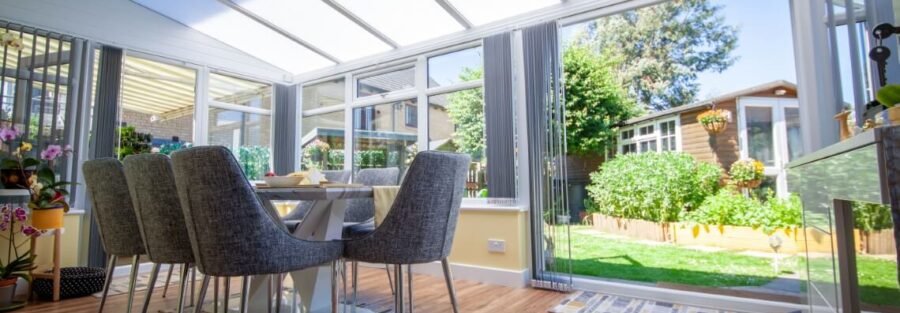
Patios and terraces. Twin-wall 6–8 mm in bronze or opal keeps the area dry and bright without trapping heat.
Carports and garages. Twin-wall 6 mm is the most common sheet; solid 3–4 mm where hail is frequent.
Industrial and warehouse roofs. Strips of polycarbonate roofing sheets between metal panels bring daylight into the building and cut lighting costs during the day.
Pools and sports halls. Multiwall 10–16 mm in opal gives diffused light and insulation, and keeps rain noise lower than a metal roof.
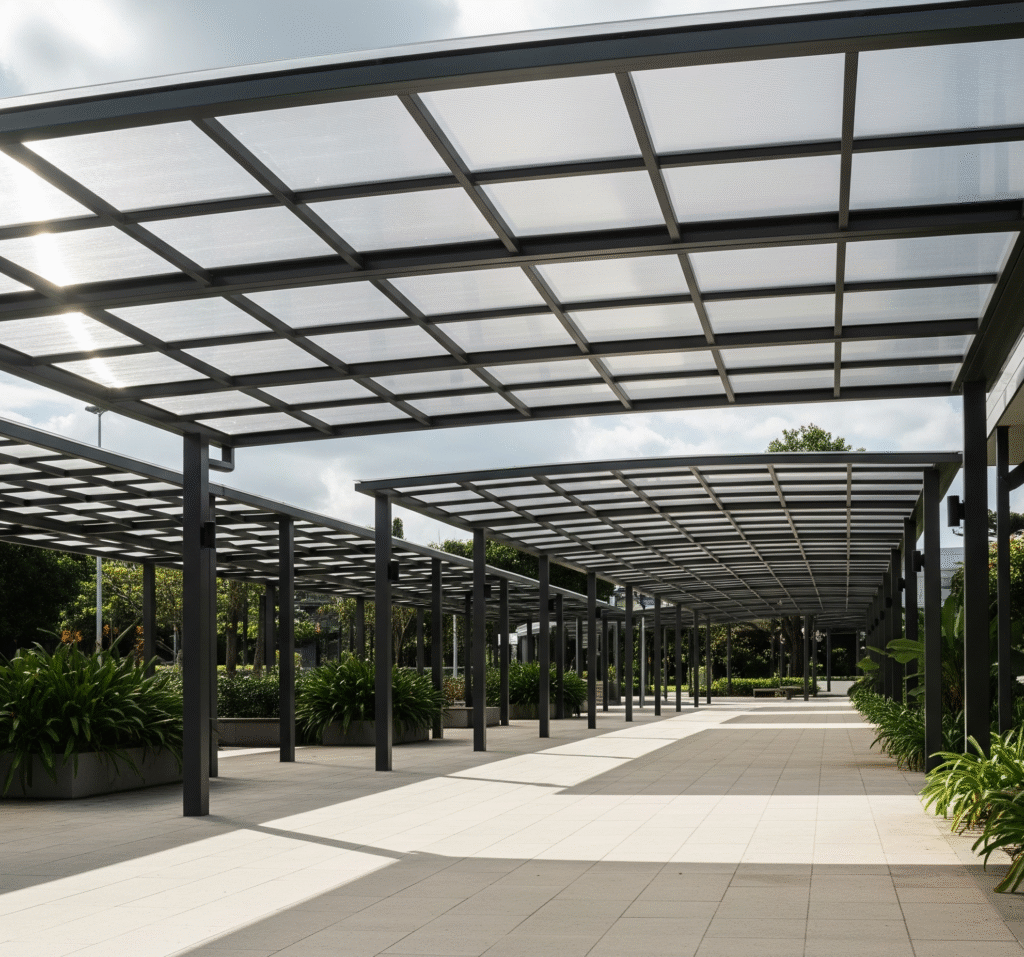
Walkways, bus shelters and entrances. Solid or twin-wall sheet on aluminium frames, often curved. See our polycarbonate canopy guide.
Greenhouses. Twin-wall 4–10 mm with sealed ends for light and insulation. See polycarbonate greenhouse panels.
Design rules for a polycarbonate roof
- Slope of at least 5° (about 9 cm per metre) so rain drains and washes the surface.
- Flutes run down the slope so condensation drains out at the lower end.
- Full-length sheets. Twin-wall and multiwall are not overlapped or joined end to end; order sheets in the full roof length.
- UV face towards the sun. It is marked on the protective film. Specify UV on both faces where the underside sees reflected sun.
- Profiles and sealing. H or HCP connectors between sheets, U profiles and tapes at both ends.
- Expansion clearance. About 3 mm per metre, with oversized screw holes.
Polycarbonate roofing sheets vs other roofing materials
| Factor | Polycarbonate (UV-protected) | Metal sheet | Fibreglass (GRP) sheet | PVC / uPVC sheet | Glass |
|---|---|---|---|---|---|
| Daylight | High (clear) to diffused (opal) | None | Medium, drops as it ages | Medium (clear PVC) to none | Highest |
| Weight | Very light | Light | Light | Light | Heavy |
| Hail and impact | Very high (about 250× glass, TDS) | Dents | Can crack | Brittle in cold (clear PVC) | Breaks |
| Insulation | Good to high (twin-wall, multiwall) | Low without insulation | Low | Low | Low (single glazing) |
| Rain noise | Moderate, lower with multiwall | Loud | Moderate | Moderate | Low |
| Typical life | 10–20 years | Long, if protected from corrosion | About 10–20 years | Varies by product | Decades, if not broken |
The practical rule: use metal where you need an opaque roof, and polycarbonate roofing sheets wherever you want light. Many industrial roofs combine both.
How much do polycarbonate roofing sheets cost?
The factory price is USD 2.50–3.50 per kg FOB for all sheet types, so the cost per m² follows the weight:
| Sheet | Weight per m² | FOB price per m² (USD) |
|---|---|---|
| Twin-wall 4 mm | 0.7–1.0 kg | 1.75–3.50 |
| Twin-wall 6 mm | 1.0–1.3 kg | 2.50–4.55 |
| Twin-wall 8 mm | 1.3–1.5 kg | 3.25–5.25 |
| Twin-wall 10 mm | 1.5–1.7 kg | 3.75–5.95 |
| Multiwall 16 mm | 2.2–2.8 kg | 5.50–9.80 |
| Solid 3 mm | 3.6 kg | 9.00–12.60 |
| Solid 6 mm | 7.2 kg | 18.00–25.20 |
For a 25 m² patio in twin-wall 8 mm, the sheet costs about USD 85–145 at factory price, before freight, duties, structure and labour. Full price tables and landed-cost examples are in polycarbonate sheet price per kg and per m².
Choosing polycarbonate roofing sheets for your climate
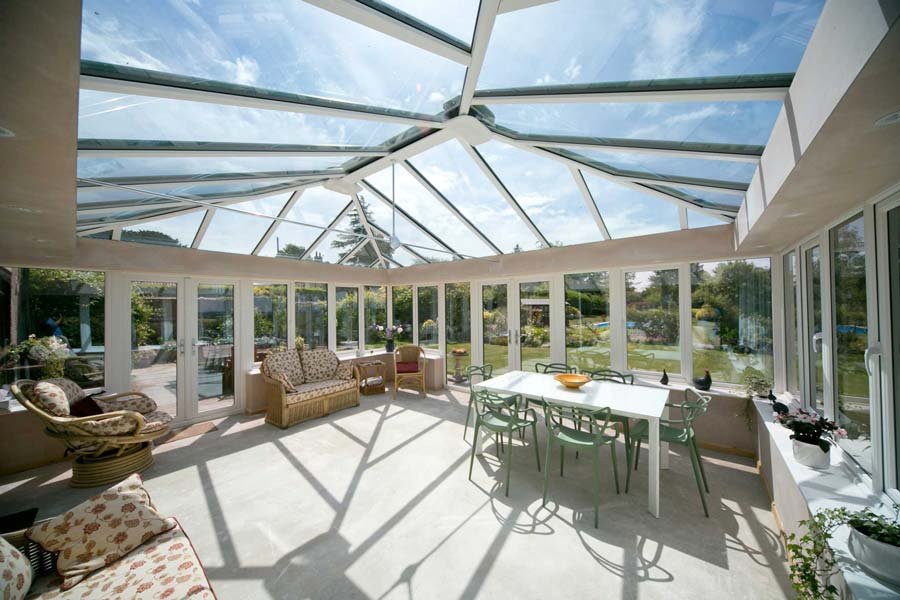
Hot and sunny (Gulf, Sahel, North Africa). UV protection on both faces where possible, bronze or opal to cut heat, and full expansion clearance for large day–night swings.
Dust and sand. Seal both ends, rinse with plenty of water before wiping, and consider embossed sheet on exposed roofs.
Tropical rain and wind (West and East African coasts). Keep at least 5° of slope, use HCP profiles fixed to every purlin, and add fixings at the eaves.
Hail. Go up a thickness, choose the heavier grade per m², or use solid sheet.
How long does a polycarbonate roof last?
With a co-extruded UV layer, polycarbonate roofing sheets last 10 years and more, and can reach 20 years with enhanced protection, correct installation and simple maintenance. G-Crystal sheets carry a written 10-year limited warranty against defects in material and workmanship. More detail in how long does polycarbonate last.
Common mistakes with polycarbonate roofs
- Slope under 5°, so water and dust sit on the sheet
- Flutes horizontal instead of down the slope
- UV face installed downwards
- Sheets joined end to end instead of full-length
- Screws over-tightened, with no expansion clearance
- Open flute ends that let in dust and insects
- Choosing by price per sheet without checking weight per m²
From the factory
G-Crystal produces polycarbonate roofing sheets in Egypt: twin-wall 4–12 mm, multiwall 8–18 mm, solid 1–10 mm and embossed 1.5–6 mm, all with a co-extruded UV layer on one or both faces, in nine standard colours, B1 (DIN 4102) and UL 94 V-2 rated, with H, HCP and U profiles for installation. The sheets are 2100 mm wide and supplied in custom lengths, so each sheet covers the full roof slope without joints.
When contractors ask us which polycarbonate roofing sheets to quote, we ask three questions first: the purlin spacing, the climate and how much light the space needs. The answers decide the type, thickness and colour.
FAQ: polycarbonate roofing sheets
What thickness of polycarbonate roofing sheet should I use? For most patios and carports, twin-wall 6–8 mm. For larger spans and exposed sites, 10 mm twin-wall or multiwall up to 18 mm.
Are polycarbonate roofing sheets better than metal? They let daylight through and resist hail without denting. Metal is the choice for an opaque roof; many roofs combine metal panels with polycarbonate strips.
Do polycarbonate roofing sheets make the space hot? Clear sheet lets in the most sun. Bronze, grey or opal sheet cuts glare and heat, and multiwall adds insulation.
What is the minimum slope for a polycarbonate roof? 5°, about 9 cm of fall per metre.
How long do polycarbonate roofing sheets last? 10 years and more with a co-extruded UV layer, and up to about 20 years with enhanced protection and correct installation.
How much do polycarbonate roofing sheets cost per m²? At factory price, twin-wall 6 mm costs about USD 2.50–4.55 per m² FOB, depending on the weight per m².
Can polycarbonate roofing sheets be curved? Yes, they are cold-bent on site. Respect the minimum radius: about 175 × thickness for twin-wall and 150 × thickness for solid sheet.
G-Crystal: polycarbonate roofing sheets from the factory
G-Crystal Plastic Industries supplies contractors, distributors and importers in more than 60 countries with polycarbonate roofing sheets in custom lengths, matching profiles and a written 10-year limited warranty.
- Sheet type, thickness and colour recommended for your roof
- Sheets cut to your roof length
- H, HCP and U profiles from the same factory
- FOB or CIF pricing to Lagos, Mombasa, Jebel Ali or your port
Contact the factory: WhatsApp +20 109 599 0442 · info@gcrystal-pc.com
Sources
- G-Crystal technical data sheets (TDS): solid, hollow and embossed polycarbonate sheets
- G-Crystal factory price list, October 2026 (USD per kg, FOB)
- Industry installation practice for multiwall polycarbonate roofing (slope, purlin spacing, sealing)
- Values for metal, fibreglass, PVC and glass roofing: typical market ranges