

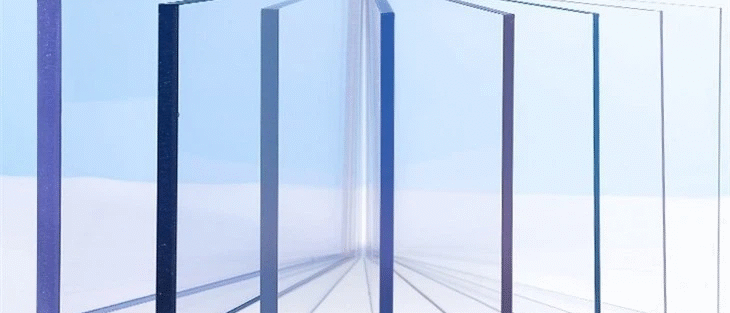
Understanding polycarbonate sheet price is the first step for any importer, contractor, or distributor planning a purchase. Prices are driven by raw material costs, sheet type, thickness, coatings, color, and order volume — and they shift with the global market. As of mid-2026, raw polycarbonate resin trades around $2.1–2.3/kg in Asia, $3.28/kg in North America, and up to $3.46/kg in Europe, setting the baseline for finished sheet pricing worldwide.
How much does a polycarbonate sheet cost? Polycarbonate sheets are priced by weight, typically $2.50 to $3.50 per kilogram (FOB) for standard sheets. The final price depends on sheet type (solid, twin-wall, multiwall), thickness, color, UV or specialty coatings, and order quantity. Bulk and container orders receive significant discounts, while specialty coatings like anti-scratch or anti-drip add a small premium.

Polycarbonate Prices in 2026: Market Overview
Polycarbonate prices move with the global resin market, which is driven by crude oil, feedstock (BPA), energy costs, and regional supply. As of mid-2026, raw resin traded around $2.1–2.3/kg in Asia, $3.28/kg in North America, and up to $3.46/kg in Europe. Finished sheet prices build on this baseline, with G-Crystal’s factory-direct polycarbonate prices holding steady at $2.50–3.50/kg FOB — competitive with global rates while offering certified quality and bulk discounts.
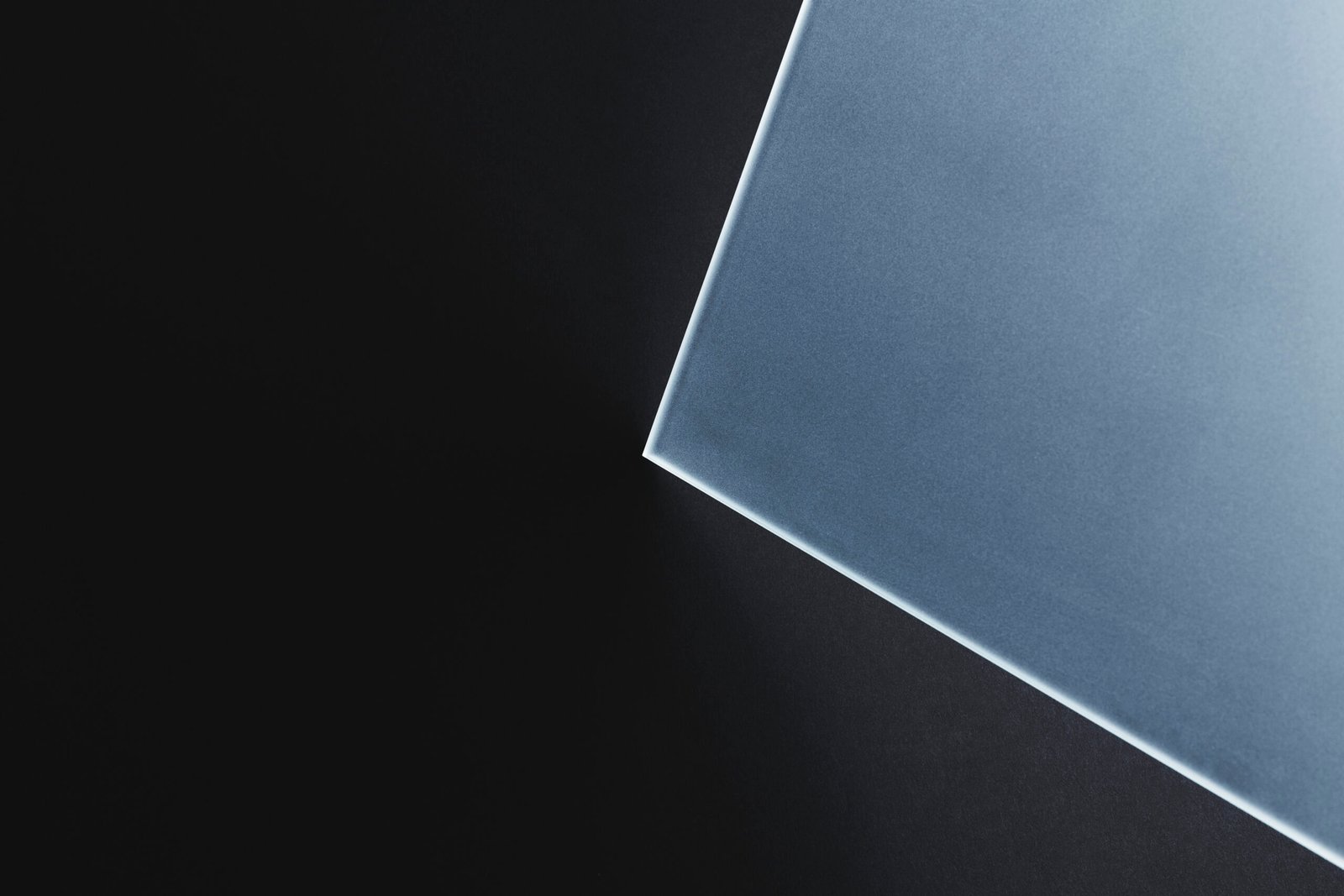
How Is Polycarbonate Sheet Price Calculated?
Unlike materials sold per sheet, polycarbonate is priced by weight (per kilogram) — the fairest method, reflecting actual material used. A sheet’s weight comes from its density, dimensions, and thickness:
Weight = length × width × thickness × density (1.2 g/cm³)
A thicker or larger sheet weighs more and costs more. When you request a quote, the price per kg is multiplied by the sheet’s weight for the final cost. This is why two sheets of the same size can differ in price if their thicknesses differ.
Polycarbonate Sheet Price by Type
Each type has a different structure, density, and production cost. Here’s how they compare (FOB, per kg):
| Sheet Type | Price Range (per kg) | Notes |
|---|---|---|
| Solid polycarbonate | $2.50 – $3.50 | Highest density; strongest and clearest |
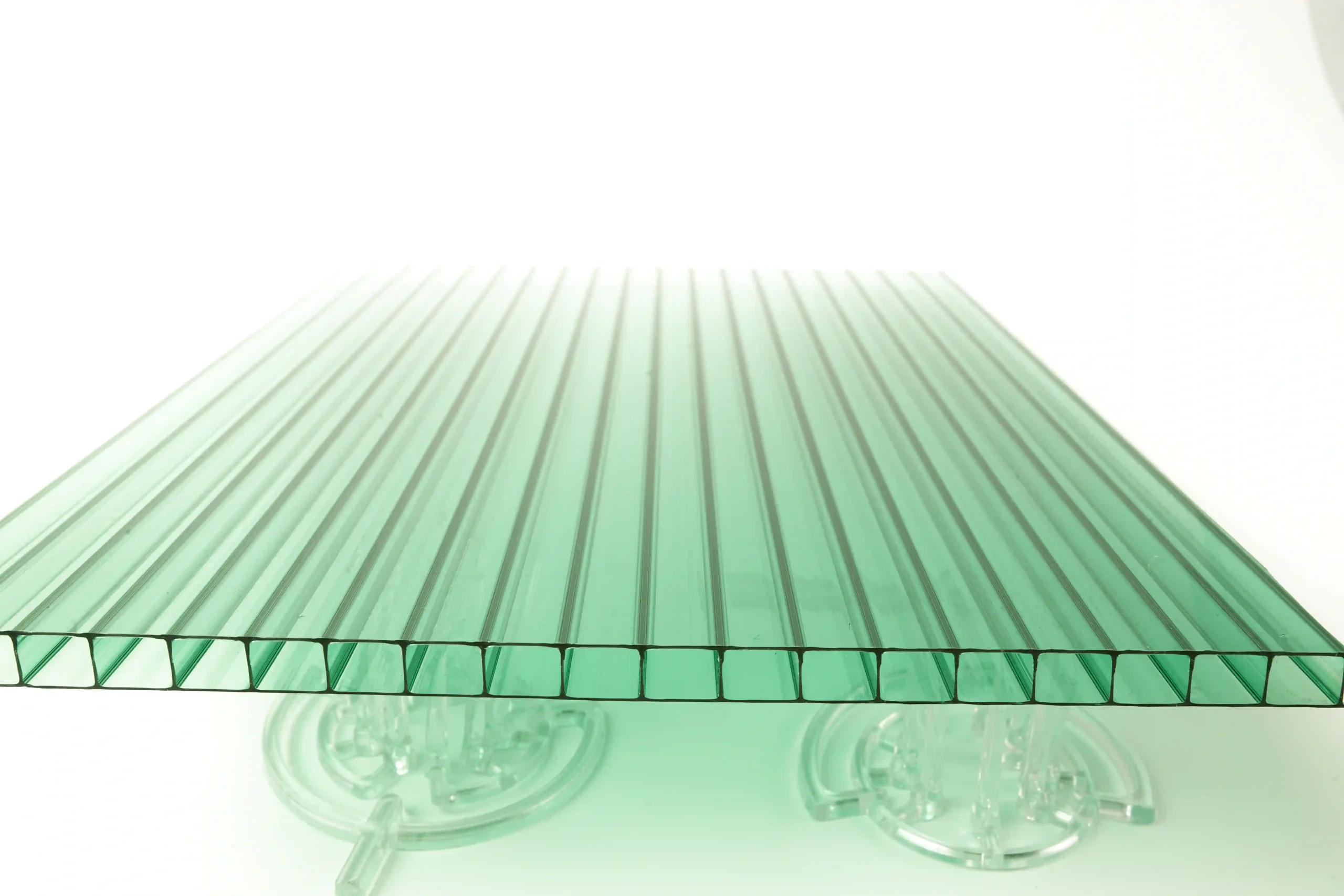
| Twin-wall (hollow) | $2.50 – $3.50 | Lighter per m² — lower cost per panel |
| Multiwall (3–5 wall) | $2.50 – $3.50 | More material than twin-wall, excellent insulation |
| Corrugated | $2.50 – $3.50 | Thin-gauge, economical for roofing |
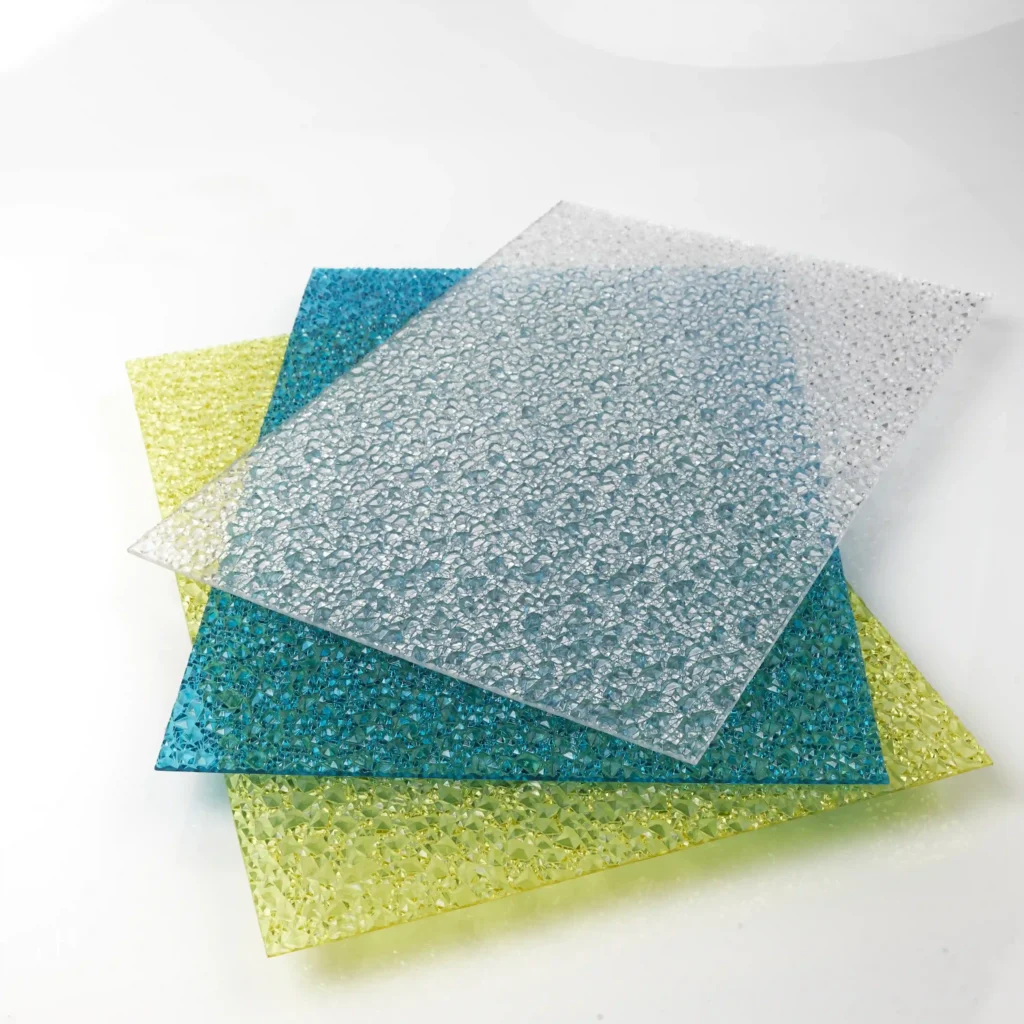
| Embossed / textured | $2.50 – $3.50 | Solid with decorative surface finish |
Important: while price per kg is similar across types, the cost per panel differs a lot. Hollow twin-wall and multiwall sheets weigh far less per m² than solid, so they’re often cheaper to cover the same area — key for budgeting large roofs or greenhouses.
How Thickness Affects Polycarbonate Sheet Price
Since price is by weight, thicker sheets cost more. Here’s the typical relationship for solid sheets:
| Thickness | Relative Weight & Price | Common Use |
|---|---|---|
| 2 mm | Lowest | Signage, displays, light glazing |
| 3–4 mm | Low–mid | Canopies, partitions, DIY roofing |
| 6 mm | Mid | Skylights, walkways, machine guards |
| 8–10 mm | Higher | Heavy-duty roofing, safety glazing |
| 12 mm+ | Highest | Security barriers, structural glazing |
For hollow sheets, thickness adds insulation more than weight, so the price increase per mm is smaller than with solid.
Polycarbonate Price per KG: How It’s Calculated
Unlike materials sold per sheet, polycarbonate is priced by weight (per kilogram) — the fairest method, reflecting actual material used. The polycarbonate price per kg ranges from $2.50 to $3.50 (FOB) for standard sheets, and a sheet’s total cost comes from its density, dimensions, and thickness:
Weight = length × width × thickness × density (1.2 g/cm³)
A thicker or larger sheet weighs more and costs more…
Polycarbonate Sheet Price per Square Meter (Conversion)
Many buyers think in price per square meter, not per kg — especially contractors estimating a roof or facade. Since polycarbonate is sold by weight, here’s how to convert:
Step 1 — Weight of 1 m²:
Weight per m² (kg) = thickness (mm) × density (1.2)
(A 1mm solid sheet ≈ 1.2 kg/m²; a 4mm sheet ≈ 4.8 kg/m².)
Step 2 — Multiply by price per kg:
Price per m² = weight per m² × price per kg
Example: a 4mm solid sheet at $3.00/kg → 4mm × 1.2 = 4.8 kg/m² → 4.8 × $3.00 = $14.40 per m²
For hollow twin-wall/multiwall, the weight per m² is much lower than solid, so the price per m² drops significantly — why they’re economical for large areas.
Polycarbonate Sheet Price per m² by Thickness (Solid)
Based on a mid-range $3.00/kg (FOB), approximate price per m² for solid sheets:
| Thickness | Weight per m² | Price per m² (@ $3/kg) |
|---|---|---|
| 2 mm | 2.4 kg | ~$7.20 |
| 3 mm | 3.6 kg | ~$10.80 |
| 4 mm | 4.8 kg | ~$14.40 |
| 6 mm | 7.2 kg | ~$21.60 |
| 8 mm | 9.6 kg | ~$28.80 |
| 10 mm | 12.0 kg | ~$36.00 |
Indicative FOB estimates at $3/kg; exact quotes depend on color, coatings, and volume. Hollow sheets cost far less per m² at the same thickness.
Incoterms: What Each Price Actually Includes
Two quotes can differ by 15% and still be identical in real cost — the gap is the Incoterm. Before comparing suppliers, confirm you are comparing the same basis.
| Incoterm | Covers | You arrange |
|---|---|---|
| EXW | Material at the factory gate | Export clearance, inland transport, freight, insurance, import |
| FOB | Material + inland transport + export clearance + loading | Ocean freight, insurance, import clearance, delivery |
| CFR | FOB + ocean freight to your port | Insurance, import clearance, delivery |
| CIF | CFR + marine insurance | Import clearance, duties, delivery to site |
What sits outside every Incoterm: import duties (based on your country’s tariff for HS code 392061), customs clearance fees, any mandatory conformity certification, and inland delivery from port to site.
How to compare correctly: take every quote back to the same basis. A CIF price that looks 12% higher than an EXW price is often lower once you add freight and insurance to the EXW figure.
Does Color Affect Polycarbonate Sheet Price?
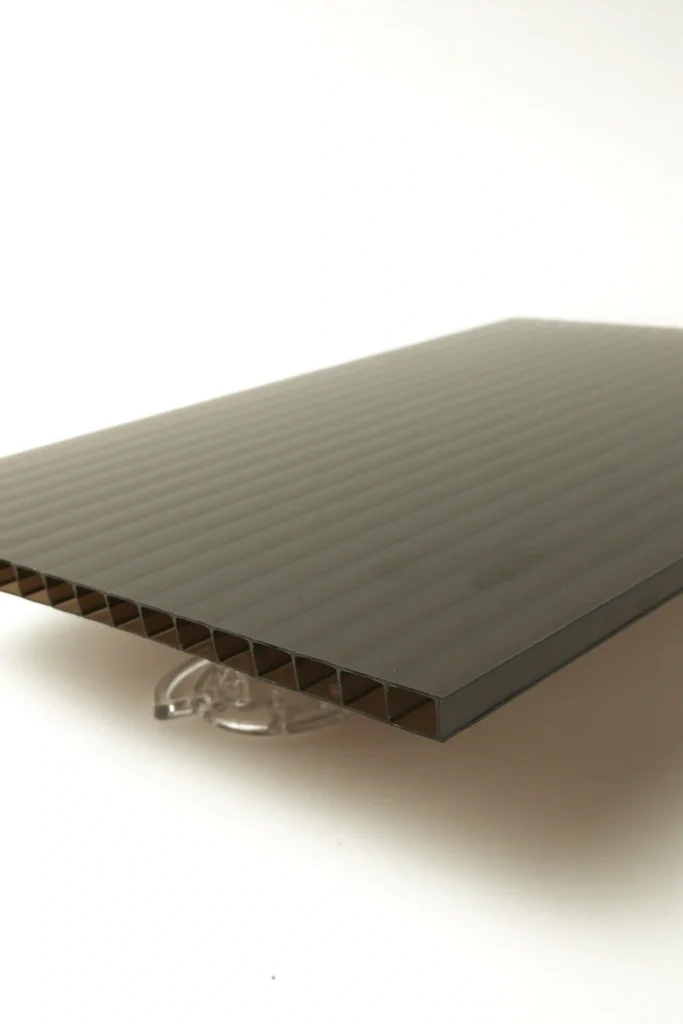
Color has a minor but real effect on price:
- Clear — standard and usually most economical; maximum light transmission
- Opal (white) — similar price to clear; used for light diffusion and heat control
- Bronze — popular for shading; same or slight premium over clear
- Blue / Green / Grey (tinted) — standard tints, minor or no surcharge in bulk
- Custom / RAL-matched — may carry a small premium for dedicated production runs
For most standard colors (clear, opal, bronze), price stays within $2.50–3.50/kg. Only custom RAL matching or unusual tints add a modest surcharge.
How Coatings & Special Properties Affect Price
Beyond the base sheet, several added properties change the polycarbonate sheet price — usually a small premium over the standard rate:
- UV protection — co-extruded UV layer (one or both sides). Standard on quality sheets; double-sided may add a slight premium but is essential outdoors.
- Anti-scratch (hard coat) — surface coating for high-traffic or public installations; adds a premium for extra processing.
- Anti-drip / anti-condensation — interior coating for greenhouses that channels condensation away; small premium, protects crops and clarity.
- Anti-fog — for skylights and enclosures where condensation clouds the surface.
- Flame-retardant (fire-rated) — grades meeting stricter fire standards; higher price due to specialized formulation.
- Custom colors / RAL matching — tinted or matched colors for large orders may carry a minor surcharge.
- Custom sizes — non-standard dimensions or extra-thick sheets are quoted individually.
Specify only what your project needs, so you don’t pay for coatings you won’t use.
Factors That Affect Polycarbonate Sheet Price
- Order volume — bulk and container orders earn discounts of 10–25%; larger orders mean lower per-kg rates
- Raw material market — resin prices fluctuate with crude oil, feedstock (BPA), and regional supply — the biggest external driver
- Shipping terms — FOB, CIF, CFR, or EXW change landed cost; FOB is the export baseline
- Destination and freight — distance to port affects CIF/landed pricing
- Manufacturer vs trader — buying factory-direct removes middleman margins for the same quality
Why Buy Polycarbonate Sheets Factory-Direct?
Most listings and local distributors add a margin on top of the manufacturer’s price. Buying factory-direct wholesale changes the economics:
- No middleman margins — pay the production price, not a reseller markup
- Volume discounts — 10–25% off for bulk and container orders, extra incentives for annual contracts
- Custom specs — exact thickness, size, color, and coatings
- Consistent quality — ISO and CE certified, 100% virgin raw material, 10-year warranty
As a direct manufacturer, G-Crystal supplies polycarbonate sheets at $2.50–3.50/kg FOB, exporting to 60+ countries — including the UAE and Kenya — with quotations returned within 24 hours.
How to Verify a Supplier Before You Order
The resin market sets a floor that no manufacturer can go below. Virgin polycarbonate resin trades at $2.10–2.30/kg in Asia and up to $3.46/kg in Europe — that is raw material alone, before extrusion, UV coating, packaging or margin.
A finished sheet quoted below the cost of its own raw material is not made from virgin resin.
Three questions that expose the difference
1. What is the resin source?
A manufacturer using virgin material will name the supplier without hesitation. Vague answers about “high-quality imported resin” usually mean regrind.
2. How is the UV protection applied?
Co-extruded UV is fused into the sheet during production and lasts the life of the panel. Sprayed or surface-applied UV wears off — the sheet yellows within 12–18 months regardless of what the label claims.
3. What is the declared weight per m²?
Compare it against the theoretical figure (thickness × 1.2 for solid). If the actual weight is lower, the real thickness is below nominal — you are paying for material that was never in the sheet.
Documents to request before committing
- Technical data sheet with declared resin origin
- UV application method stated in writing
- ISO 9001, ISO 14001, ISO 45001 and CE certification
- Written warranty against yellowing, with a defined term
- Declared weight per m² for the exact specification quoted
A supplier who cannot produce all five is not selling the same product, whatever the price suggests.
How to Get an Accurate Price Quote
Send us these details for a precise quote fast:
- Sheet type (solid, twin-wall, multiwall, corrugated, embossed)
- Thickness (e.g. 4mm, 6mm, 10mm)
- Dimensions (standard 2.10 × 5.80 m or custom)
- Color (clear, opal, bronze, custom)
- Coatings (UV both sides, anti-scratch, anti-drip, fire-rated)
- Quantity and destination port
Our sales team responds within 24 hours with a detailed FOB quotation.
📞 Request your price now: +2 01095990442 | ✉️ info@gcrystal-pc.com
Summary
The polycarbonate sheet price ranges from $2.50 to $3.50 per kg (FOB) for standard sheets, calculated by weight — roughly $7–36 per m² for solid sheets depending on thickness. Solid sheets carry the highest material cost; hollow twin-wall and multiwall cover more area per kg. Thickness raises price directly, standard colors stay within range, and specialty coatings (UV, anti-scratch, anti-drip, fire-rated) add a small premium for real value. To lower cost without sacrificing quality, buy factory-direct in bulk from a certified manufacturer.
Frequently Asked Questions
How much does a polycarbonate sheet cost?
Standard polycarbonate sheets cost $2.50 to $3.50 per kg (FOB), or roughly $7–36 per m² for solid sheets depending on thickness. Price varies by type, color, coatings, and order volume.
How do I convert polycarbonate price per kg to per m²?
Multiply the thickness (mm) by density (1.2) to get weight per m², then multiply by the price per kg. Example: 4mm × 1.2 = 4.8 kg/m² × $3 = $14.40/m².
Why is polycarbonate priced per kilogram?
Because pricing by weight reflects actual material used. Weight comes from dimensions, thickness, and density (1.2 g/cm³) — the fairest, most transparent method.
Does UV or anti-scratch coating increase the price?
Yes, slightly. Coatings like anti-scratch, anti-drip, anti-fog, and fire-rated add a small premium over the standard rate for extra processing and value.
Does color affect polycarbonate sheet price?
Standard colors (clear, opal, bronze, tints) stay within the normal range. Only custom RAL-matched or unusual colors add a modest surcharge.
Is there a minimum order for wholesale pricing?
Yes. We offer FOB pricing for bulk orders with flexible container-loading and discounts of 10–25% for larger quantities.
Which polycarbonate type is cheapest?
Per kg, prices are similar, but hollow twin-wall sheets often cost least per m² of coverage because they weigh less than solid — ideal for large roofs and greenhouses.
How much does a full container of polycarbonate cost?
A 20 ft container holds up to 28 tonnes. At $3.00/kg that is around $84,000 FOB, covering roughly 5,833 m² in 4 mm solid. Hollow sheets cover far more area per container but reach the volume limit before the weight limit.
What is the HS code for polycarbonate sheets?
392061 — used for customs classification and determining import duty in most countries. Duty rates vary by destination.
Why does the same quote look different from two suppliers?
Usually the Incoterm. An EXW price excludes export clearance, freight and insurance, which a CIF price includes. Bring both quotes to the same basis before comparing.
How can I tell if a cheap quote uses recycled material?
Compare it against current virgin resin market rates. Resin alone costs $2.10–3.46/kg depending on region — a finished sheet priced below that cannot be virgin. Request the technical data sheet and resin origin in writing.
Can I mix different sheet types in one container?
Yes, and it usually lowers your freight cost per square metre. Solid sheets reach the weight limit while hollow sheets reach the volume limit, so combining them uses both allowances of the same container.


