

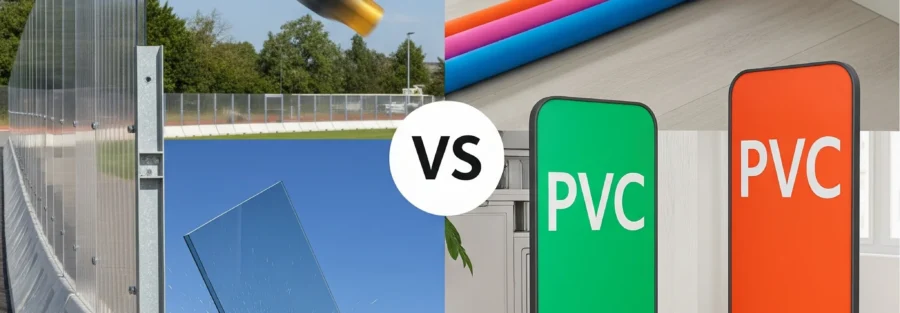
The global polycarbonate market was valued at USD 16.76 billion in 2024 and is projected to reach USD 32.40 billion by 2033 — growing more than twice as fast as the PVC sheet market. That gap reflects a real shift: across construction, roofing, signage, and greenhouses, buyers are choosing PVC vs polycarbonate based not just on price, but on performance and lifetime value. See our complete polycarbonate buyer’s guide for the full material breakdown.
This guide breaks down every key difference — with real numbers — so you can choose the material that truly fits your project.
Which is stronger, PVC or polycarbonate? Polycarbonate is significantly stronger than PVC. It offers up to 250 times the impact resistance of glass and far outperforms PVC in durability, temperature range, and outdoor life. It bends without cracking (it’s used in riot shields and unbreakable windows), while PVC can crack or shatter under strong impact — especially in cold or rigid forms. Choose PVC only when budget or specific chemical resistance outweighs the need for strength.

Understanding the Materials
What is polycarbonate?
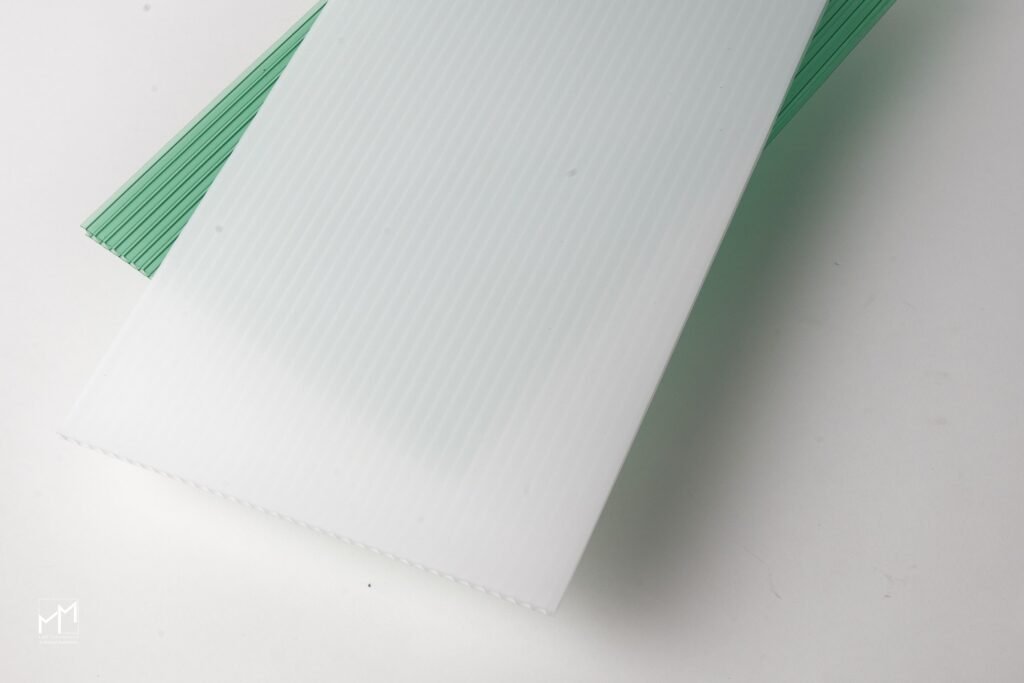
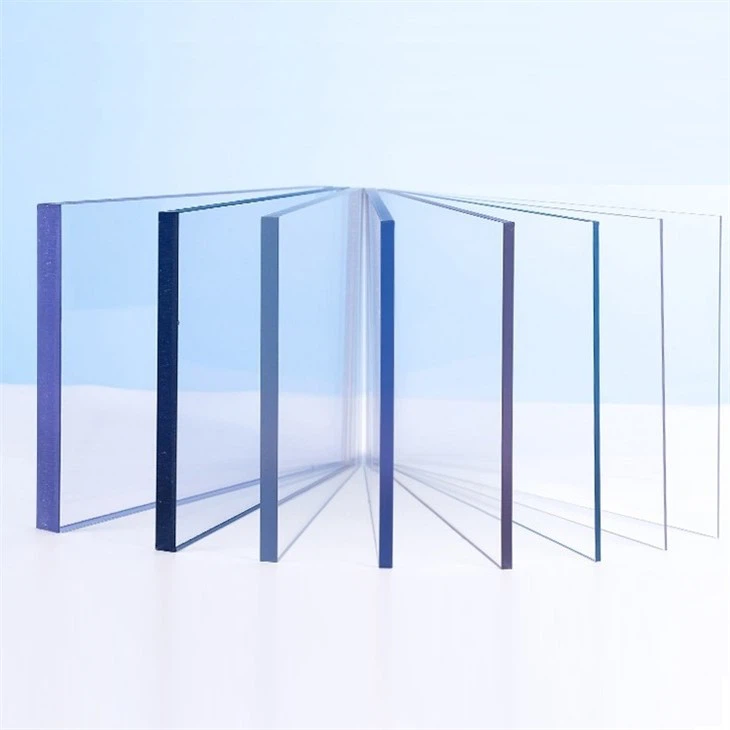
Polycarbonate is a high-performance thermoplastic known for exceptional strength, impact resistance, and optical clarity — often called “transparent steel.” It withstands roughly 250 times the impact of glass yet weighs about half as much. It can be molded, thermoformed, and cold-bent on-site, and comes as solid sheets, multiwall sheets, and corrugated panels for diverse applications.
What is PVC (Polyvinyl Chloride)?

PVC is one of the most widely produced plastic polymers globally. It can be rigid (pipes, window frames) or flexible (cables, flooring). For sheeting, PVC offers good chemical resistance, low cost, and easy processing — but it lacks polycarbonate’s strength, clarity, and temperature range, and degrades faster outdoors.
PVC vs Polycarbonate: Head-to-Head (9 Differences)
1. Impact Resistance — Polycarbonate Wins Decisively
Polycarbonate is virtually unbreakable, with up to 250× the impact resistance of glass and roughly 30× that of acrylic — far beyond PVC. Rigid PVC can crack or shatter under strong impact, especially in cold weather. This is why polycarbonate dominates impact-resistant safety glazing, machine guards, and protective barriers, while PVC stays in low-stress uses.
2. Transparency & Optical Clarity — Polycarbonate Leads
Polycarbonate delivers 88–90% light transmission, comparable to glass, ideal for windows, skylights, and displays. PVC transmits less light and often shows a yellowish tint or haze, worsening with thickness. If you’re also weighing acrylic against polycarbonate for a glazing project, clarity is where the two plastics come closest — though polycarbonate still wins on impact strength.
3. Temperature Resistance — Polycarbonate’s Wider Range
Polycarbonate performs from –40°C to 120°C. PVC becomes brittle in cold and softens or deforms at just 60–70°C. For outdoor roofing, facades, or any climate with real temperature swings, PVC simply can’t keep up.
4. Weight — Both Light, Polycarbonate Stronger Per Weight
Both weigh far less than glass (about half), easing transport and installation. But polycarbonate’s superior strength-to-weight ratio means a thinner polycarbonate sheet can outperform a thicker PVC one — saving on framing and handling.
5. Cost — PVC Wins Upfront, Polycarbonate Wins Long-Term
PVC is cheaper per sheet — typically 20–40% less upfront. But this is only half the story: because PVC yellows and cracks in 2–5 years outdoors while polycarbonate lasts 10–15+, the cost per year of service usually favors polycarbonate. Check our detailed price breakdown by thickness and type to model the real numbers for your project. (See the lifetime-cost breakdown below.)
6. Chemical Resistance — PVC’s Main Advantage
PVC has excellent resistance to many acids, alkalis, and salts, making it strong for chemical tanks and piping. Polycarbonate resists many chemicals but is vulnerable to strong solvents and alkalis. For aggressive chemical exposure, PVC can be the better pick — one of its few clear wins.
7. Scratch Resistance — Polycarbonate Needs a Coating
Bare polycarbonate is softer and scratches more easily, but hard-coated scratch-resistant grades solve this for high-traffic surfaces. Standard PVC also scratches, so for demanding surfaces, coated polycarbonate wins.
8. Fire Safety — Polycarbonate Self-Extinguishes
Polycarbonate is typically self-extinguishing — it chars and stops burning once the flame source is removed, and carries a B1 fire rating in many grades. PVC can be flammable and releases more smoke, though fire-rated grades exist. For fire-compliance projects, polycarbonate is generally safer.
9. UV Resistance — Polycarbonate Excels with Treatment
Untreated polycarbonate can yellow, but sheets with a co-extruded UV protection layer block up to 99.9% of UV and resist yellowing for 10–15 years. PVC degrades and embrittles under UV unless specially stabilized — and even then, its outdoor life is shorter. For projects where solar heat gain matters as much as UV, tinted polycarbonate sheets add color control without sacrificing this protection.
Matching Thickness — Why “Same Thickness” Isn’t a Fair Comparison
When comparing quotes, buyers often assume a 6mm PVC sheet and a 6mm polycarbonate sheet are equivalent — they’re not. Because polycarbonate carries roughly 250× the impact resistance of glass at the same thickness (versus PVC’s much lower rating), a thinner polycarbonate sheet frequently matches or beats a thicker PVC sheet on structural performance. In practice, this means a 4mm solid polycarbonate sheet can outperform a 6–8mm PVC sheet in impact and load-bearing applications — while weighing less and costing less to ship. When you’re quoting a project, ask your supplier to compare sheets by performance requirement, not by matching millimeter-for-millimeter; otherwise you may be overpaying for PVC thickness that still underperforms a lighter polycarbonate spec.
PVC vs Polycarbonate: Full Comparison Table
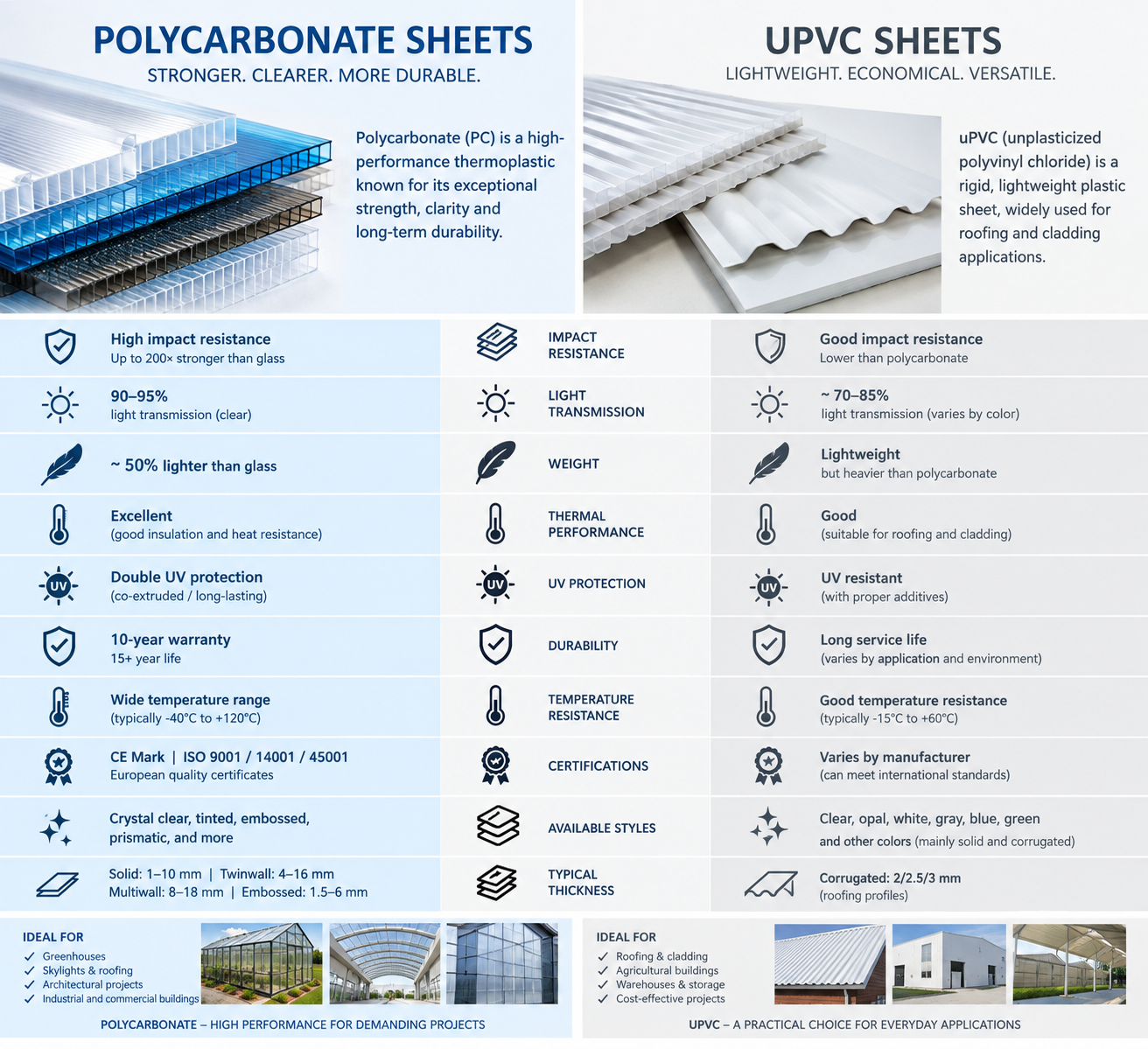
| Feature | Polycarbonate (PC) | PVC |
|---|---|---|
| Impact Resistance | Excellent (250× glass, unbreakable) | Good (cracks when rigid/cold) |
| Transparency | High (up to 90%) | Good (slight tint/haze) |
| Temperature Range | Wide (–40°C to 120°C) | Narrow (–15°C to 70°C) |
| Weight | Light (stronger per weight) | Light |
| Upfront Cost | Higher | Lower |
| Lifetime Cost | Lower (lasts 10–15+ yrs) | Higher (replace every 2–5 yrs) |
| Chemical Resistance | Good (weak vs strong solvents) | Very good (acids, alkalis) |
| Scratch Resistance | Poor (excellent with hard coat) | Moderate to poor |
| Fire Safety | Self-extinguishing | Flammable (FR grades exist) |
| UV Resistance | Excellent with UV coating | Moderate (degrades untreated) |
| Flexibility | Excellent (cold-formable) | Good (needs heat to shape) |
| Outdoor Lifespan | 10–15+ years | 2–5 years (clear PVC) |
The True Cost: Why Cheaper PVC Can Cost More
Upfront price tells only part of the story. Consider a simple outdoor roofing example over 15 years:
- Clear PVC — lower sheet cost, but yellows and cracks in ~3–5 years. Over 15 years you may replace it 3–4 times, plus repeated labor and disposal.
- UV polycarbonate — higher sheet cost, but one installation lasts the full 15 years with its 10-year warranty.
Once you factor in replacement sheets, repeated installation labor, and downtime, the “expensive” polycarbonate often costs less per year of service than the “cheap” PVC. Run your own numbers with our price and container calculator — for any permanent, sun-exposed structure, this lifetime math is the single most important number, and it’s why professional contractors and importers standardize on polycarbonate.
Is PVC Better Than Polycarbonate?
No — PVC is not better than polycarbonate for most demanding applications. Polycarbonate outperforms PVC on impact resistance, clarity, temperature range, fire safety, and outdoor durability. PVC’s only real advantages are lower upfront cost and superior resistance to certain acids and alkalis. For any project involving impact, sunlight, heat, or safety, polycarbonate is the stronger, longer-lasting, and often more economical choice over time.
PVC vs Polycarbonate for Greenhouses
For greenhouses, polycarbonate is far superior to PVC. Twin-wall and multiwall polycarbonate diffuse light evenly to reach every leaf, insulate well enough to cut heating costs 30–50%, block harmful UV while protecting plants, and last 10–20 years without yellowing. PVC sheeting yellows, embrittles, and cracks within a few seasons under constant sun — forcing costly replacement cycles that eat into any upfront saving. Serious and commercial growers choose polycarbonate; our full polycarbonate greenhouse panels guide covers thickness and color selection in detail.
PVC vs Polycarbonate Roofing
For roofing, polycarbonate outlasts and outperforms PVC. Polycarbonate roofing shrugs off hail, storms, and debris, handles –40°C to 120°C, and stays clear for 10–15+ years thanks to UV protection. Clear PVC roofing is cheaper upfront but yellows, embrittles, and cracks within 2–5 years — meaning multiple replacements over a roof’s life. For canopies, skylights, walkways, and industrial roofs, polycarbonate is the long-term winner. Learn more in our polycarbonate roofing sheets guide.
When to Choose Each Material
Choose polycarbonate when:
- Impact resistance or safety from shattering is critical
- High clarity and light transmission matter (skylights, glazing, displays)
- The material faces wide temperature swings or direct outdoor sun
- Design flexibility (cold bending, curves) is required
- Roofing, greenhouses, or any long-term outdoor use — where lifetime cost matters
Browse our full range of polycarbonate sheets to compare all types side by side.
Choose PVC when:
- Budget is the single overriding constraint
- Strong chemical resistance to acids/alkalis is essential (tanks, piping)
- The application is indoor, low-impact, and away from extreme heat
- Basic durability for non-critical use is enough
The Verdict
The PVC vs polycarbonate decision isn’t about one being universally better — it’s about matching the material to the job and the timeframe. Polycarbonate consistently wins on impact, clarity, temperature range, fire safety, and outdoor durability, and usually on lifetime cost — making it the choice for high-performance, safety-critical, roofing, and greenhouse projects. PVC remains a valid low-cost option for indoor, low-stress, or chemically aggressive applications. Match the material to your real requirements, and factor in lifetime cost — not just the sticker price.
Looking for the Right Polycarbonate Supplier? Trust G-Crystal
At G-Crystal Plastic Industries, we don’t just manufacture polycarbonate sheets — we engineer performance, durability, and trust. With exports to 60+ countries, CE certification, ISO 9001/14001/45001 standards, 100% virgin raw material, and a 10-year warranty, we’re the reliable partner for importers, wholesalers, and contractors worldwide — with factory-direct FOB pricing from $2.50–3.50/kg and no middleman margins.
Whether you’re specifying sheets for roofing, greenhouses, glazing, or signage, our team helps you choose the right grade and thickness, then delivers consistent bulk supply with fast international shipping.
📞 Get a free quote today: +2 01095990442 | ✉️ info@gcrystal-pc.com
Frequently Asked Questions
Which is stronger, PVC or polycarbonate?
Polycarbonate is clearly stronger — up to 250× the impact resistance of glass, bendable without cracking, and stable from –40°C to 120°C. PVC cracks or deforms more easily, especially outdoors or in cold.
Is PVC better than polycarbonate?
No. Polycarbonate outperforms PVC on impact, clarity, temperature range, fire safety, and UV durability. PVC only wins on upfront cost and certain chemical resistance.
Is polycarbonate or PVC better for a greenhouse?
Polycarbonate — it diffuses light, insulates better (cutting heating 30–50%), blocks UV, and lasts 10–20 years, while PVC yellows and cracks within a few seasons.
Which is better for roofing, PVC or polycarbonate?
Polycarbonate — it resists impact, handles extreme temperatures, and stays clear 10–15+ years, while clear PVC yellows and cracks in 2–5 years.
Is polycarbonate more expensive than PVC?
Upfront, yes. But because polycarbonate lasts far longer outdoors, its cost per year of service is usually lower — making it cheaper over the life of the project.
Can polycarbonate replace PVC?
In most structural, roofing, glazing, and outdoor uses, yes — polycarbonate is a stronger, longer-lasting upgrade. PVC remains preferable mainly for low-cost indoor or chemically aggressive applications.


