

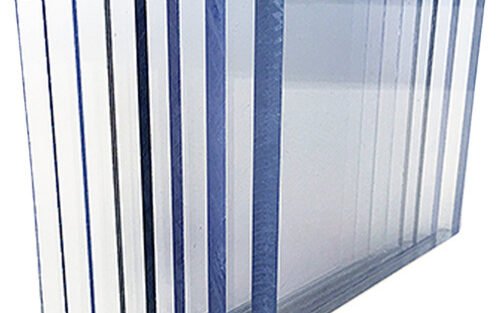
Polycarbonate sheet replaces glass wherever breakage, weight or installation cost is the real problem: roofs and skylights, canopies, security glazing, schools, sports halls, greenhouses and machine guards. It is not the right choice where a surface is scrubbed daily, where perfect long-term optics matter, or where fire-rated glazing is required. This guide gives you the numbers behind that answer, the right sheet and thickness for each application, and the installation rules that decide whether a polycarbonate project lasts.
Updated October 2026 · Reviewed by the technical team at G-Crystal Plastic Industries, polycarbonate sheet manufacturer.
In short:
- Polycarbonate takes 250 times the impact of glass at half the weight.
- It is the right glass alternative for skylights, roofs, canopies, security glazing, schools, greenhouses and machine guards.
- Glass still wins on surfaces scrubbed daily, display windows and fire-resistant glazing.
- Success depends on installation: about 3 mm of expansion clearance per metre and the UV side facing the sun.
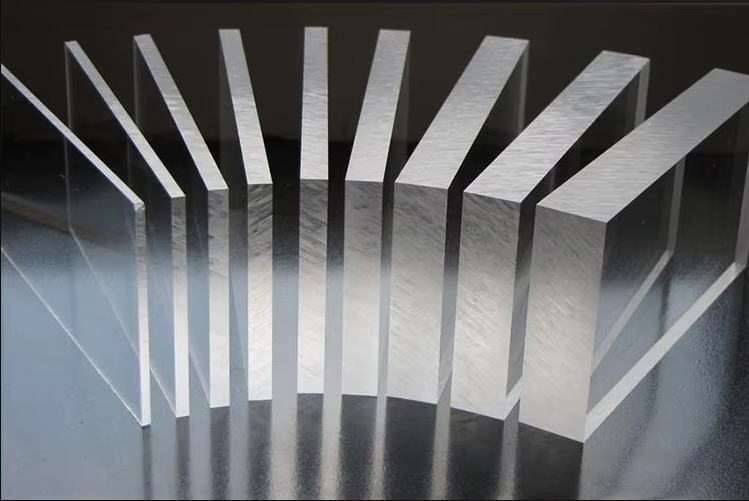
Polycarbonate vs glass at a glance
The table compares clear solid polycarbonate with ordinary float glass of similar thickness. Polycarbonate values come from G-Crystal’s technical data sheets; glass values are typical industry figures. For a deeper side-by-side, see polycarbonate sheet vs glass.
| Property | Solid polycarbonate | Float glass |
|---|---|---|
| Impact resistance | 250× glass, 30× acrylic (G-Crystal TDS) | Brittle; breaks into sharp shards |
| Density | 1.20 g/cm³ | About 2.5 g/cm³ |
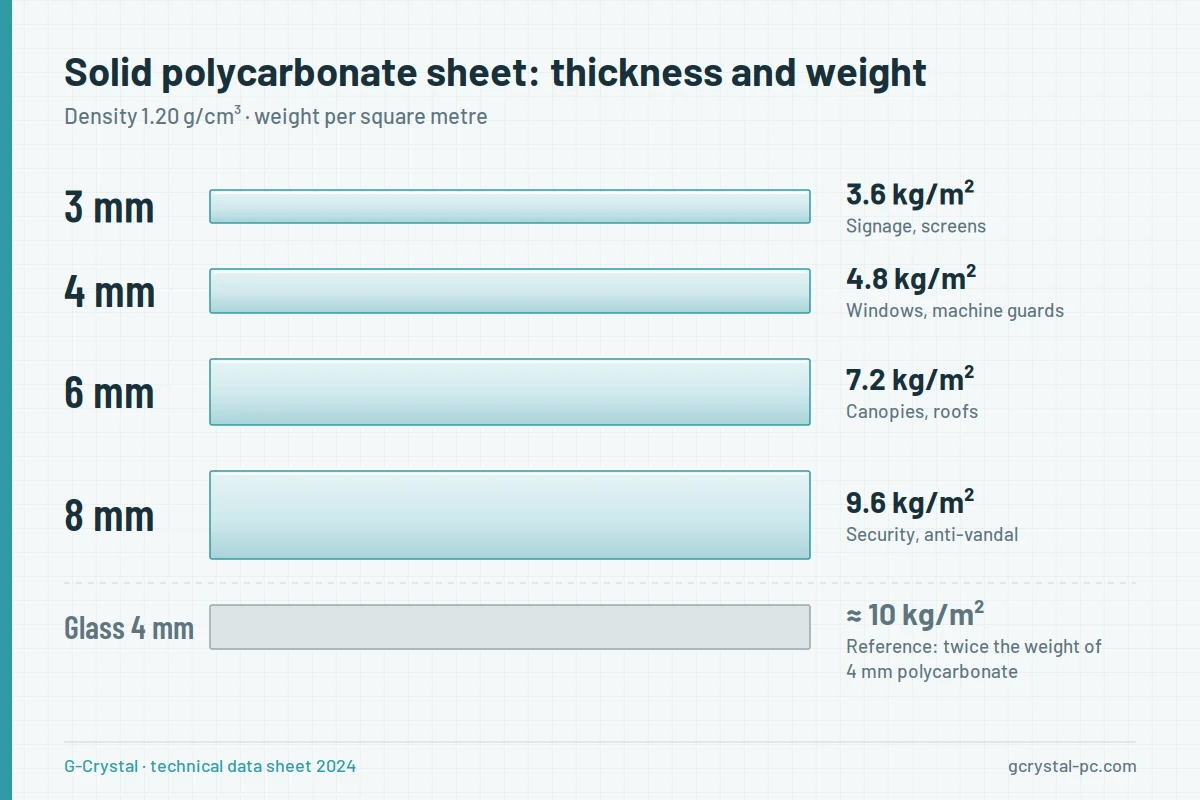
| Weight of a 4 mm sheet | About 4.8 kg/m² | About 10 kg/m² |
| Light transmission, clear 4 mm | 88–92% (G-Crystal TDS) | About 89–90% |
| U-value, single 4 mm sheet | About 5.3 W/m²K | About 5.8 W/m²K |
| Thermal expansion | 0.068 mm/m·°C (6.8 × 10⁻⁵ /°C) | About 0.009 mm/m·°C |
| Stiffness (elastic modulus) | About 2.3 GPa | About 70 GPa |
| Continuous service temperature | −40 °C to +120 °C | Far higher |
| Surface hardness | Soft; scratches without a hard-coat | Very hard |
| Can be cold-bent on site | Yes, within the minimum radius | No |
Two rows decide most projects. Impact resistance is why polycarbonate wins. Stiffness and expansion are why it fails when it is installed like glass.
Why the “times stronger than glass” number keeps changing
You will see 100×, 200×, 250× and even 290× in different catalogues. None of them is wrong, because none of them measures the same thing.
The figure comes from impact tests, and the result depends on the test method, the sheet thickness, the type of glass used for comparison and the temperature. Thin annealed glass breaks at very low energy, so the ratio against it is high. Toughened glass absorbs far more energy, so the ratio drops.
For a buyer, the useful point is simpler: at the same thickness, solid polycarbonate is practically unbreakable in normal building use, while glass is not. If an impact figure matters for your specification, ask the supplier for the test standard and the thickness behind it. G-Crystal’s technical data sheet states 250 times the impact strength of glass and 30 times that of acrylic, and the sheet does not break in the Charpy unnotched impact test.
Polycarbonate vs tempered and laminated safety glass
When impact matters, nobody compares polycarbonate with ordinary float glass. The real choice is between polycarbonate and safety glass, either tempered (toughened) or laminated. Each one fails in a different way, and that difference usually decides the specification.
| Tempered glass | Laminated glass | Solid polycarbonate | |
|---|---|---|---|
| What it is | Heat-treated glass, about 4–5 times stronger than ordinary glass | Two or more glass layers bonded with a plastic interlayer, usually PVB | A single thermoplastic sheet |
| Under heavy impact | Shatters completely into small, blunt granules | Cracks, but the pieces stay stuck to the interlayer | Does not break (no break in the Charpy test, G-Crystal TDS) |
| After the impact | The opening is left empty | The cracked pane must be replaced | The panel stays in place; it may dent or scratch |
| Weight at 6 mm | About 15 kg/m² | About 15 kg/m² (3 + 3 mm) | 7.2 kg/m² |
| Cut or drill on site | No, only before tempering | Difficult; usually cut at the factory | Yes, with ordinary tools |
| Curved shapes | Factory-bent only | Factory-bent only | Cold-bent on site |
| Surface hardness | Very hard | Very hard | Soft; scratches without a hard-coat |
A practical rule:
- Tempered glass for doors, shower screens and shopfronts that are cleaned often, need perfect optics and rarely take impacts.
- Laminated glass for overhead glazing, balustrades and façades where the code requires glass and the pane must stay in place after it breaks.
- Polycarbonate where impacts are frequent or costly (schools, sports halls, public buildings, hail zones), where weight and transport matter, and where sheets must be cut, drilled or curved on site.
Many building codes require certified safety-glazing classes for doors, low-level glazing and overhead glazing. Check the local requirement and the product’s test certificate before substituting one material for another.
Where polycarbonate should replace glass
The table matches each application with the sheet type and thickness range most projects use. Final thickness depends on span, wind and snow load, and frame design.
| Application | Recommended sheet | Typical thickness | Why it beats glass here |
|---|---|---|---|
| Skylights and roof glazing | Multiwall, or solid with UV side up | 6–10 mm multiwall, 3–6 mm solid | Hail and falling objects; half the structural load |
| Canopies, walkways, car parks | Solid or embossed | 3–6 mm | No shard risk overhead; easy curved shapes |
| Security and anti-vandal glazing | Solid clear | 4–8 mm (up to 10 mm for high risk) | Does not shatter; stays in the frame |
| Schools, sports halls, stadiums | Solid clear | 4–6 mm | Ball and impact resistance |
| Greenhouses | Twin-wall or multiwall | 4–10 mm | Insulation plus diffused light; hail resistance |
| Machine guards and industrial screens | Solid clear | 4–6 mm | Operator safety; easy to drill and cut |
| Partitions and privacy screens | Embossed (crystal, prismatic) or frosted | 2–5 mm | Light through, view blocked, light weight |
| Signage and light boxes | Solid opal | 2–3 mm | Even light diffusion; survives transport |
In hot climates there is a second reason. A 2023 study in the International Journal of Sustainable Energy simulated a residential building and found that 16 mm multiwall polycarbonate cut annual cooling energy by 35% in wall glazing and 44% in skylights, compared with 3 mm single clear glass. For projects in the Gulf, North Africa and Sub-Saharan Africa, that is a running-cost argument, not only a safety one.
Site conditions in Africa and the Gulf
Most polycarbonate guides are written for European or North American weather. Projects in Nigeria, Kenya, Ghana, the Gulf and North Africa face different conditions, and each one changes the specification.
Heat and strong sun. In the Gulf, the Sahel and northern Nigeria, a co-extruded UV layer is not optional. Bronze or opal sheets cut glare and heat gain under roofs and skylights. Large day–night temperature swings make the expansion clearance described below even more important. G-Crystal sheets are rated for continuous service up to +120 °C, well above any roof temperature in these climates.
Dust, sand and harmattan. The dry harmattan wind across West Africa and sandstorms in the Gulf carry abrasive particles that scratch smooth surfaces. Embossed textures such as crystal and prismatic hide fine scratches, and a hard-coated grade helps on exposed vertical glazing. Always rinse with plenty of water before wiping, never dry-wipe dust off the sheet.
Heavy rain and humidity. In coastal cities such as Lagos, Accra or Mombasa, give roofs enough slope to drain, close multiwall flutes with suitable tape and profiles so dirt and moisture stay out, and use UV-resistant EPDM gaskets.
Security. For ground-floor windows, kiosks and guard houses on urban sites, use solid sheet of 6–10 mm in a robust frame. It stays in place where glass would leave an open hole.
Logistics. Sheets often travel hundreds of kilometres inland after the port. Half the weight of glass and no breakage in transit make a measurable difference to landed cost.
From the factory: G-Crystal technical data
The polycarbonate figures in this guide come from the technical data sheets (TDS) of our three production lines in Egypt. Where the TDS is silent (U-value and cold-bending radius), we use standard industry values and say so in the text:
| Property | Solid | Twin-wall / multiwall | Embossed |
|---|---|---|---|
| Thickness | 1–10 mm | Up to 10 mm | 1.5–6 mm |
| Light transmission | 88–92% | 82–88% | 88% (clear) |
| Sizes | Custom | Custom | 2,100 × 5,800 mm |
| Surface | Smooth | Twin-wall cells | Crystal, prismatic and Diva |
All three lines share the rest: no break in the Charpy unnotched impact test, service from −40 °C to +120 °C, a co-extruded UV layer on one or both sides, and nine colours (clear, bronze, blue, orange, green, yellow, turquoise, opal and red). They are self-extinguishing and fire-rated B1 (DIN 4102) and UL 94 V-2, carry a 10-year limited warranty, and are produced under ISO 9001, ISO 14001 and ISO 45001 with CE marking.
One thing you only see from the plant floor: most complaints a manufacturer receives are not about the sheet but about how it was installed. That is why the installation section below matters as much as the product choice.
Where glass is still the better choice
A supplier who tells you polycarbonate is better everywhere is not helping your project. Choose glass, or a glass system, in these cases:
- Surfaces cleaned hard and often. Shop fronts, counters and doors that are wiped with abrasive pads will scratch. A hard-coated polycarbonate grade narrows the gap but does not close it. Ask your supplier whether a hard-coated grade is available.
- Perfect optics for decades. Display windows and view glazing where any haze is unacceptable stay with glass.
- Fire-rated glazing. G-Crystal sheets are self-extinguishing and classified B1 (DIN 4102) and UL 94 V-2, but that is a reaction-to-fire class, not fire-resistant glazing. Where a code calls for fire-resistant glass, use it.
- Very high temperatures. Near ovens, furnaces or permanent heat sources above 120 °C (its maximum service temperature), polycarbonate loses stiffness.
- Solvent exposure. Polycarbonate is attacked by aromatic hydrocarbons, ketones, esters, chlorinated solvents and ammonia-based cleaners.
- Large spans without extra support. With roughly 1/30 of the stiffness of glass, a polycarbonate sheet of the same thickness deflects much more. Large panes need a thicker sheet, a multiwall structure or closer supports.
What about acrylic (plexiglass)?
Acrylic, also sold as plexiglass or PMMA, is the other common glass substitute. It is slightly clearer than polycarbonate, usually cheaper, and more resistant to scratching. But G-Crystal’s TDS puts polycarbonate at 30 times the impact strength of acrylic, and acrylic tends to crack when it is drilled near the edge or bent cold. Use acrylic for indoor displays, signage and decoration. Use polycarbonate for roofs, security glazing, hail and wind. See the full comparison in plexiglass vs polycarbonate.
Choosing the right polycarbonate sheet
Three decisions cover most specifications. For the full range by type, thickness and use, see our guide to polycarbonate sheet types, thicknesses and prices.
Solid or multiwall. Solid polycarbonate sheet looks most like glass and gives the highest impact resistance per millimetre. Twin-wall and multiwall sheet traps air in its cells, so it insulates far better and weighs less per square metre, but you do not see clearly through it. Use solid where people need to see through the panel. Use multiwall for roofs, skylights and greenhouses where light matters more than view.
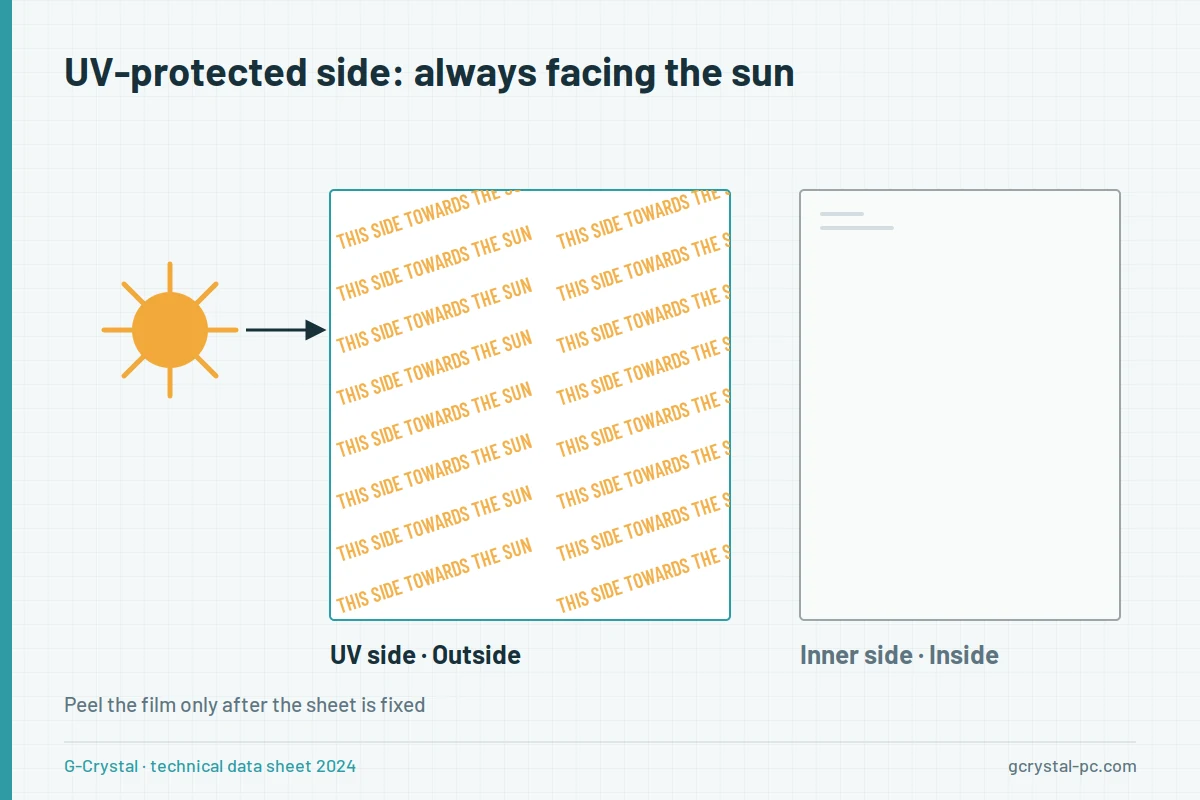
UV protection. Unprotected polycarbonate yellows and becomes brittle in sunlight. Outdoor sheet needs a UV-resistant layer on the exposed face, ideally co-extruded so it cannot peel. Install with the marked UV side facing the sun. G-Crystal sheets carry a co-extruded UV layer on one or both sides and a 10-year limited warranty against defects in material and workmanship.
Colour and texture. Clear gives maximum light. Opal and frosted diffuse light and hide what is behind. Tinted polycarbonate in bronze cuts glare and heat gain; blue, green and other colours are available for design projects. Embossed textures such as crystal and prismatic give privacy while letting light through, and they hide small scratches better than a smooth sheet.
Installing polycarbonate is not installing glass
Most polycarbonate failures are installation failures. These rules matter more than the sheet itself.
Leave room for expansion. Polycarbonate expands more than seven times as much as glass (6.8 × 10⁻⁵ /°C). A 2 m sheet that sees a 50 °C swing between night and midday grows by about 6.8 mm. A common rule is to allow around 3 mm of clearance per metre of sheet length and width inside the frame, and to drill screw holes larger than the screw so the sheet can move.
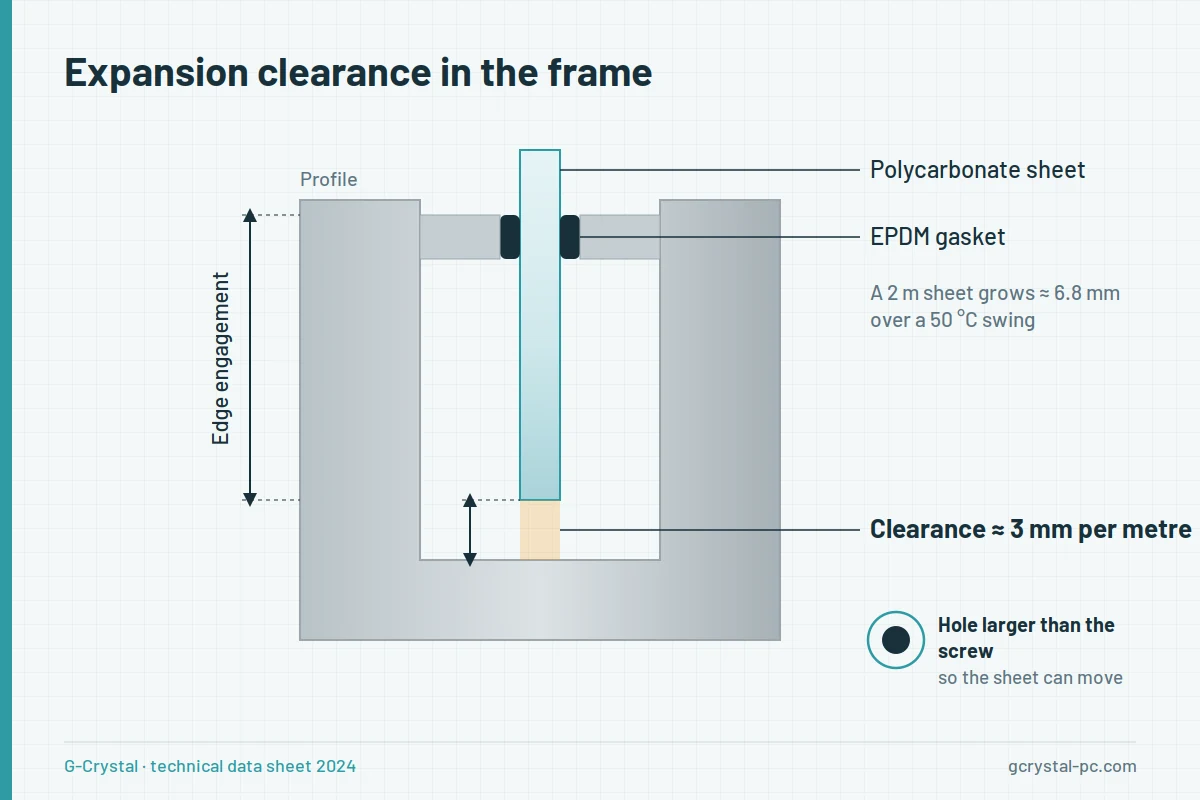
Give the frame enough depth. Because the sheet flexes more than glass, the edge needs deeper engagement in the frame so it cannot pull out under wind load. Follow the supplier’s span and rebate tables for your thickness.
Use compatible materials. Use EPDM gaskets and neutral-cure silicone approved for polycarbonate. Avoid PVC gaskets with plasticisers and solvent-based sealants, which can cause stress cracking.
Bend cold, not hot. Polycarbonate can be bent into arches on site without heating, down to a minimum radius that depends on thickness and type. Going tighter creates permanent stress. As a rule of thumb, the minimum radius is about 150 times the thickness for solid sheet and 175 times for multiwall (for example, 600 mm for 4 mm solid); confirm it on the datasheet.
Keep the film on until the end. Remove the protective film only after fixing, and never leave it in the sun for weeks or it bonds to the surface.
Clean gently. Mild soap, lukewarm water and a soft cloth. No abrasive pads, no ammonia and no solvents.
For cutting and drilling on site, see our guide on how to cut polycarbonate sheets.
Cost: compare the whole project, not the square metre
Per square metre, ordinary float glass is often cheaper than solid polycarbonate. That is the wrong comparison when impact matters. The fair comparison is with toughened or laminated safety glass, and there polycarbonate is frequently competitive.
The larger savings sit outside the sheet price:
- Lighter structure. Half the weight per millimetre means lighter frames and supports.
- Cheaper transport. More square metres per container and fewer losses from breakage in transit.
- Faster installation. Sheets are cut and drilled on site with ordinary tools.
- Fewer replacements. Vandalism, hail and accidental impacts stop being recurring costs.
For current price levels by thickness and type, see polycarbonate sheet price per kg and per m².
How to specify and source polycarbonate for a project
If you are a contractor, distributor or importer, ask every supplier for the same information so you can compare offers fairly:
- Resin: 100% virgin polycarbonate or blended with recycled material
- UV protection: method, layer thickness, and which faces are protected
- Warranty: years, what it covers (yellowing, light loss, breakage) and in writing
- Light transmission certified for each thickness and colour
- Thickness tolerance and weight per m², since a lighter sheet at the same nominal thickness is thinner
- Reaction-to-fire classification and the test report
- Packaging, protective film marking, and container loading per thickness
- Lead time, minimum order and available sizes
G-Crystal provides all eight items in writing with every quotation. Factory contact details are at the end of this guide.
Frequently asked questions
Is polycarbonate cheaper than glass? It is usually more expensive than ordinary float glass per square metre, and often competitive with toughened or laminated safety glass. Lighter structures, cheaper transport and fewer breakages usually make the total project cost lower.
Does polycarbonate turn yellow? Unprotected polycarbonate yellows in sunlight. Sheets with a co-extruded UV layer, installed with the UV side facing out, keep their clarity for many years. Check the written warranty for the exact period.
Does polycarbonate scratch more easily than glass? Yes. Its surface is much softer. Use hard-coated grades for high-contact areas, embossed textures where small marks should not show, and clean only with soft cloths and mild soap.
Can polycarbonate be used for windows? Yes, especially where breakage or vandalism is a risk. Use solid clear sheet, allow expansion clearance in the frame, and choose a thicker sheet or extra supports for large panes.
Is polycarbonate bulletproof? Standard sheets are highly impact resistant but not bullet resistant. Bullet-resistant glazing uses certified multi-layer laminates tested to specific standards.
Does polycarbonate insulate better than glass? Solid sheet insulates slightly better than single glass of the same thickness. Multiwall sheet insulates much better because of the air in its cells.
How long does polycarbonate last outdoors? With a proper UV layer and correct installation, outdoor sheets typically last 10 years or more. G-Crystal backs its solid, multiwall and embossed sheets with a 10-year limited warranty.
G-Crystal: polycarbonate glass alternative direct from the factory
What you get when you request a quote:
- A sheet type and thickness recommendation for your application, span and climate
- The technical data sheet and the 10-year limited warranty in writing
- Custom sizes in solid and multiwall sheet
- Profiles and installation accessories in the same order
- FOB or CIF pricing to your port, for example Lagos, Mombasa or Jebel Ali
To estimate quantities before you write, try our polycarbonate container price calculator.
Contact the factory: WhatsApp +20 109 599 0442 · info@gcrystal-pc.com. Tell us the application, approximate quantities and destination port.
Sources
- G-Crystal technical data sheets (TDS): solid, hollow and embossed polycarbonate sheets, 2024 edition
- Mohammed, Menkabo and Budaiwi, “Assessment of polycarbonate material as a sustainable substitute for glazing in hot climates”, International Journal of Sustainable Energy, 2023


