

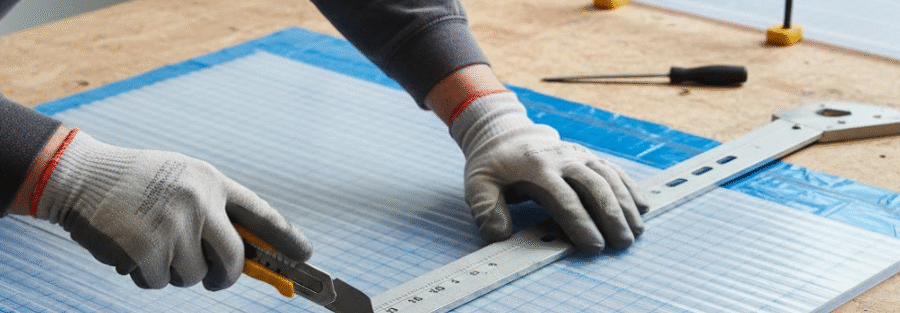
Polycarbonate sheets cut cleanly with tools most workshops already own — but the material punishes two mistakes: cutting too fast, which melts the edge back together behind the blade, and removing the protective film early, which leaves permanent scratches.
This guide to how to cut polycarbonate sheets covers the four methods that work, matched to thickness and sheet structure, plus the specific technique for cutting Lexan and hollow twin-wall panels.
📞 Need sheets cut to size instead? We produce to your exact dimensions at the factory. +2 01095990442

Quick Answer: Which Method for Which Sheet
| Sheet | Thickness | Best method |
|---|---|---|
| Solid | up to 3 mm | Utility knife — score and snap |
| Solid | 3–12 mm | Circular saw, fine-tooth (60T+) |
| Solid | curves, cut-outs | Jigsaw, fine metal blade |
| Twin-wall / multiwall | any | Circular saw or jigsaw, cut along the flutes |
| Any | 1–2 sheets, no power tools | Utility knife or fine-tooth hand saw |
The two rules that apply to every method: keep the protective film on, and cut slowly enough that the blade produces chips rather than melted strings.
Tools You Need to Cut Polycarbonate Sheets

For scoring: a sharp utility knife with fresh blades, a straight edge or metal ruler, and clamps.
For sawing: a circular saw with a fine-tooth blade — 60 teeth or more for a 185 mm blade. A blade designed for aluminium or laminate works well. Standard wood blades have too few teeth and will chip the edge.
For curves: a jigsaw with a fine-tooth metal-cutting blade, set to zero or minimal orbital action.
Also useful: clamps, safety glasses, dust mask, fine sandpaper (240–400 grit) for deburring, and compressed air for hollow sheets.
What not to use: wood blades with coarse teeth, angle grinders, tin snips on sheets above 1 mm, and any blade with a large hook angle — these grab the material and crack it.
Method 1: Score and Snap (up to 3 mm)
The fastest method for thin solid polycarbonate sheets, and the one that needs no power tools.
- Mark the cut line on the protective film, not the sheet.
- Clamp a straight edge firmly along the line.
- Score deeply with a sharp utility knife — 5 to 7 passes, pressing firmly, always in the same direction. Aim to cut at least a third of the way through.
- Position the score line over a table edge, scored side up.
- Press down sharply on the overhanging section. The sheet snaps along the line.
- Sand the edge lightly with fine sandpaper if needed.
Why it fails: too few passes. A shallow score produces a ragged break that wanders off the line. If the snap resists, score again rather than forcing it.
Works well on our 2 mm and 3 mm solid sheets.
Method 2: Circular Saw (3 mm and above)
The standard method for straight cuts in thicker polycarbonate panels.
- Fit a fine-tooth blade — 60 teeth minimum, ideally a non-ferrous metal or laminate blade.
- Support the sheet fully on both sides of the cut. Unsupported polycarbonate vibrates and chips.
- Clamp a guide rail or straight edge for the saw base to follow.
- Set the blade depth so it protrudes only 3–5 mm below the sheet. Excess depth increases friction and heat.
- Cut at moderate speed with steady feed pressure. Let the blade do the work.
- Watch the chips. Clean flakes mean the speed is right. Melted strings or a gummy edge mean you are cutting too slowly for the blade speed, or the blade is dull.
If the edge melts: increase feed rate slightly, or reduce saw RPM if variable. Melting comes from friction, not from cutting fast.
For 4 mm, 6 mm and thicker solid sheets, this is the method to use.
Method 3: Jigsaw (curves and cut-outs)
For circles, notches and any non-straight cut.
- Use a fine-tooth metal-cutting blade — 21 TPI or finer.
- Set orbital action to zero. Orbital motion tears polycarbonate.
- Drill a starter hole for internal cut-outs, at least 10 mm diameter, positioned inside the waste area.
- Run at medium speed with light, continuous pressure.
- Support the sheet close to the cut to prevent flexing and vibration.
Curved cuts are common on domes, canopies and bendable sheeting applications.
How to Cut Polycarbonate Sheets by Hand
If you have no power tools, two approaches work.
Utility knife — the score-and-snap method above handles up to 3 mm reliably. This is the answer for most people asking how to cut polycarbonate sheets without a workshop.
Fine-tooth hand saw — a hacksaw or a Japanese pull saw with fine teeth cuts thicker sheets slowly but cleanly. Support the sheet firmly, keep the blade angle shallow, and let the saw find its own rhythm rather than forcing it.
For a single sheet or an occasional trim, hand cutting is entirely practical. For volume, a circular saw is faster and produces a straighter edge.
How to Cut Twin-Wall and Multiwall Sheets
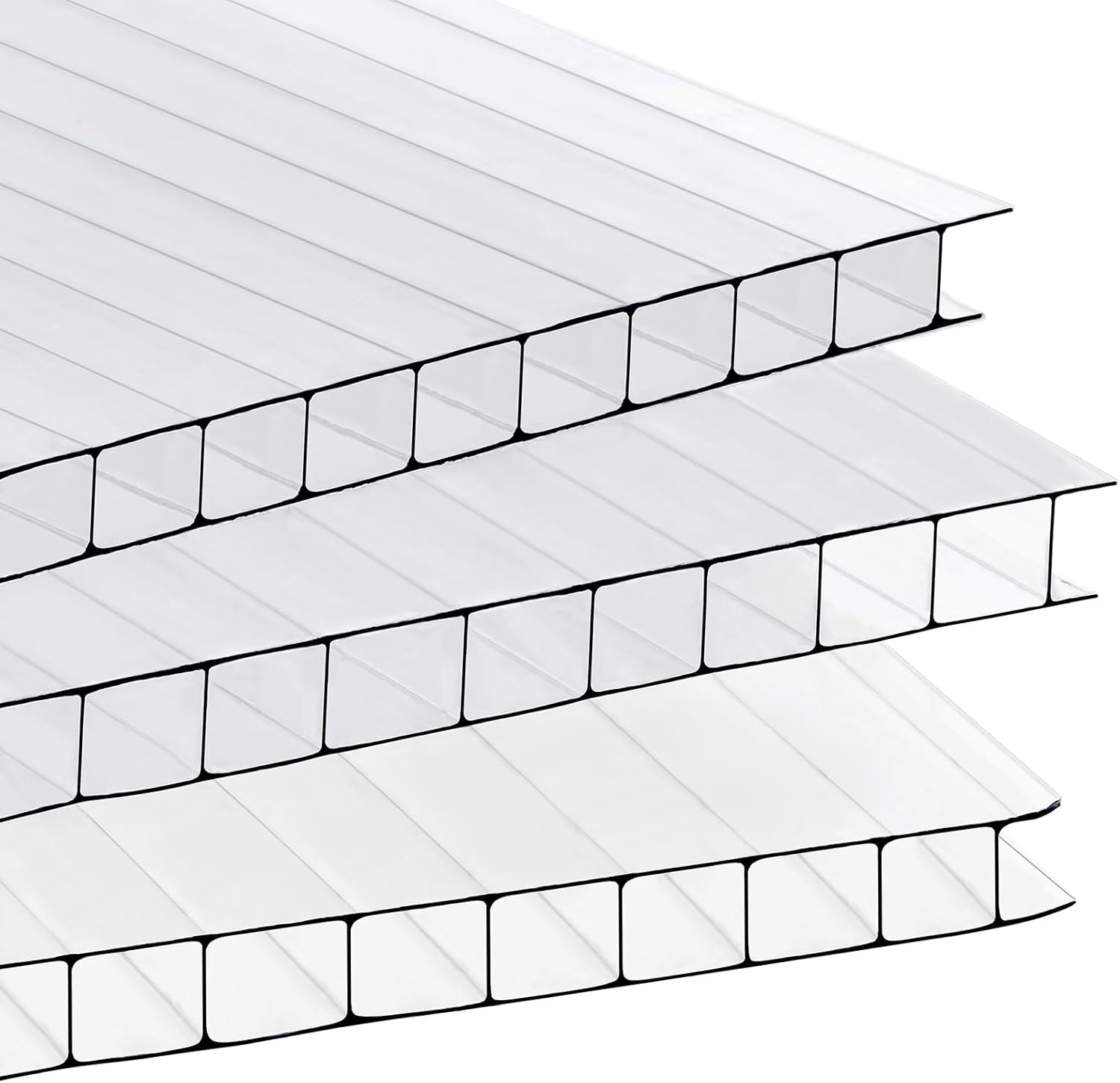
- Cut along the flutes wherever possible. Cutting across them is possible but leaves open channels that must be sealed.
- Use a circular saw or jigsaw with a fine-tooth blade — a utility knife cannot cut through the ribs cleanly.
- Support both sides. Hollow sheets flex more than solid.
- Blow out the swarf. After cutting, use compressed air to clear plastic chips from inside the channels. Chips left in the flutes stay visible for the life of the panel.
- Seal the cut edge immediately — solid aluminium tape at the top edge, vented anti-dust tape at the bottom. An unsealed flute fills with dust and condensation and turns the panel opaque.
This applies to twin-wall and multiwall sheets alike — see hollow sheet types for the structural differences.
How to Cut Lexan Polycarbonate Sheet
Lexan is polycarbonate — a brand name owned by SABIC, in the same way Makrolon is Covestro’s. The material is chemically identical, so every method above applies unchanged.
The only practical difference is that Lexan sheets often ship with a branded protective film that adheres more firmly. Remove it slowly and only after installation, and if it resists, warm it gently rather than pulling hard.
For the full brand-versus-material picture, see Lexan polycarbonate sheets.
Finishing the Cut Edge
A saw-cut edge is usable as-is in most applications, but three finishing steps improve the result:
Deburr with 240-grit sandpaper, working along the edge rather than across it.
Smooth with 400-grit for visible edges.
Flame polish for a glass-clear edge on display work: pass a propane torch quickly along the edge, never pausing. This takes practice — test on offcuts first, and skip it entirely on sheets that will be glued or stressed, as flame polishing induces internal stress that can cause crazing.
How to Cut Polycarbonate Sheets: Mistakes to Avoid
- Removing the protective film first — scratches from the workbench and clamps are permanent
- Coarse wood blade — chips and cracks the edge
- Cutting too slowly — friction melts the kerf closed behind the blade
- No support under the sheet — vibration causes chipping and wandering cuts
- Orbital action on the jigsaw — tears rather than cuts
- Forgetting to clear hollow flutes — chips visible forever inside the panel
- Leaving hollow edges unsealed — dust and condensation enter within weeks
- Cutting in direct summer sun — a hot sheet is softer and melts more readily
Safety
Wear safety glasses — polycarbonate chips fly at speed. Use a dust mask for extended sawing. Clamp the workpiece rather than holding it. Keep hands clear of the blade path, and let power tools reach full speed before contacting the material.
Do You Need to Cut at All?
Now that you know how to cut polycarbonate sheets properly, there is a question worth asking before you start: does the job need cutting at all?
If you are ordering a project quantity, cutting on site costs time and generates offcuts you have already paid for — polycarbonate is sold by weight, so waste is money.
We produce polycarbonate sheets to the exact width and length your project requires, straight from the extrusion line. No cutting, no waste, and the UV layer stays continuous across the full panel.
- Custom dimensions to your specification
- All structures — solid, twin-wall, multiwall, embossed
- Thicknesses 1–18 mm, standard and custom colours
- 100% virgin resin, co-extruded UV protection, 10-year warranty
- CE and ISO certified, export to 60+ countries
See the full range in our polycarbonate sheets guide, or check quantities and cost with our price and container calculator.
📞 Send your cutting list — quote within 24 hours.
WhatsApp: +2 01095990442 | ✉️ info@gcrystal-pc.com
Frequently Asked Questions
How do you cut polycarbonate sheets?
For sheets up to 3 mm, score deeply with a utility knife against a straight edge and snap along the line. For thicker sheets, use a circular saw with a fine-tooth blade of 60 teeth or more, cutting at moderate speed with the sheet fully supported.
What blade do you use to cut polycarbonate?
A fine-tooth blade — 60 teeth or more on a circular saw, or 21 TPI and finer on a jigsaw. Blades made for aluminium or laminate work well. Coarse wood blades chip the edge.
How do you cut polycarbonate sheets by hand?
A sharp utility knife handles sheets up to 3 mm using the score-and-snap method: score 5 to 7 times along a clamped straight edge, then snap over a table edge. Thicker sheets can be cut with a fine-tooth hacksaw or pull saw, slowly and with firm support.
How do you cut Lexan polycarbonate sheet?
Exactly as any other polycarbonate — Lexan is a brand name for the same material. Score and snap up to 3 mm, fine-tooth circular saw above that, keeping the protective film in place.
Why does my polycarbonate melt when I cut it?
Friction, not speed. A dull blade, too many teeth in contact, or feeding too slowly all generate heat that melts the kerf closed. Increase feed rate slightly, reduce blade depth, or fit a sharper blade.
Should I remove the protective film before cutting?
No. Leave it on through cutting and installation. It protects against scratches from the workbench, clamps and the saw base, and those scratches are permanent.
How do you cut twin-wall polycarbonate?
With a circular saw or jigsaw and a fine-tooth blade, cutting along the flutes where possible. Afterwards, blow out the internal channels with compressed air and seal the edge — solid tape at the top, vented tape at the bottom.
Can you cut polycarbonate with a utility knife?
Yes, up to about 3 mm. Score 5 to 7 times along a clamped straight edge, cutting at least a third of the way through, then snap the sheet over a table edge.
How do you get a smooth edge?
Deburr with 240-grit sandpaper, then smooth with 400-grit. For a glass-clear edge on display work, flame polishing works but induces internal stress — avoid it on structural or bonded parts.
Can polycarbonate be cut with a laser?
It can, but the cut edge yellows and the process releases fumes that require proper extraction. Mechanical cutting gives a better result for sheet work.
Does cutting affect the UV protection?
The UV layer covers the sheet faces, not the cut edges. Cut edges are not UV-protected, which is another reason ordering sheets at the finished size is preferable for long-term outdoor installations.
'/%3E%3C/svg%3E)

'/%3E%3Cpath%20d='m454%20250-4%204-4-4c-3%203-9%205-9%205l2-5q-9%205-10%203c-1-1%2010-12%2012-26%200-1%203-18-8-13-2%201-4-5%200-7%203-2%2010-1%2011%200q1-2%203-2c2%200%2011%201%2014%206%202%205%202%2014%202%2015q0%2015%208%2027c-1%201-8-2-8-2v3s-7-2-9-4m-12-32c4%2014-9%2031-11%2033%2011%200%2012-10%2015-24l1%201c-2%2011-5%2022-8%2025l7-4%203-22h1l-3%2022%203%203%203-3-1-21h1l1%2021%208%203c-5-8-6-25-6-23h1c2%2012%203%2022%2012%2022-3-3-8-16-7-25q0-12-2-15-6-3-10%202-2%202-5-1c-2-2-1-2-6-4q-7-2-6%205s9-3%2013%205zm7-8q-3%201-1%202%203%200%201-2'/%3E%3C/g%3E%3C/svg%3E)
'/%3E%3Cpath%20fill='%23b2b2b2'%20d='M241%20382q0%2016%2017%2026%2017%2011%2042%2011t42-11q16-11%2017-26V269H241'/%3E%3Cpath%20fill='%239f7e00'%20d='M241%20379q0%2014%208%2023%209%209%2021%209%2014%200%2021-9%209-9%209-23V269h-59'/%3E%3Cpath%20d='M241%20339v-70h59v110q0%2014-9%2023l-6%205v-68h-15v72q-8%200-14-4v-68zm59%2040c0%2022%2015%2032%2029%2032%2021%200%2030-18%2030-32v-40h-59'/%3E%3Cpath%20fill='%239f7e00'%20d='M266%20277v5h2v12h-3v-5h2v-5h-9v5h2v5h-4v9h3v18h-5v10h34v-10h-5v-18h3v-9h-4v-5h2v-5h-9v5h2v5h-3v-12h2v-5zm42%20101q0%2010%206%2017%206%206%2015%207%2010-1%2016-7%206-7%206-17v-29h-43'/%3E%3Ccircle%20fill='%230044ad'%20cx='329.5'%20cy='372'%20r='6'/%3E%3Cellipse%20fill='%230044ad'%20cx='300'%20cy='340'%20rx='16'%20ry='21'/%3E%3C/svg%3E)
