

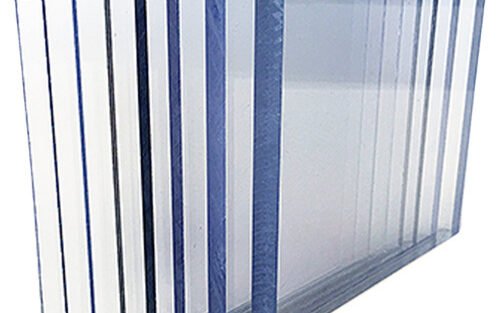
Polycarbonate sheet sizes come down to three numbers: the sheet dimensions, the thickness and the weight per square metre. Solid sheet is most often supplied at 1220 × 2440 mm (4 × 8 ft), twin-wall sheet at 2100 mm wide and up to 6000 mm long, and embossed sheet at 2100 × 5800 mm. This guide gives every standard size, the thickness range for each type, a weight chart you can use for quotes and freight, and a simple way to choose the right size for your project.
Updated October 2026 · Reviewed by the technical team at G-Crystal Plastic Industries, polycarbonate sheet manufacturer.
In short:
- Solid sheet: 1220 × 2440 mm standard, 1–10 mm thick, 1.2 kg/m² for every millimetre.
- Twin-wall sheet: 2100 mm wide, 4–12 mm thick; multiwall sheet: 8–18 mm thick; lengths up to 6000 mm or cut to your roof.
- Embossed sheet: 2100 × 5800 mm, 1.5–6 mm thick.
- For multiwall sheet, weight per m² is the real specification: ask for it in every quote.

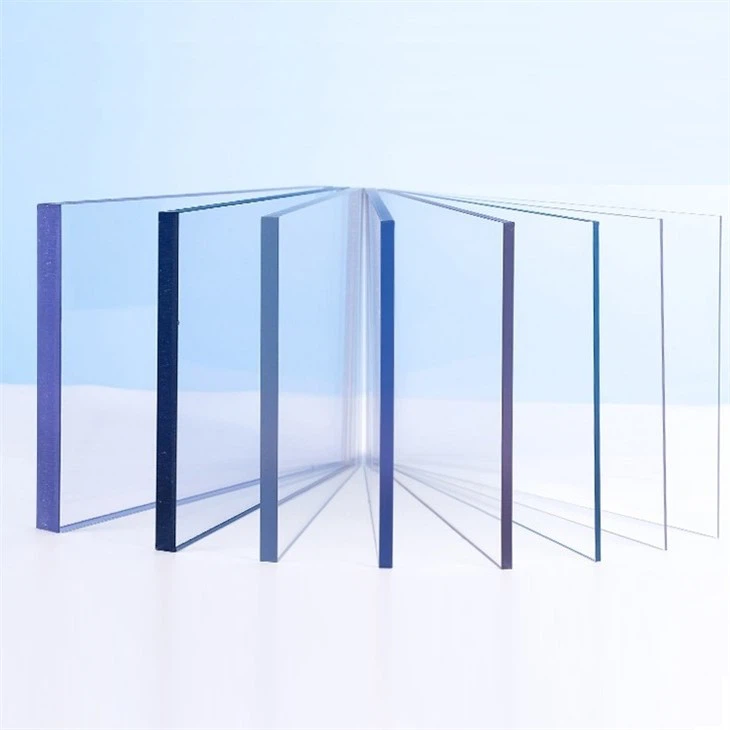
Standard polycarbonate sheet sizes by type
Each type of sheet comes in a different standard format, because each one is made and used differently. The table shows G-Crystal’s standard polycarbonate sheet sizes; all lines can also be produced to custom dimensions.
| Sheet type | Standard size | Thickness range | Typical use |
|---|---|---|---|
| Solid polycarbonate sheet | 1220 × 2440 mm (4 × 8 ft) | 1–10 mm | Glazing, security, signage, machine guards |
| Twin-wall polycarbonate sheet | 2100 mm wide, up to 6000 mm long | Twin-wall 4–12 mm; multiwall 8–18 mm | Roofs, skylights, greenhouses, canopies |
| Embossed sheet (crystal, prismatic, Diva) | 2100 × 5800 mm | 1.5–6 mm | Partitions, privacy screens, canopies, light diffusers |
Other polycarbonate sheet sizes are common in some markets, such as 2050 × 3050 mm and 2100 × 6000 mm for solid sheet. If your fabricator or distributor works to one of those formats, ask for it: solid sheet can be cut to size before shipping.
Metric and imperial polycarbonate sheet sizes
Many buyers in Nigeria, Ghana and the Gulf still order in feet and inches. These are the usual equivalents:
| Imperial | Metric |
|---|---|
| 4 × 8 ft | 1220 × 2440 mm |
| 1/8 inch | about 3 mm |
| 3/16 inch | about 4.5 mm |
| 1/4 inch | about 6 mm |
| 3/8 inch | about 10 mm |
Always confirm the metric thickness on the quote: a “1/4 inch” sheet may be quoted as 6 mm or 6.35 mm, and the difference matters in a frame.
Polycarbonate sheet sizes and thickness: which one for which job?
Thickness drives three things: stiffness, impact resistance and price. The right choice depends on the span between supports and on what the sheet has to resist. Our dedicated pages cover the most requested thicknesses in detail: 2 mm, 3 mm, 4 mm and 6 mm.
| Application | Sheet type | Typical thickness |
|---|---|---|
| Signage and light boxes | Solid, opal or clear | 2–3 mm |
| Partitions and privacy screens | Embossed or solid | 2–5 mm |
| Windows and machine guards | Solid clear | 4–6 mm |
| Security and anti-vandal glazing | Solid clear | 6–10 mm |
| Canopies and walkways | Solid, or twin-wall | 3–6 mm solid, 6–8 mm twin-wall |
| Roofs and skylights | Twin-wall, or solid | 6–12 mm twin-wall, 10–18 mm multiwall, 3–6 mm solid |
| Greenhouses | Twin-wall | 4–10 mm, most often 6–8 mm |
For roofs, thickness and purlin spacing go together: thinner sheet needs supports closer together. Our guide on how to install polycarbonate roofing sheets gives purlin spacing for each thickness.
Polycarbonate sheet sizes and weight chart
Weight is the number you need for structural loads, freight quotes and container planning, and it is where polycarbonate sheet sizes are most often misread.
Solid polycarbonate sheet sizes and weights
Solid polycarbonate has a density of 1.20 g/cm³ (G-Crystal technical data sheet). That gives a simple rule: every millimetre of thickness weighs 1.2 kg per square metre.
| Thickness | Weight per m² | Weight per 1220 × 2440 mm sheet |
|---|---|---|
| 1 mm | 1.2 kg | 3.6 kg |
| 2 mm | 2.4 kg | 7.1 kg |
| 3 mm | 3.6 kg | 10.7 kg |
| 4 mm | 4.8 kg | 14.3 kg |
| 5 mm | 6.0 kg | 17.9 kg |
| 6 mm | 7.2 kg | 21.4 kg |
| 8 mm | 9.6 kg | 28.6 kg |
| 10 mm | 12.0 kg | 35.7 kg |
For comparison, ordinary glass weighs about 2.5 kg/m² per millimetre, so a 4 mm glass pane is about 10 kg/m² against 4.8 kg/m² for 4 mm polycarbonate.
Twin-wall polycarbonate sheet sizes and weights
Multiwall sheet has no single weight per thickness, because the wall thickness inside the sheet varies between grades. These are the ranges found on the market:
| Thickness | Weight per m² (market range) | Weight per 2100 × 6000 mm sheet |
|---|---|---|
| 4 mm | 0.7–1.0 kg | 8.8–12.6 kg |
| 6 mm | 1.0–1.3 kg | 12.6–16.4 kg |
| 8 mm | 1.3–1.5 kg | 16.4–18.9 kg |
| 10 mm | 1.5–1.7 kg | 18.9–21.4 kg |
For 12 mm twin-wall, count on about 1.7–2.0 kg/m², or 21.4–25.2 kg per 2100 × 6000 mm sheet.
Same thickness, different weight: what it means
Two 6 mm twin-wall sheets can weigh 1.0 kg/m² and 1.3 kg/m². The heavier one has thicker inner and outer walls: it is stiffer, spans further between purlins and stands up better to hail. The lighter one costs less and is perfectly suitable for sheltered applications with close supports. Neither is “wrong”; they are different grades for different jobs.
What matters is that you compare like with like. When you collect quotes, ask every supplier for:
- Thickness and weight per m² for each item
- Sheet width and length
- Thickness tolerance
- Number of walls (twin-wall, triple-wall or more)
- UV protection on one or both faces
A lower price per sheet with a lower weight per m² is not a cheaper sheet; it is a different product. Comparing price per kilogram, as explained in our guide to polycarbonate sheet price per kg and per m², makes offers comparable.
Twin-wall vs multiwall: polycarbonate sheet sizes by structure
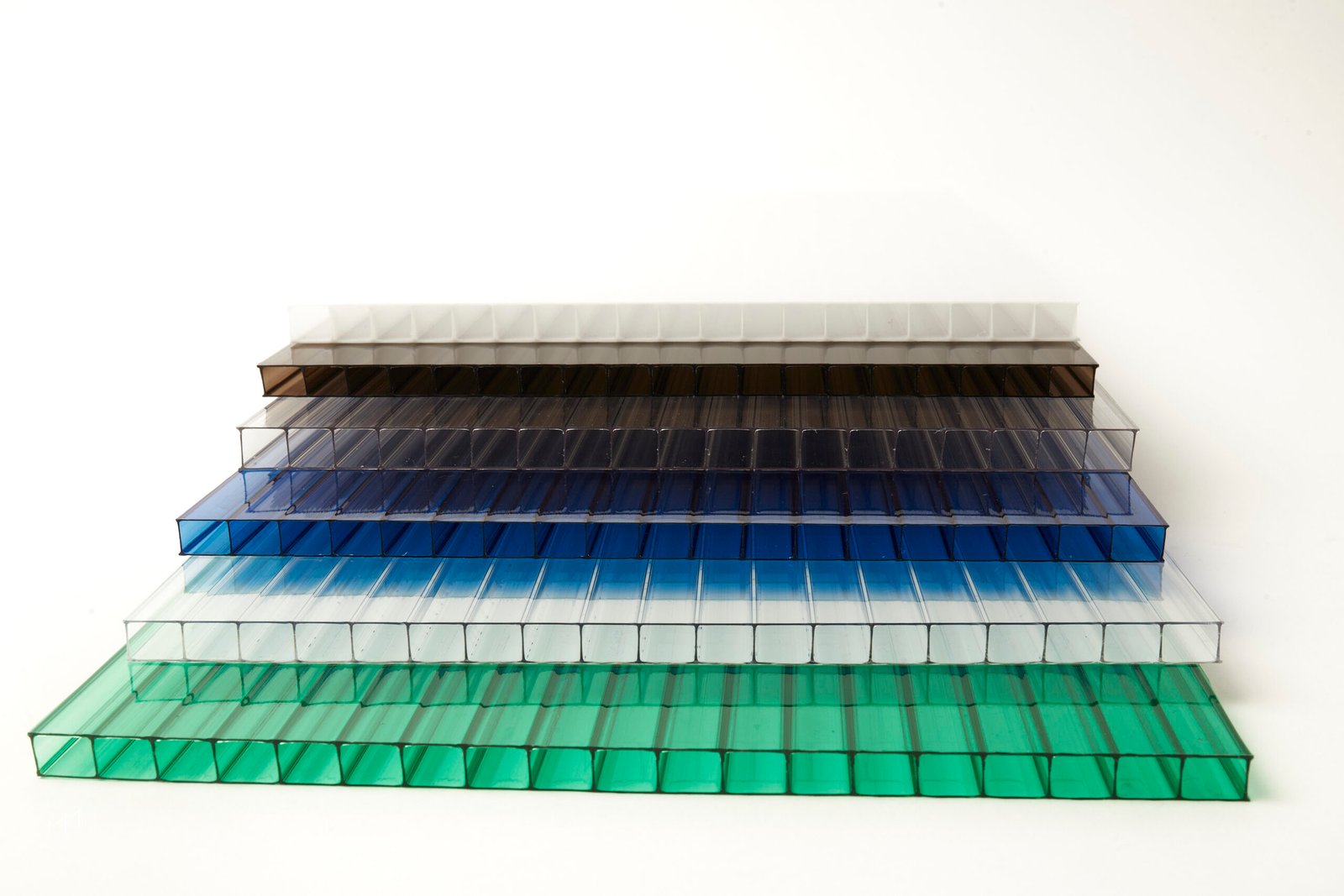
Hollow polycarbonate comes in two families. Twin-wall sheet has two skins joined by ribs; multiwall sheet has three or more skins, often in a triple-wall or X structure. The extra walls change the polycarbonate sheet sizes, weights and performance you should expect.
| Twin-wall | Multiwall | |
|---|---|---|
| Structure | 2 walls | 3 or more walls (triple-wall, X structure) |
| G-Crystal thickness range | 4–12 mm | 8–18 mm |
| Standard width | 2100 mm | 2100 mm |
| Thermal insulation | Good | Higher, thanks to more air layers |
| Light transmission | Higher | Lower, as each wall absorbs some light |
| Typical use | Canopies, greenhouses, small and medium roofs | Large roofs, skylights, façades, insulated glazing |
Multiwall polycarbonate sheet sizes and weights
At the same thickness, multiwall sheet is heavier than twin-wall because of the extra walls. These are typical market ranges:
| Thickness | Weight per m² (market range) | Weight per 2100 × 6000 mm sheet |
|---|---|---|
| 8 mm | 1.5–1.7 kg | 18.9–21.4 kg |
| 10 mm | 1.7–2.0 kg | 21.4–25.2 kg |
| 12 mm | 1.9–2.3 kg | 23.9–29.0 kg |
| 16 mm | 2.2–2.8 kg | 27.7–35.3 kg |
| 18 mm | 2.5–3.0 kg | 31.5–37.8 kg |
Insulation and light by thickness
Insulation improves as thickness and the number of walls go up. As a market guide, U-values run from about 3.9 W/m²K for 4 mm twin-wall to about 3.0 W/m²K for 10 mm twin-wall, and down to about 2.0 W/m²K or less for 16–18 mm multiwall. Light transmission moves the other way: G-Crystal’s data sheet gives 82–88% for clear hollow sheet depending on thickness and colour, and multiwall sits lower because each extra wall absorbs some light. Choose polycarbonate sheet sizes by balancing the two: more insulation for air-conditioned spaces, more light for greenhouses.
Choosing polycarbonate sheet sizes for your project
Order twin-wall in the full roof length. Multiwall sheet is not overlapped or butt-jointed end to end. If the roof slope is 4.5 m long, order 4.5 m lengths or cut them from 6 m sheets, and plan the layout so offcuts are usable elsewhere.
Plan solid sheet around the 1220 × 2440 mm module. For windows and partitions, design openings that use the full sheet or clean halves and quarters. Remember the expansion clearance: a pane in a frame needs about 3 mm per metre less than the opening on each side.
Check the width against your purlin or rafter layout. Twin-wall sheets are 2100 mm wide; joints must fall on a support when you use HCP profiles. Setting rafters at 1050 mm or 2100 mm centres avoids cutting sheets lengthwise.
Do not forget accessories. Every twin-wall roof needs H or HCP connectors along the joints and U profiles at both ends, in the same thickness as the sheet.
Polycarbonate sheet sizes by market
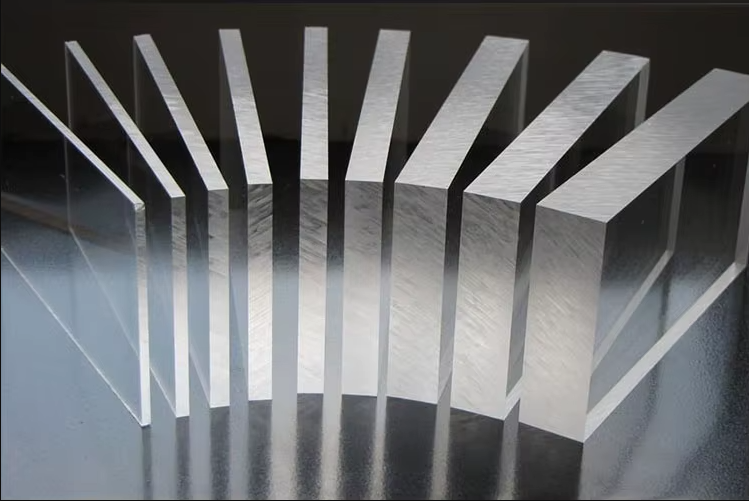
Each market has its own habits, and knowing them speeds up quoting:
- Solid sheet: 4 × 8 ft (1220 × 2440 mm) is the universal format. Markets supplied from Europe also use 2050 × 3050 mm.
- Twin-wall and multiwall sheet: 2100 mm wide almost everywhere. Lengths of 5800 or 6000 mm are the most common; long roofs sometimes use 11800–12000 mm sheets, which only fit a 40 ft container.
- Retail formats: DIY stores sell narrow widths such as 980, 1050 or 1220 mm. If your market works to those polycarbonate sheet sizes, ask in your quote whether sheets can be cut to width before shipping.
Shipping: how polycarbonate sheet sizes affect freight
Polycarbonate sheet sizes have a direct effect on freight cost, and two rules explain most of it:
- Solid sheet is weight-limited. A full container of thick solid sheet reaches the weight limit before it is full.
- Twin-wall sheet is volume-limited. It is light and bulky, so the container fills up long before it reaches its weight limit.
Length matters too. The internal length of a 20 ft container is about 5.9 m, so 6 m twin-wall sheets need a 40 ft container. Embossed sheets at 5.8 m and solid sheets at 2.44 m fit a 20 ft container.
To estimate costs before you ask for a quote, use our polycarbonate price and container calculator. For the full range of types and uses, see our guide to polycarbonate sheet types, thicknesses and prices.
Example: reading polycarbonate sheet sizes on a quote
Take a typical line: twin-wall 6 mm, clear, 2100 × 6000 mm, 1.3 kg/m², UV one side, 100 sheets. Each sheet covers 12.6 m², so the order covers 1,260 m². At 1.3 kg/m² that is about 1,640 kg of sheet, shipped in a 40 ft container because of the 6 m length. If another supplier quotes the same line at 1.0 kg/m², they deliver about 1,260 kg: it is not the same product, and the comparison has to be made per kilogram.
Packaging and handling
Every sheet ships with a protective film on both faces; the UV-protected face is marked on the film. Sheets are stacked flat on pallets with edge protection. On arrival, keep them flat, covered and in the shade, and do not leave the film in the sun for weeks before installation.
From the factory
The polycarbonate figures in this guide come from G-Crystal’s technical data sheets: density 1.20 g/cm³, solid sheet from 1 to 10 mm, twin-wall from 4 to 12 mm, multiwall from 8 to 18 mm, embossed from 1.5 to 6 mm, nine standard colours, a co-extruded UV layer on one or both faces, and service from −40 °C to +120 °C. All three lines carry a 10-year limited warranty against defects in material and workmanship. Where the data sheet is silent, as with multiwall weight ranges, we give market values and say so.
The question we hear most from importers is not about price but about polycarbonate sheet sizes: which length fits the roof, which thickness fits the span, and how many sheets fit the container. Getting those three right at the quoting stage avoids most problems on site.
FAQ: polycarbonate sheet sizes
What is the standard size of a polycarbonate sheet? Solid sheet is most often 1220 × 2440 mm (4 × 8 ft). Twin-wall sheet is 2100 mm wide and up to 6000 mm long. Embossed sheet is 2100 × 5800 mm.
What thicknesses do polycarbonate sheets come in? Solid sheet from 1 to 10 mm, twin-wall from 4 to 12 mm, multiwall from 8 to 18 mm, and embossed from 1.5 to 6 mm.
How much does a polycarbonate sheet weigh? Solid sheet weighs 1.2 kg/m² for every millimetre, so a 4 mm sheet of 1220 × 2440 mm weighs about 14.3 kg. Twin-wall weight depends on the grade: 4 mm is typically 0.7–1.0 kg/m².
Can polycarbonate sheets be cut to size? Yes. Solid sheet can be cut to your dimensions before shipping, and twin-wall can be supplied in custom lengths so that each sheet covers the full roof slope.
What thickness should I use for a roof? For most roofs and canopies, 6 or 8 mm twin-wall. On exposed sites or long spans, 10–12 mm twin-wall or 16 mm multiwall with HCP profiles.
Do 6 m sheets fit in a 20 ft container? No. The internal length of a 20 ft container is about 5.9 m, so 6 m sheets need a 40 ft container.
What is the difference between twin-wall and multiwall polycarbonate sheet sizes? Both are 2100 mm wide. Twin-wall runs from 4 to 12 mm thick, multiwall from 8 to 18 mm. Multiwall is heavier per m² and insulates better; twin-wall lets in more light and costs less.
G-Crystal: standard and custom polycarbonate sheet sizes
G-Crystal Plastic Industries manufactures solid, twin-wall and embossed polycarbonate sheets in Egypt and exports to more than 60 countries. We supply standard polycarbonate sheet sizes and custom lengths, with the H, HCP and U profiles to install them.
- Recommended size, thickness and grade for your application
- Weight per m² and per sheet stated on every quote
- Technical data sheet and 10-year limited warranty in writing
- FOB or CIF pricing to Lagos, Mombasa, Jebel Ali or your port
Contact the factory: WhatsApp +20 109 599 0442 · info@gcrystal-pc.com


