

Polycarbonate sheets are engineering thermoplastic panels that transmit up to 90% of light while withstanding impacts up to 250 times better than glass — at roughly half the weight. With a co-extruded UV layer, they hold their clarity for more than 15 years outdoors.
This guide covers what you actually need before ordering: the four sheet structures, thickness and weight tables, colour options, pricing by the kilogram, installation rules and the mistakes that ruin a job.
📞 Request a factory quote — FOB $2.50–3.50 USD/kg, exporting to 60+ countries. +2 01095990442

What Are Polycarbonate Sheets?
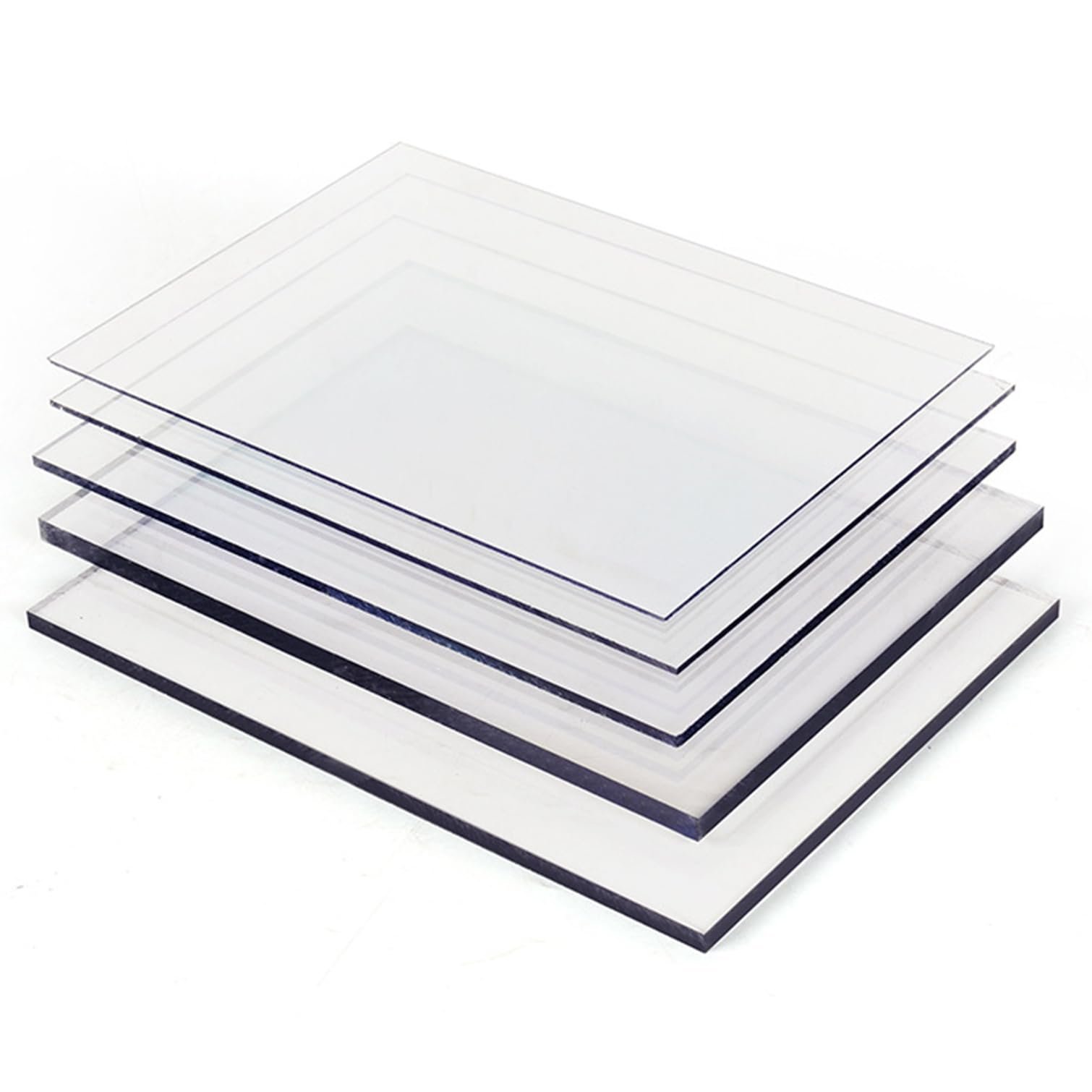
A polycarbonate sheet is a flat panel extruded from polycarbonate resin, a thermoplastic engineered for impact strength and optical clarity. Unlike glass, it does not shatter: under impact it deforms, absorbs the energy, then returns to shape.
That single property is why polycarbonate sheets replaced glass and fibreglass across roofing, glazing, machine guarding and greenhouse construction.
They appear under several names — polycarbonate panels, PC sheets, polycarbonate plastic sheets, or brand names such as Lexan and Makrolon. All describe the same material. See our guide to Lexan polycarbonate sheets for the brand-versus-material distinction, and polycarbonate properties for the polymer science behind them.
At G-Crystal we extrude from 100% virgin resin, never regrind. Recycled polycarbonate carries a yellow haze from day one and loses impact strength far faster — see our virgin material commitment.
Technical Specifications
| Property | Value |
|---|---|
| Impact resistance | up to 250× glass |
| Light transmission | up to 90% (clear solid) |
| Density (solid) | 1.20 g/cm³ |
| Service temperature | −40 °C to +120 °C |
| Softening point | ≈ 145 °C |
| Thermal expansion | ≈ 3 mm per metre |
| Cold bending radius | 175 × thickness |
| Fire behaviour | Self-extinguishing (B1 by grade) |
| UV protection | Co-extruded, blocks 99.9% (280–400 nm) |
| Standard sheet size | 2100 × 5800 mm (custom available) |
| Service life | 15+ years |
| Warranty | 10 years against yellowing |
Inside the Factory: How Polycarbonate Sheets Are Made
Most suppliers describe the product. Few can show the line it comes off. The video below follows a polycarbonate sheet through our production in 6th of October City, from raw resin to packed pallet.
[الفيديو هنا]
- Drying — virgin granules are dried to remove residual moisture. Skip this and the sheet comes out with internal bubbles and reduced impact strength.
- Co-extrusion — the resin is melted and pushed through a flat die. In the same pass, a UV-stabilised layer is fused onto the surface. Because it is co-extruded rather than sprayed on, it cannot peel, wash off or wear away. This is the single biggest difference between a sheet that lasts 15 years and one that yellows in three.
- Calibration and cooling — calibrated rollers fix the thickness. On hollow sheets, the internal ribs are formed here, defining the wall structure and the U-value.
- Quality control — thickness, light transmission and UV layer are verified against specification on every run.
- Protective film and packing — double-sided film is applied, then sheets are stacked on export-standard pallets with the UV face marked.
This is what buying from a polycarbonate sheet manufacturer rather than a trader means in practice: full control of the resin, the UV layer and the tolerances. More on our capability: polycarbonate sheet manufacturers.
The Four Types of Polycarbonate Sheets
Solid Polycarbonate Sheets
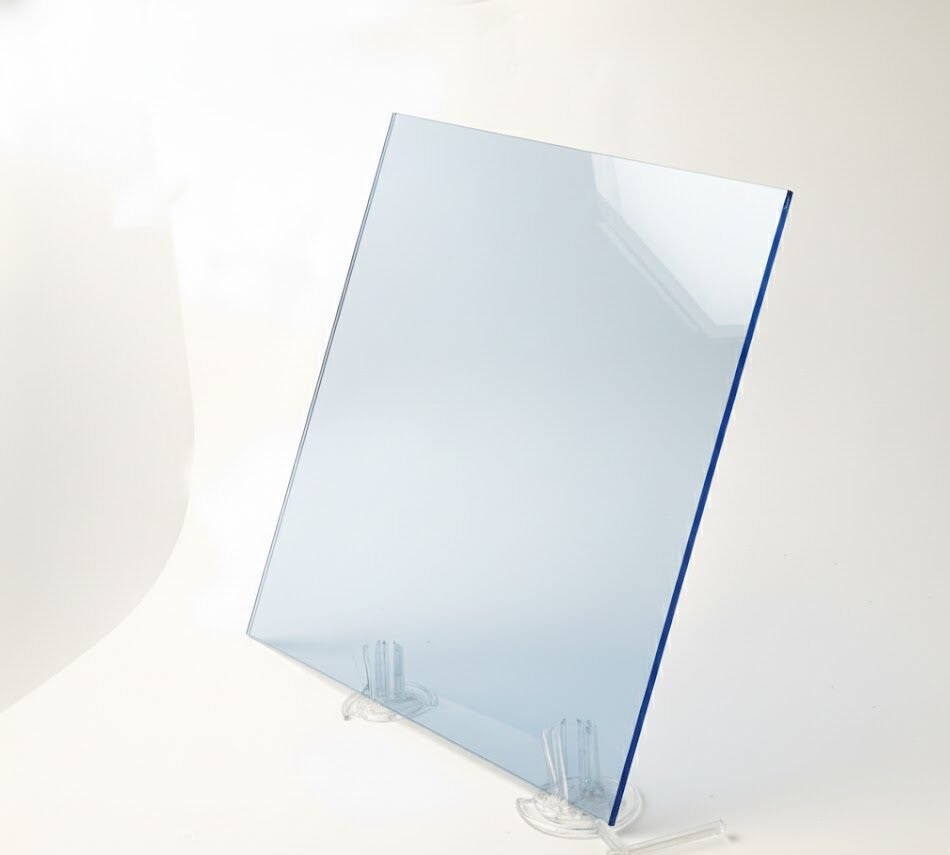
Full-thickness panels with the highest clarity and impact strength in the range. Available 1–12 mm, they are the choice for glazing, skylights, machine guards and security applications.
Finishes: clear, frosted, light diffuser and anti-scratch.
→ Solid polycarbonate sheets
Twin-Wall Polycarbonate Sheets
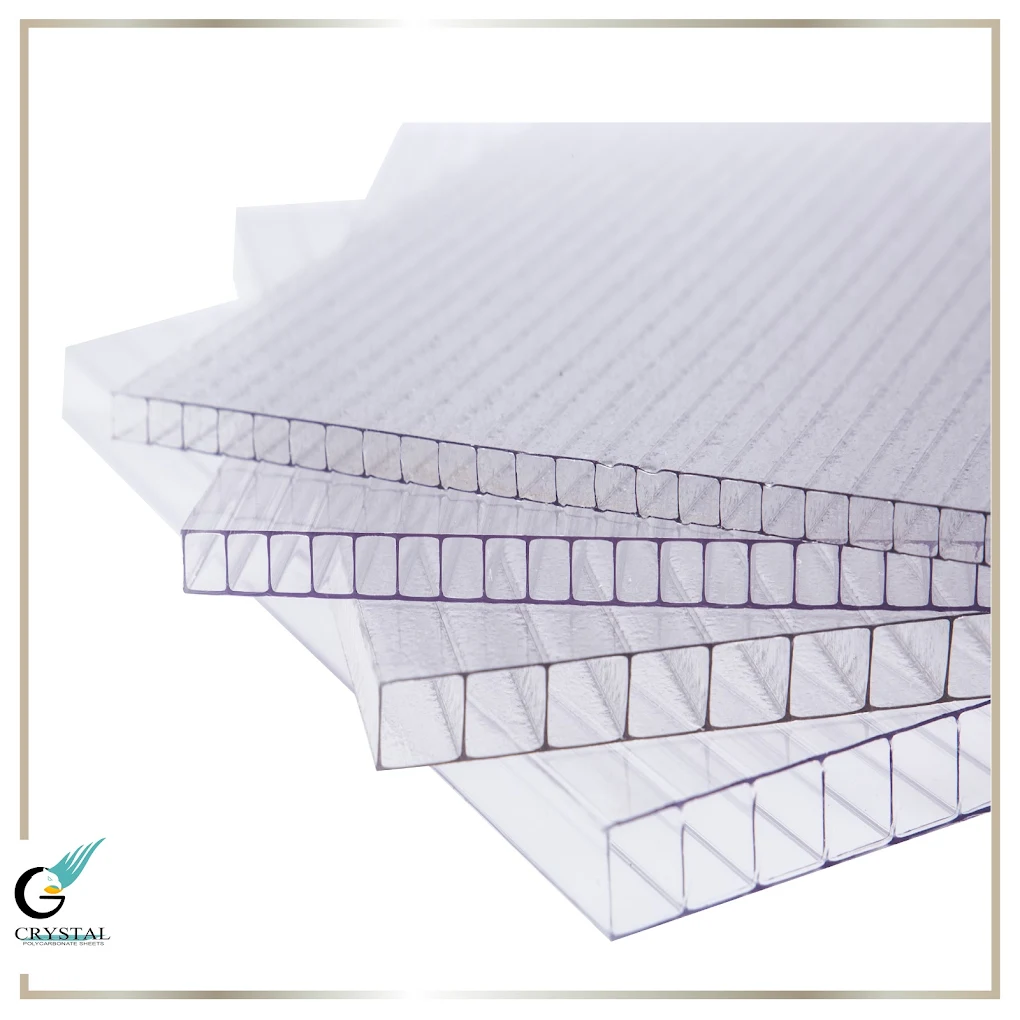
Two walls separated by ribs, forming air chambers. Available 4–10 mm at roughly one-sixth the weight of solid, with far better insulation. The standard for small greenhouses, carports and pergolas.
→ Twin-wall polycarbonate sheets · clear · frosted
Multiwall Polycarbonate Sheets
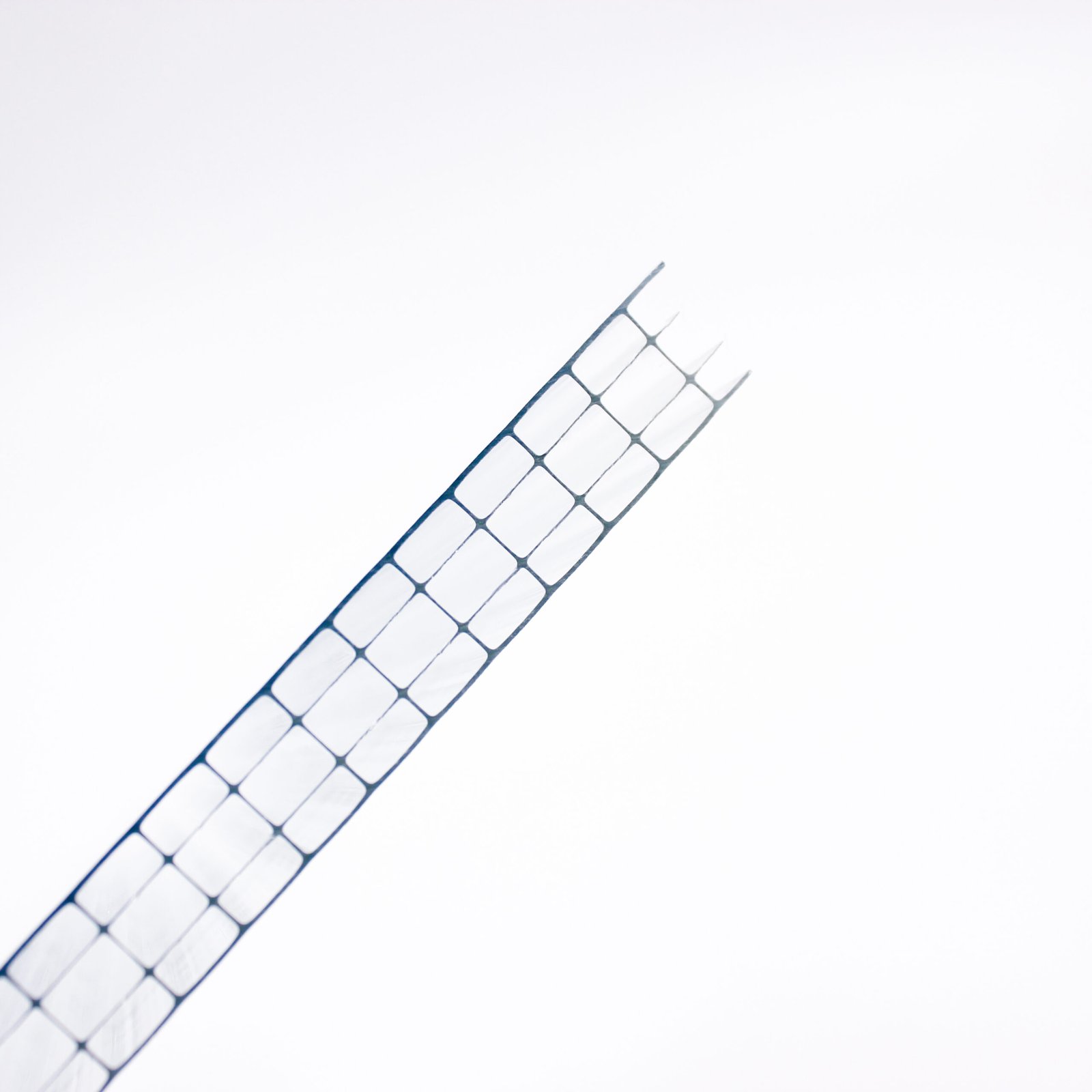
Four walls and two extra thermal barriers, from 8 to 18 mm. U-values reach 1.7 W/m²K — more than three times better than single glazing — which is why commercial greenhouses and industrial roofs specify them.
→ Multiwall polycarbonate sheets · hollow sheet types explained
Embossed Polycarbonate Sheets
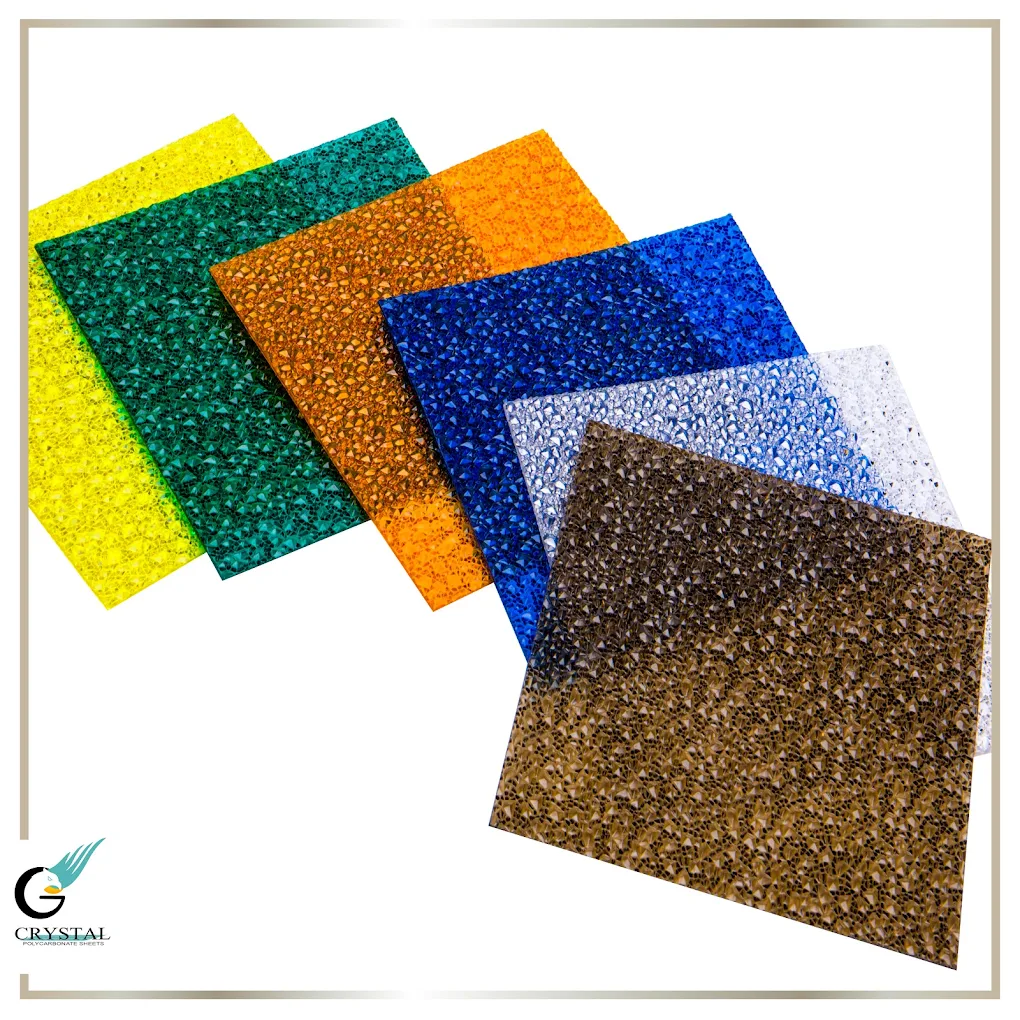
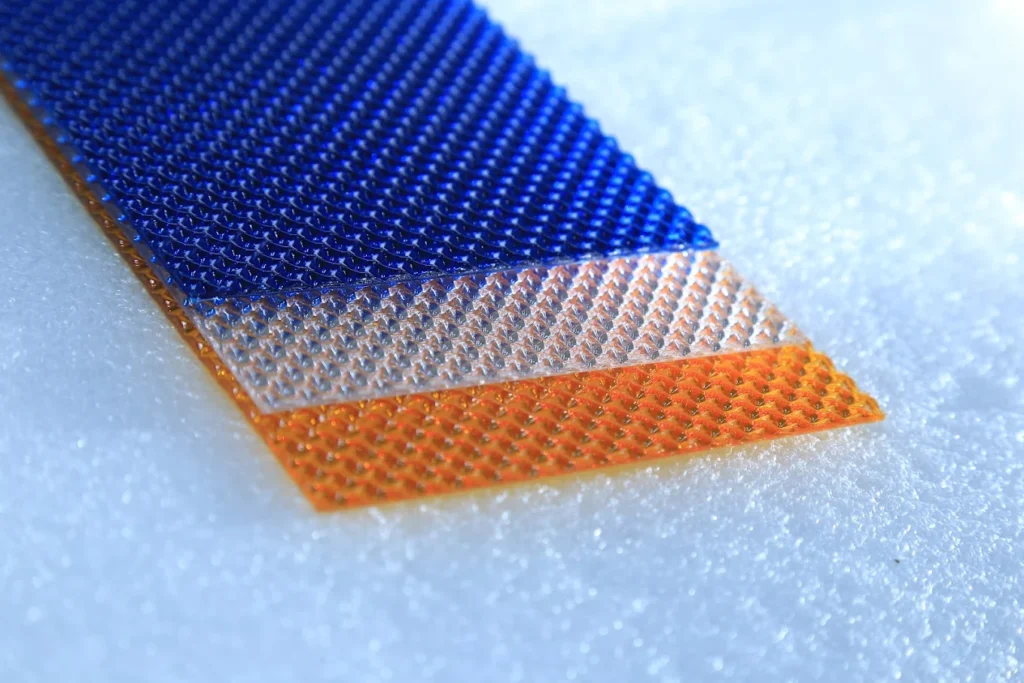
Textured surface that diffuses light, hides scratches and adds privacy. Patterns: Crystal, Prismatic and Diva. Widely used in partitions, signage and lighting covers.
→ Embossed polycarbonate sheets
Solid vs Hollow: Which Structure?
| Criterion | Solid | Twin-wall | Multiwall 4-wall |
|---|---|---|---|
| Thickness range | 1–12 mm | 4–10 mm | 8–18 mm |
| Clarity | up to 90%, sharp | 80–88%, translucent | 74–91%, diffused |
| Impact resistance | Maximum | High | High |
| Insulation (U-value) | ≈ 5.0 W/m²K | 2.9–3.5 | 1.7–2.5 |
| Weight per m² | 1.2–14.4 kg | 0.8–1.7 kg | 1.6–2.9 kg |
| Cost per m² | Highest | Lowest | Low |
| Best for | Glazing, security, façades | Small covers, carports | Greenhouses, large roofs |
The rule: choose solid polycarbonate sheets when clarity and impact strength decide the job; choose hollow when insulation, weight and cost per square metre decide it.
Thickness and Weight Chart
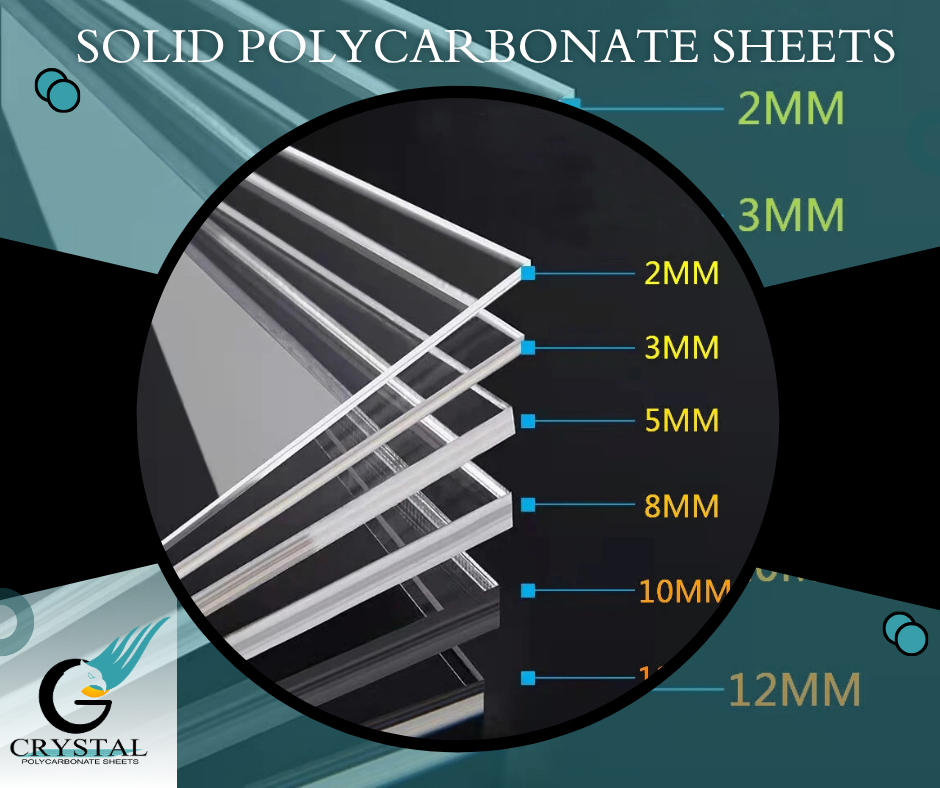
Weight drives price, because polycarbonate sheets are sold by the kilogram.
| Thickness | Structure | Weight/m² | Typical use |
|---|---|---|---|
| 2 mm | Solid | 2.4 kg | Signage, light guards — 2mm sheet |
| 3 mm | Solid | 3.6 kg | Interior glazing, displays — 3mm sheet |
| 4 mm | Solid | 4.8 kg | Canopies, shelters — 4mm sheet |
| 4 mm | Twin-wall | 0.8 kg | Garden greenhouses |
| 6 mm | Solid | 7.2 kg | Roofing, verandas — 6mm sheet |
| 6 mm | Twin-wall | 1.3 kg | Pergolas, patio covers |
| 8 mm | Solid | 9.6 kg | Security glazing |
| 10 mm | Multiwall | 1.85 kg | Commercial greenhouses |
| 12 mm | Solid | 14.4 kg | High-security, structural |
| 16 mm | Multiwall | 2.63 kg | Industrial roofs, cold climates |
Rule of thumb: outdoors, never specify below 6 mm with UV protection. The wider the span between supports, the thicker the sheet.
Colours and Light Transmission
| Colour | Transmission | Effect |
|---|---|---|
| Clear | up to 90% | Maximum daylight |
| Opal (white) | ≈ 45% | Even diffusion, no glare — opal sheet |
| Bronze | ≈ 35% | Solar control, warm tone |
| Smoke grey | ≈ 35% | Neutral shading |
| Blue / green | varies | Architectural, pools |
| Custom RAL | — | Projects, +5% surcharge |
Standard colours carry no price premium. See the full range of tinted polycarbonate sheets.
Common mistake: specifying clear on a south-facing roof. The space overheats. Opal is usually the better call for patios and verandas.
Polycarbonate Sheets vs Other Plastic Sheets
Polycarbonate sits at the top of the transparent plastic sheet category, but it is not always the right answer.
| Property | Polycarbonate | Glass | Acrylic (PMMA) | PVC |
|---|---|---|---|---|
| Impact resistance | 250× glass | baseline | ≈ 17× glass | Moderate |
| Light transmission | up to 90% | ≈ 90% | ≈ 92% | 60–80% |
| Weight | ½ of glass | Heavy | Light | Light |
| Temperature range | −40 to +120 °C | High | −20 to +80 °C | −15 to +70 °C |
| Cold bending | Yes | No | No | Limited |
| Breakage safety | Does not shatter | Sharp shards | Cracks | Splits |
| Outdoor life | 15–20 yrs | Long | 8–10 yrs | 2–5 yrs |
| Scratch resistance | Lower (coating available) | High | High | Moderate |
Acrylic wins on clarity and surface hardness; polycarbonate panels win decisively on impact, heat tolerance and formability. PVC is cheaper upfront but yellows within a few years outdoors, which usually cancels the saving.
Full comparisons: vs glass · vs PVC · vs plexiglass · vs polyethylene · vs ABS
Applications

- Construction & architecture — skylights, canopies, domes, curtain walls, windows, covered walkways
- Roofing — polycarbonate roofing sheets, roof panels, conservatory roofs, carports, corrugated UPVC roofing
- Agriculture — greenhouse panels, tunnels, replacement panels, anti-fog sheets for condensation control
- Safety & security — bullet-resistant panels, hurricane panels, riot shields, impact-resistant glazing, fire-rated sheets
- Industry & signage — machine guards, light boxes, illuminated signs, bendable sheeting for curved forms
Browse by sector: construction · agriculture · industrial · safety · signage
Polycarbonate Sheet Prices
Polycarbonate sheets are priced by the kilogram — the fairest method, since it reflects the material actually supplied.
| Unit | Price |
|---|---|
| Ex-works (FOB) | $2.50 – 3.50 USD/kg |
| Volume discounts | By tonnage and repeat orders |
Price per m² = thickness (mm) × density × price/kg
Example: a 4 mm solid sheet weighs 4.8 kg/m². At $3.00/kg → $14.40/m².
A 10 mm multiwall weighs 1.85 kg/m² → $5.55/m² — the reason hollow sheets dominate large roofs.
🧮 Price your order with our polycarbonate price & container calculator — weight, price per m², price per sheet and container fill.
Full breakdown: polycarbonate sheet price guide · bulk orders
How to Cut and Install Polycarbonate Sheets
- UV face toward the sun — marked on the protective film. Installed upside down, the sheet yellows within months.
- Keep the film on through cutting and installation. Site scratches are permanent.
- Cutting — utility knife up to 3 mm; fine-tooth circular saw (60 teeth minimum) above that. Move slowly to avoid melting the edge.
- Hollow sheets: flutes run with the slope, never across. Across, they trap water and go permanently opaque.
- Oversize the holes — 3 mm clearance per side. The material expands about 3 mm per metre.
- Screws with sealing washers, never fully tightened.
- Seal the flutes — solid aluminium tape at the top, vented tape at the bottom. Never the reverse.
- Minimum roof pitch 5%, 10–15% recommended for self-cleaning.
- Finish with profiles — U-channel for edges, H-channel for joints, HCP-channel for reinforced assemblies. Secure with nylon cable ties where required.
Common Mistakes to Avoid
- UV layer facing inward — yellowing within one season
- Flutes laid horizontally — trapped water, permanently opaque panel
- Solid tape at the bottom — condensation cannot escape
- Undersized thickness for the span — deflection, then failure under snow load
- Screws torqued fully — cracks around holes by the first summer
- Cleaning with solvents — the UV layer is destroyed irreversibly
- Buying without UV protection for outdoor use — replacement within 2–3 years
- Walking on the sheet — always use load-spreading boards
Maintenance
- Wash with lukewarm water and mild soap, soft cloth or sponge
- Never use solvents, ammonia or abrasives
- Rinse thoroughly to avoid streaking
- Inspect sealing tapes and gaskets annually
Properly maintained, polycarbonate sheets retain over 95% of their original light transmission after ten years.
Certifications
| Certification | Scope |
|---|---|
| CE Marking | European market conformity |
| ISO 9001 | Quality management |
| ISO 14001 | Environmental management |
| ISO 45001 | Occupational health & safety |
See our CE-certified sheets for the European market.
Where to Buy Polycarbonate Sheets
Three routes exist, and the right one depends on volume.
Local distributors — fastest for a few sheets, but you pay a reseller margin and take whatever thickness and colour is in stock.
Online retailers — convenient for small quantities, with limited specification choice and no technical documentation.
Direct from the manufacturer — the route for distributors, contractors and importers. You get factory pricing, custom production, full certification and export documentation.
Buying polycarbonate sheets direct changes the equation:
- Factory pricing with no reseller margin
- Custom production — thickness, colour and dimensions to specification
- 100% virgin resin, co-extruded UV protection, 10-year warranty
- CE and ISO certified, full technical documentation
- Flexible Incoterms — FOB, CIF, CFR, EXW
- Export to 60+ countries from Egypt
We supply distributors, contractors and importers worldwide — see our global supplier profile, manufacturer page, and regional pages for the UAE and Kenya.
📞 Send your specification — quote within 24 hours.
WhatsApp: +2 01095990442 | ✉️ info@gcrystal-pc.com
Frequently Asked Questions
What are polycarbonate sheets made of?
Polycarbonate resin, a thermoplastic polymer produced from bisphenol A and phosgene. Our sheets use 100% virgin resin with a co-extruded UV layer, with no recycled content.
Are polycarbonate panels the same as polycarbonate sheets?
Yes. Panels, sheets and boards describe the same product; usage varies by region and trade. Brand names such as Lexan and Makrolon also refer to polycarbonate.
How strong are polycarbonate sheets?
Up to 250 times more impact-resistant than glass and roughly 10 times more than acrylic. They deform under impact rather than shattering.
What thickness of polycarbonate sheet do I need?
2–3 mm for signage and interior glazing, 4–6 mm for canopies and roofing, 8–12 mm for security glazing. For hollow sheets, 4–6 mm for small covers and 10–16 mm for greenhouses and industrial roofs. Outdoors, 6 mm with UV protection is the practical minimum.
How much do polycarbonate sheets cost?
Ex-works pricing runs $2.50–3.50 USD per kilogram. A 4 mm solid sheet at 4.8 kg/m² costs about $14.40/m² at $3.00/kg. Volume discounts apply by tonnage.
Do polycarbonate sheets yellow over time?
Not with a co-extruded UV layer, which blocks 99.9% of ultraviolet radiation. Our sheets carry a 10-year warranty against yellowing. Untreated polycarbonate does yellow.
Solid or hollow — which should I choose?
Solid for maximum clarity and impact strength. Hollow (twin-wall or multiwall) for insulation, light weight and lower cost per m² over large areas.
Can polycarbonate sheets be cut on site?
Yes. A utility knife handles up to 3 mm; above that use a fine-tooth circular saw. Keep the protective film in place while cutting.
Can polycarbonate sheets be bent?
Yes, cold, with a minimum radius of 175 times the thickness — no heating required. That allows curved roofs and domes.
Are polycarbonate sheets fire resistant?
They are self-extinguishing and rated B1 depending on grade. Fire-rated grades are available for regulated applications.
How long do polycarbonate sheets last?
More than 15 years outdoors, often 20, with UV protection and minimal maintenance.
What sizes are available?
The standard sheet is 2100 × 5800 mm. Custom widths, lengths and thicknesses are produced to order for bulk projects.
Where can I buy polycarbonate sheets in bulk?
Direct from the factory. We supply distributors, contractors and importers in over 60 countries under FOB, CIF, CFR or EXW, with full export documentation.
'/%3E%3C/svg%3E)

'/%3E%3Cpath%20d='m454%20250-4%204-4-4c-3%203-9%205-9%205l2-5q-9%205-10%203c-1-1%2010-12%2012-26%200-1%203-18-8-13-2%201-4-5%200-7%203-2%2010-1%2011%200q1-2%203-2c2%200%2011%201%2014%206%202%205%202%2014%202%2015q0%2015%208%2027c-1%201-8-2-8-2v3s-7-2-9-4m-12-32c4%2014-9%2031-11%2033%2011%200%2012-10%2015-24l1%201c-2%2011-5%2022-8%2025l7-4%203-22h1l-3%2022%203%203%203-3-1-21h1l1%2021%208%203c-5-8-6-25-6-23h1c2%2012%203%2022%2012%2022-3-3-8-16-7-25q0-12-2-15-6-3-10%202-2%202-5-1c-2-2-1-2-6-4q-7-2-6%205s9-3%2013%205zm7-8q-3%201-1%202%203%200%201-2'/%3E%3C/g%3E%3C/svg%3E)
'/%3E%3Cpath%20fill='%23b2b2b2'%20d='M241%20382q0%2016%2017%2026%2017%2011%2042%2011t42-11q16-11%2017-26V269H241'/%3E%3Cpath%20fill='%239f7e00'%20d='M241%20379q0%2014%208%2023%209%209%2021%209%2014%200%2021-9%209-9%209-23V269h-59'/%3E%3Cpath%20d='M241%20339v-70h59v110q0%2014-9%2023l-6%205v-68h-15v72q-8%200-14-4v-68zm59%2040c0%2022%2015%2032%2029%2032%2021%200%2030-18%2030-32v-40h-59'/%3E%3Cpath%20fill='%239f7e00'%20d='M266%20277v5h2v12h-3v-5h2v-5h-9v5h2v5h-4v9h3v18h-5v10h34v-10h-5v-18h3v-9h-4v-5h2v-5h-9v5h2v5h-3v-12h2v-5zm42%20101q0%2010%206%2017%206%206%2015%207%2010-1%2016-7%206-7%206-17v-29h-43'/%3E%3Ccircle%20fill='%230044ad'%20cx='329.5'%20cy='372'%20r='6'/%3E%3Cellipse%20fill='%230044ad'%20cx='300'%20cy='340'%20rx='16'%20ry='21'/%3E%3C/svg%3E)
